Don’t tangle with entangled whales
KwaZulu-Natal Sharks Board has whale release teams on standby throughout the whale season.
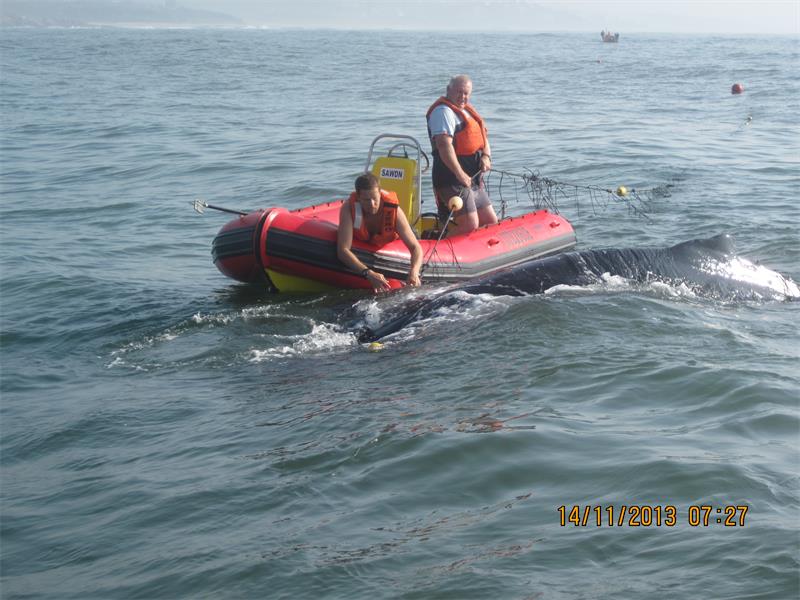
THE recovery of whale populations along South Africa’s east coast during the annual migration is a great achievement in conservation terms but this success does have a small down side.
As KwaZulu-Natal Sharks Board head of operations, Mike Anderson-Reade, pointed out, more whales travelling along our coast from June to November meant more natural and unnatural whale deaths. It also meant more shark net entanglements.
“Unfortunately on occasions whales collide with shark nets. The majority of adults are capable of breaking free. However younger animals often have to be assisted. The Sharks Board is a member of the South African Whale Disentanglement Network (Sawdn), an official body responsible for all whale disentanglement in South Africa. It has three specialised whale release teams on standby throughout the whale season,” he said.
According to Mike the two main species that migrate along our coast are the humpback whale (Megaptera novaeangliae) and, to a lesser extent, the southern right whale (Eubalaena australis).
“Humpback whale populations have almost returned to their pre-whaling day population size off the South African coast,” Mike said. There were about 14 000 of this species and this was increasing by between seven and nine percent every year.
“With the population almost reaching the natural carrying capacity it is highly likely that the mortality rate, both from natural and unnatural causes, will increase,” he pointed out.
Adult humpback and southern right whales were both extremely large. The average length of an adult humpback whale was between 12m and 16m and it weighed about 36,000 kilograms (36 tonnes). The average adult southern right whale attained a maximum size of 15m and could weigh up to 47,000 kilograms (47 tonnes).
If one of these marine giants does become entangled in a shark net, members of the public should not try and free it.
“Members of our specialised whale release teams are highly trained and equipped for releasing large marine mammals from shark safety gear. Response times vary depending on where the entanglement occurs. However, it is important that the public is aware that the animal is capable of surviving for a long period of time, as long as it can make the surface for air,” said Mike.
He pointed out that the objective of the whale release team was to ensure that the whale was not only freed but that all entangling ropes or netting were removed. The release operation was carefully planned to ensure that the whale did not swim away before all the lines are removed. Any ropes or netting not removed could possibly lead to the whale’s demise.
“Two recent incidents of members of the public attempting to cut whales free from shark nets, which is illegal in terms of the Marine Living Resources Act (1998), are a serious cause for concern. This is not only extremely dangerous for the individuals involved but also for the animal, which, in all likelihood, will swim away trailing some of the netting and ropes. These could eventually kill the animal.”
He said untrained people did not realise the power of these animals and anyone entering the water with an entangled animal was courting disaster. He appealed to people to refrain from approaching any entangled whale. Instead they should contact the sharks board, at 031 5660400, with details of the entanglement. The entanglement release team would then respond to the situation to release the whale.