Shona’s wonderful Wild Coast walk – Day 2
Our journey of some 14 kilometers entails criss-crossing through the red sands to look at stone age tools, clay pots, a firepit and shells exposed by the wind.
Lightning is often used as a symbol for witchcraft (ukupehla), says guide Sinegugu Zukulu, to the group of eager hikers on day two of the Wild Coast hike, which has quickly dawned.
We wave goodbye to our host Nolwandile Ndovela, a widow who runs both her homestead and a nearby shop in Mtolani village. She is also a fantastic cook, who presented us with delicious dishes of wholesome traditional food the night before.
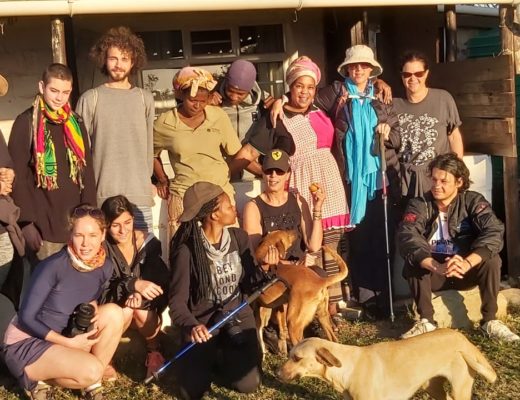
We are a few kilometers into our walk when Sinegugu stops us, and points with his stick at a shrub called ‘Ibhulu’ or ‘ruikbossie’ – the common Afrikaans name. He explains that at the onset of a thunderstorm a handful of Ibhulu dried leaves are burnt on a bed of coals in the belief that the smoke will drive away the lightning.
While Ibhulu is burning on the coals in the fireplace, a small piece of Umayibophe wehlathi (Moth-fruit) found in the forest, is chewed and spat out in a custom called ‘ukuchila’ – to protect oneself from lightning strikes during a storm.
Following traditional custom all the family members, seated on the floor inside the home, spit towards the doorway believing that this action will prevent lightning from striking the home – Sinegugu Zukulu
In Sinegugu’s recently-published book, Medical and Charm Plants of Pondoland, which he has compiled together with Tony Dold, Tony Abbott and Domitilla Raimondo, it is explained that another plant called Isixhono (Natal Gasteria) is used as ‘Intelezi’ – for protection against lightning strikes and misfortune caused by witchcraft.
The Pondoland has a very high number of plants species that are not found anywhere in the world. Sinegugu says these are called ‘endemic species’, and it is estimated that the Pondoland Centre has as many as 200 endemic plant species, with some of these being medicinal plants used by the amaMpondo.
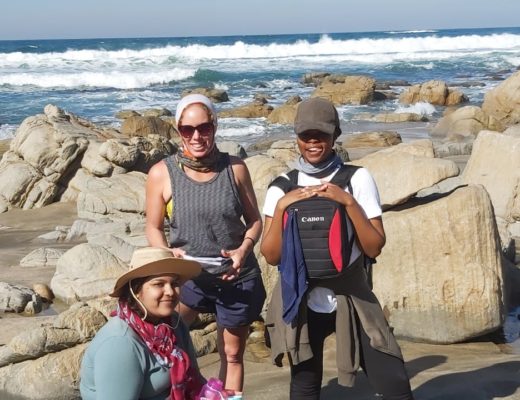
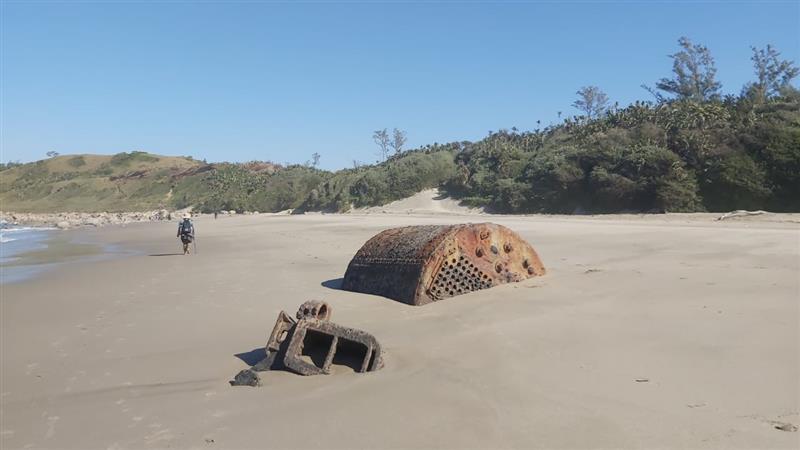
Our journey of some 14 kilometers entails criss-crossing through the red sands to look at stone age tools, clay pots, a firepit and shells exposed by the wind. We then hike down to the beach where we walk for several hours along the shoreline, admiring the fossil beds at Kwanyana River mouth and coming across the weathered wreck of a ship partially buried in the sand.
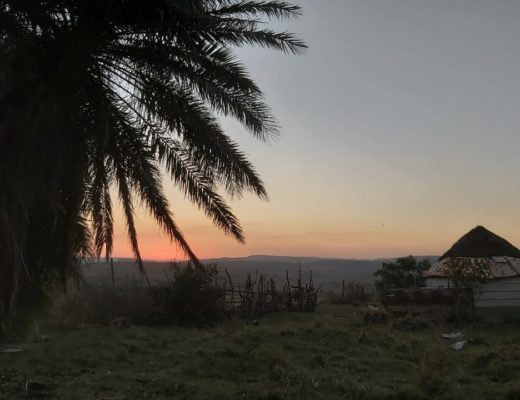
After crossing the Sikombe River, we finally venture up to Mtentu, where we spend the night at an old fisherman’s cottage, where our hosts bring us hot water to wash followed by dinner. We gather around the fire, and after dinner, young leader Siyabonga Ndovela shares with us a series of riveting stories from the Pondo Revolt – the long historic fight for the land and the bitter bloodshed.
Then, like a flash of lightning, the story of the cold-blooded murder of chairman of the Amadiba Crisis Committee, Sikhosiphi ‘Bazooka’ Rhadebe in 2016, brings back the daunting threat of the proposed Xolobeni mining, to our thoughts.
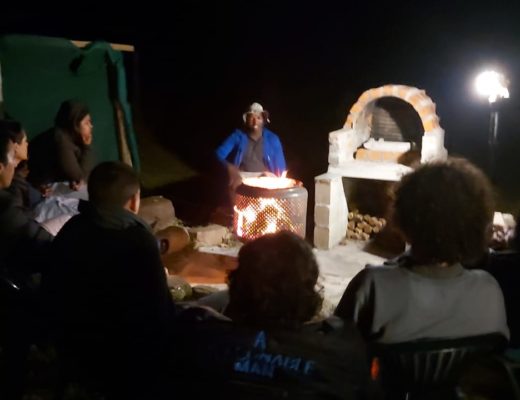
Two young boys join us around the warm fire, the men break into song, and the boys dance to the beat of a drum. “In song it is always acceptable to criticise,” adds Sinegugu, chuckling.
* Shona Aylward is taking part in the Wild Coast hike sponsored by the environmental journalism training agency, Roving Reporters (www.rovingreporters.co.za) and the 8 Mile Club, an adventurous group of charity swimmers who raise funds for various deserving charities.
* Shona will update us on her journey as and when conditions and cell phone signal permit, so watch this space.
HAVE YOUR SAY
Like the South Coast Herald’s Facebook page, follow us on Twitter and Instagram
To receive our FREE email newsletter, click HERE