Ray of hope for mantas – you can play a part
The status of manta rays is in line with that of the rhinoceros population with increasing threats diminishing the population.
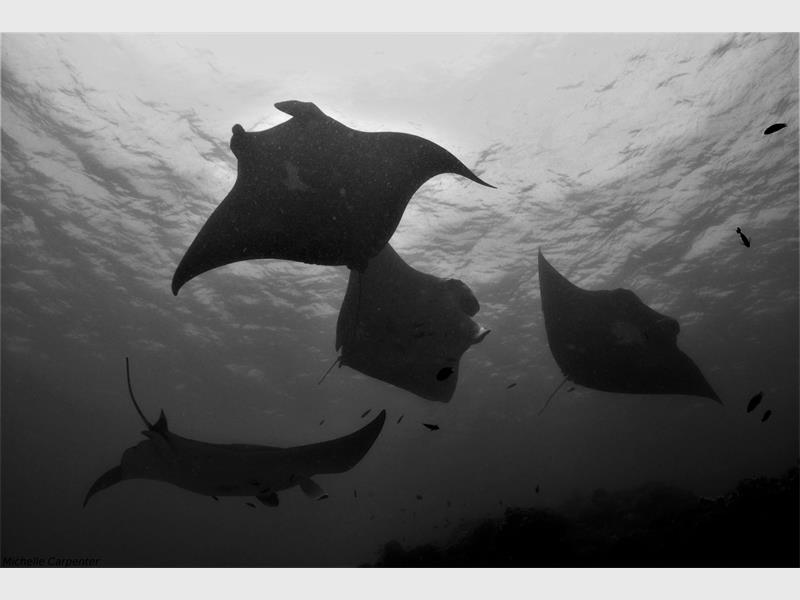
During Heritage Month, South Africans were encouraged to take part in a new global celebration on September 17 – World Manta Day.
South Coast-based manta ray expert, Michelle Carpenter said this day was vital to highlighting the threat these marine creatures are under, in particular the giant manta and reef manta.
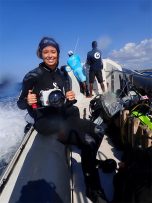
Michelle, now based at Clansthal, is a PhD student at the University of Cape Town.
She is focusing her thesis on the use of cleaning stations by manta rays and devil rays of southern Africa.
Having started her research in Mozambique in 2016 with the Marine Megafauna Foundation, and then onto Indonesia in 2017, Michelle felt the need to return to Africa.
“I am forever inspired by the rugged and wild beauty of the African environment, its people, and the conservation movement to fight to protect what we still have. We have the most complex, fascinating, and threatened megafauna both on land and sea.”
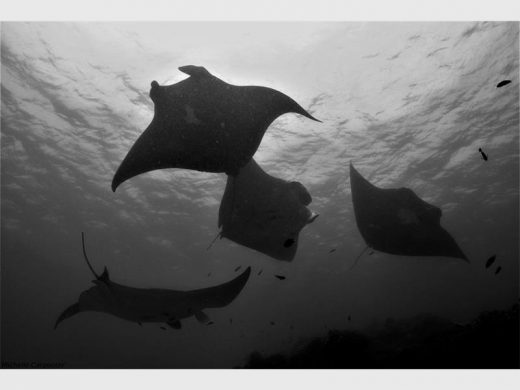
Although manta rays are largely understudied in South Africa, both the giant manta rays and reef manta rays are often spotted at the Wild Coast, at Aliwal Shoal on the South Coast, Durban and Sodwana Bay on the north coast, particularly during the annual Sardine Run.
“No one has yet studied the manta rays here. Although we’ve found two individuals that travel to and from Mozambique and Sodwana Bay, we still have no idea if there is a unique subpopulation specific to South Africa, or one large mixing population that constantly crosses international borders. It is crucial to understand the habitat use and movements of our southern African manta rays to better protect them.”
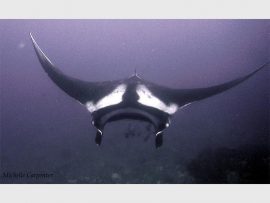
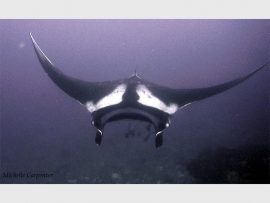
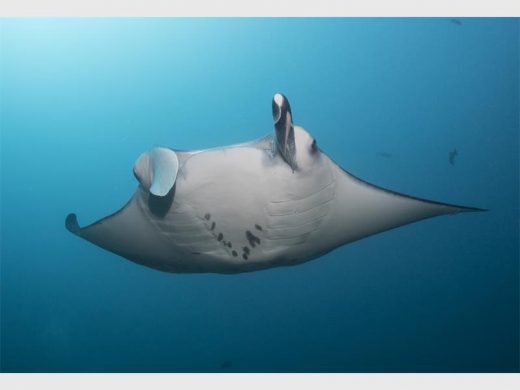
Every manta ray possesses a unique spot patterning on its belly which, like a fingerprint, allows for individual identification.
Over time, this photographic data provides information about population numbers, distribution, and habitat use.
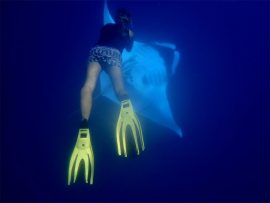
“The most exciting thing about manta research is that you don’t have to be a scientist to take a photo of a manta ray belly,” said Carpenter.
“Everyone can file their own pictures of mantas and join our global effort though Manta Matcher.”
Manta Matcher is a public database for manta ray encounters, made by WildBook.
It has provided global and public data for the world’s manta rays.
Through this, citizen-science researchers have been able to discover that reef manta rays travel more than was previously thought – in one instance, some 450 kilometres between Komodo National Park and Nusa Penida.
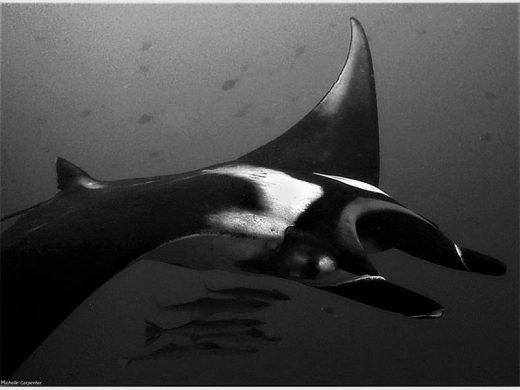
Photo by Michelle Carpenter
The status of manta rays is in line with that of the rhinoceros population with increasing threats diminishing the population.
Intensive monitoring in Tofo, Mozambique has revealed the largest documented populations of manta rays in Africa, but also drastic sighting declines of up to 98 percent for the reef manta, mostly due to destructive fishing methods.
With South Africa remaining a mystery in terms of manta ray habitat use, numbers, and travel, it is crucial to upload identification photos to Manta Matcher or email them to Michelle at crpmic001@myuct.ac.za.
These will be used for research purposes only as a way to understand and better protect these animals.
MANTA RAY FAST FACTS
• They are considered one of the ‘marine big 5’.
• They are highly migratory but visit specific locations at certain times of the year, at different life stages, or in response to plankton or water current movements.
• Considered the smartest fish in the ocean, manta rays are highly social, and have specific gatherings at cleaning stations and feeding grounds.
• The manta ray is the largest ray, reaching over 8m in size (wing tip to wing tip).
• These filter feeders eat zooplankton, the smallest marine animals.
• There are two species; the reef manta ray (up to 5.5m), and the giant manta ray (up to 8+m), both found in South Africa.
• They are among the most gentle animals; they can be as playful as dolphins but are also capable of extraordinary things like diving to depths of 1400 metres.
• All species of manta and devil rays are listed as Vulnerable or Endangered on the IUCN Red-List.