Careers in Focus: An ideal ‘fit’ for Avisha
Orthotics on the other hand involves more practical hospital work and some lab work.
Finding one’s ideal career path is always daunting.
After a thorough evaluation, one might find that they don’t want to pursue that career anymore.
For instance, there are people who want to join the medical field as doctors but find they are too squeamish for the job.
This is the predicament that Avisha Rajcoomar found herself in.
After plenty of research and a bit of job-shadowing, she managed to find a loophole.
Four years later she has joined the medical field, doing what she loves while avoiding the physically grisly aspects of it.
She job-shadowed an occupational therapist, where she watched a little boy with cerebral palsy come in for treatment.
He had a weak hand and after temporary treatment, he was referred to an orthotist.
It was at this point that Avisha had realised her dream career – a certified prosthetist and orthotist (CPO).
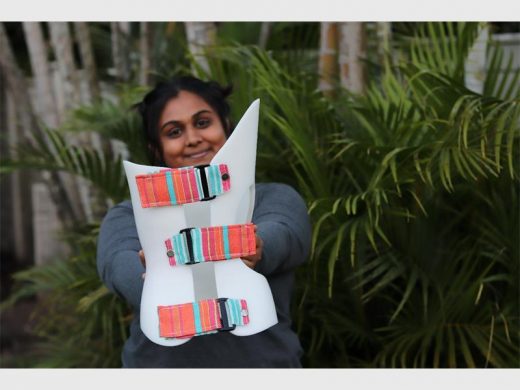
Orthotics refers to a device or appliance that can be used to stabilise and/or protect a body part that is injured.
This assists in the correct healing of the body while placed in the ideal and correct position.
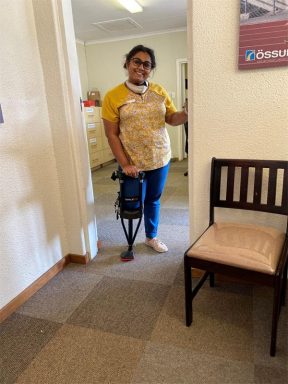
Prosthetics refers to the replacement of a lost limb or part of the body with a manufactured device, known as a prosthesis.
This can range from lower to upper limb amputations.
Being a CPO however, does not come without the shock factor. Avisha explains how applying traction to a patient is a very unpleasant process.
“Traction is applied to a patient who has a fractured femur/pelvis so that the bones can be aligned. I once had to put a young boy in traction after he had been in a car accident. He was in so much pain and was crying, I felt heartsore and was afraid that I was hurting him. However, he felt much better once the traction was on” she explained.
On the bright side, the field of prosthetics and orthotics is highly rewarding.
“Watching patients who haven’t walked in months, sometimes years, take their first steps is so rewarding. Seeing the disbelief in their eyes and bright smiles on their faces is the best. My heart feels warm and I feel proud, knowing that I’ve helped make someone’s life better”.
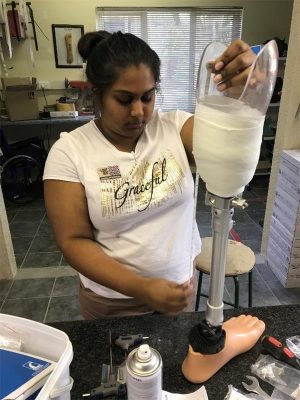
Prosthetics includes more lab work, seeing patients and carrying out fittings.
Orthotics on the other hand involves more practical hospital work and some lab work.
“My advice to those wanting to become CPOs is to just do it. It was the best choice I’ve made. While it is a lot of hard work, it’s definitely worth it. One of the most interesting things I’ve done at university was dissecting a cadaver, to learn more about the anatomy of a human body. Luckily there was no blood,” Avisha said.
It takes four years to obtain a Bachelor’s degree in Medical Orthotics and Prosthetics.
While CPOs differ from other kinds of medical practitioners, Avisha explains that they still play an important role in helping people, “Imagine being unable to walk and having no professionals to assist. There wouldn’t be appliances like wheelchairs or crutches available to people who need them. Walking aids only help one mobilise but the correct prosthesis will help one walk independently again”.
Once fitted with a prosthesis, patients can always go back for adjustments or to have components replaced:
Avisha shares what a typical day in the life of a CPO is like.
“I work in Margate and we begin at 8am. Once there I check which patients are coming in and prepare to see them. Everyday is different, which is what I like. Usually in the mornings when doctors do their rounds, I get called out for compression stockings, moonboots, crutches and even wheelchairs.
“Thereafter I see to appointments. If there is a prosthetic patient that comes in, I usually spend most of the day in the lab.
After work I take a breather and go to CrossFit. I spend the rest of the evening relaxing with my family”.
CPOs play a key role in helping people with disabilities and adding value back into their lives. From walking aids and helping children with deformities to breast prostheses after a mastectomy, they help patients perform their daily activities as independently as possible.
HAVE YOUR SAY
Like the South Coast Herald’s Facebook page, follow us on Twitter and Instagram