Tent Travels: Between the rocks in a hard place
The Richtersveld, a mountain desert, supports an amazing array of fauna and flora.

THERE are so many reasons to visit the Ai-Ais/Richtersveld Transfrontier Park, one of them being its unique claim to fame. The Richtersveld is South Africa’s only true desert.
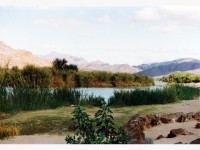
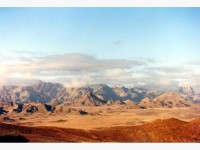
It is also a mountain desert, an unforgiving but awe-inspiring place of ancient rock formations, jagged peaks, steep, flinty slopes and vast, sandy plains ringed by purple mountains. In contrast to this rugged environment is its green corridor, the thin ribbon of life-sustaining vegetation lining the banks of the Orange River, the northern border of the South African section of the transfrontier park.
How strange the Richterveld mountains are, constantly changing colour in the altering light, The unforgiving midday sun seems to drain the landscape of colour, but the softer mornings and evenings bring out unexpected tints of pink, blue, mauve, gold and even peppermint green in the rocky surfaces.
All this dramatic scenery makes it one of the most intriguing, perhaps the most physically beautiful, of all our South African National Parks.
From a geological point of view this harsh terrain is a fascinating place. It has been shaped over eons by almost every geological process in Mother Nature’s arsenal. Some of the rock formations are ancient, about 2 000-million years old, while others, like the granite rocks found in the south of the park, are among the youngest of their kind in the southern hemisphere.
As a true desert, it is watered by an average rainfall of only 70mm a year and the little moisture brought in by the ‘malmokkies’, those strange, spooky morning fogs that roll in from the cold Atlantic Ocean. In spite of its arid nature, the Richterveld is home to countless insects, birds, small mammals and a vibrant plant life.
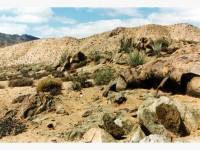
‘God’s rockery’, I call it, for as you travel through the rocky terrain, it looks as if it has been artfully landscaped by a divine hand to show off the diverse and fascinating succulents and other hardy plants that thrive here. It is one of the richest succulent areas in the world and about a third of its plant species are endemic, occurring nowhere else in the world but this inhospitable little corner of South Africa.
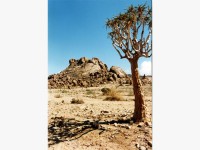
Most eye-catching are the strange and rare halfmens (Pachypodium namaquanum), the kokerboom or quiver trees (Aloe dichotoma), the giant quiver trees (Aloe pillansii) and the maiden quiver three (Aloe ramosisima) but countless other hardy plants, big and tiny, occur here and a walk across the veld is a fascinating experience.
From a cultural point of view it is an interesting park as well. Since it was proclaimed in 1991 the Richterveld National Park has been jointly managed as a contractual park by South African National Parks and the local Nama people. It is unique in that controlled grazing of stock is allowed within its borders. In this way, the park helps to conserve the culture and traditional way of life of the descendants of the pastoral people who arrived in South Africa from Botswana some 2 000 years ago. While exploring the park, visitors are likely to meet some of these herders and to see their flocks of lively goats and their mobile mat-house homes.
In 2003 the national park made history again when it was joined to Namibia’s Ai-Ais Hot springs Game Park to become a pioneer of the cross-border conservation concept known as transfrontier or peace parks.
The Richtersveld is not really a destination for those who are overly concerned about their creature comforts. It is rugged 4×4 country with bumpy, often corrugated tracks that wind their was up steep stony slopes, through rocky mountain passes, along dry, boulder-strewn river beds and across broad, sandy plans.
When we first visited the park in 1999 the inland and riverside camping sites, although lovely, lacked any facilities at all. In 2003, we were thrilled to find that the camping areas had been provided with ablution blocks. Proper loos and cold water showers, made camping there seem quite a luxurious experience.
For visitors with an aversion to cold showers and sleeping under canvas, comfortable self-catering accommodation is now available, although roughing it a little to camp under the Richtersveld stars is a wilderness experience that shouldn’t be missed.
The riverside camping sites at Pootjiespram, De Hoop and Richtersveld are attractive and comfortable and it us usually possible to find a shady spot under a tree. The birdlife near the river is amazing, and campers enjoy a constant parade of little avian visitors to their campsite. We’ve spent many pleasant hours relaxing on the river bank, watching birds or splashing in the river when the temperature rises too high for comfort.
However, my fondest memory is of an overnight stay at one of the inland campsites at Kokerboomkloof, in 2003.
Knowing just how stunning the route is from the Orange River to the inland Kokerboomkloof camp, via the magical Springbokvlakte, we pack up our camp at Richtersberg and leave early in the morning.
We take it slowly, making the most of the scenic route, stopping to admire the majestic views from various viewing points. It is after midday by the time we reach Kokerboomkloof where we are to spend our final night in the park.
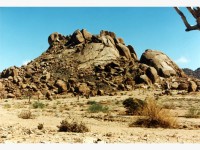
After the jagged mountainous terrain we have traversed, the Kokerboomkloof camping area, with its massive, rounded outcrops and curvaceous rock formations, is softer on the eye. It is a little windy so we set up camp in the shelter of a cluster of giant boulders.
There are other campers in one of the Kokerboomkloof campsites but their encampment is quite far from ours and and we can’t see anyone at all from our site. Here, from our rocky eyrie, with nothing interrupting the surrounding vistas of quiver trees and flat, stark, plain, the solitude is exhilarating.
Living up to its desert designation, the Richterveld is blisteringly hot today so we enjoy an extended lunchtime break in a shady nook. Later in the afternoon, when the sun starts to lose some of its searing heat, we venture out of our pool of shade and explore our rocky surrounds. Clambering over the boulders, we discover perfectly lovely secret gardens, all boasting a myriad scrubby little plants tenaciously clinging to life in their harsh environment and celebrating the advent of spring by flowering profusely.
The light mellows as evening approaches and we take a long walk in the surrounding veld, admiring the sun-gilded quiver trees that throw long shadows across the flat earth. Nothing moves and the veld is so perfectly silent that the crunch of our shoes as we walk across the stony ground seems like an intrusion.
Back in camp we climb one of the highest boulders for a sundowner-with-a-view. The vast expanse of the Richtersveld, visible from our lofty perch is just so amazing. As we gaze across it, it is as if mother nature is switching on a series of coloured floodlights and the desert rocks and sand and sky turn mauve, pink, copper, gold, indigo and finally a star-studded velvety black.
We sit around our lonely little camp fire for a long time that night, looking at the diamond-bright stars. And, as one does in the profound silence and solitude of a desert night, we listening to them sing.