Tent Travels: Reserved for ellies
Camping at Milibangalalala is not for the faint-hearted.
OUR 2002 trip through Mozambique made us very aware of the tourism potential of South Africa’s fascinating eastern neighbour so we weren’t surprised when it eventually became the flavour of the month.
Not long after we returned everyone we knew seemed to be off to ‘Moz’, often for an extended holiday. Also, as KwaZulu-Natal travellers had easy access to the extreme southern section of the country via the Kosi Bay border post, Mozambican resort towns like Ponto do Ouro were becoming more and more popular for long weekend jaunts and diving sorties.
We were keen to take a look at this area – and even more keen to see Mozambique’s Maputo Elephant Reserve, so we saved up 10 days’ leave to do a road trip through southern Mozambique and that wild and wonderful northerly part of KwaZulu-Natal known as Maputaland.

It makes sense to combine these two regions on a road trip as, topographically, they are closely connected and have much in common from an environmental point of view. In fact, there is currently plenty of discussion between South African and Mozambican conservationists who have plans to merge conserved areas in southern Mozambique and northern KwaZulu-Natal to form transfrontier parks. There is also a big project in the pipeline to reopen an old corridor, used by migrating elephants in years gone by, between the Maputo Elephant Reserve and the Tembe Elephant Reserve in KwaZulu-Natal.
On our way to Mozambique we stopped at one of our favourite little KwaZulu-Natal beauty spots, Bonamanzi Game Reserve. While this private reserve offers plenty of upmarket lodge-style accommodation, it caters for budget-minded travellers as well, offering self-catering accommodation and excellent camping sites. Situated near False Bay in the vicinity of the isiMangaliso Wetland Park, it is a pretty reserve in the heart of KwaZulu-Natal’s wildest region. It is also very user-friendly, offering first class facilities, including wonderful walking trails and a good network of roads for game drives.

After two pleasant nights there we had made a good start on our holiday birdlist, but now it was time to leave the rather upmarket comfort of the reserve and to head for Mozambique.
We left early in the morning and crossed the border, without any problems or delays, at about 9.30am. Then we found ourselves negotiating an extremely sandy network of roads, not overly supplied with any useful sort of signage. Aiming for the Maputo Elephant Reserve’s most southerly gate, we were using two vague maps of the area plus a hand drawn one from a friend. None of the maps had anything in common with each other or with the terrain through which we were travelling. Through luck rather than any navigating skills we eventually turned onto the main road north and found our way to the main gate, much further away than the southern one for which we had been searching.

Approaching the park we drove through what looked like a giant bluegum plantation and were beginning to have some concerns about the state of the reserve, but we need not have worried. The route was a bit confusing but once we had driven through the gates the pristine landscape was exquisite. Sandy tracks wound their way through lush grasslands, over ancient, wooded dunes, down into marshy valleys and alongside fresh water lakes. As we crested the huge old dunes that grew bigger and bigger as we progressed towards the coastline, we kept on expecting to see the ocean over the next crest. However, we had quite a way to go before, eventually spotting the sea and reaching our destination, the Milibangalala camping area.
There were some fishermen in a couple of the camping sites but the large one we selected was totally secluded, hidden in the coastal bush near the beach and overlooking a small grassy plain that was home to all sorts of interesting birds and small creatures.

Camping at Milibangalala is not for the faint-hearted. Facilities consisted of a drunkenly leaning long-drop toilet, the seat of which slanted rather alarmingly, and a well from which brackish water had to be laboriously drawn. Visitors have to be pretty self-sufficient to camp there and they need to bring their own drinking water.
However, what Milibangalala lacked in comfort it more than made up in untouched beauty. The beach was absolutely gorgeous, a slice of tawny sand beneath towering, vegetated dunes, similar to those at Cape Vidal, and bordered by rocky slabs at the edge of a turquoise sea. I have never seen such a living beach. It simply teemed with life.
As far as we could see in both directions it was covered with ghost crabs. Thousands of these little pink creatures foraged on the damp sand, scuttling up and down as the lacy wavelets surged and receded. En masse they would move out of our way as we approached them, immediately rushing back to reclaim their patch as soon as we had passed.
There were also large flocks of terns, often just sitting on the sand, watching the waves. And all along the shoreline, mingling with the crabs, white fronted plovers scurried back and forth. Like the crabs these busy little scavengers moved out of our way but did not seem unduly concerned about our presence. It was only the terns that seemed a bit flustered about the appearance of humans in their domain.
If there was a downside to this briny paradise, it was the puzzling amount of litter that had either been left on the beach or had washed ashore, perhaps discarded by unheeding occupants of passing boats. On one of our walks we collected two big bags of rubbish – mostly plastic containers, discarded fishing line and plastic bait wrappers. How sad it was that people could befoul even this remote, pristine place. And Milibangalala is about remote and as pristine as it gets.
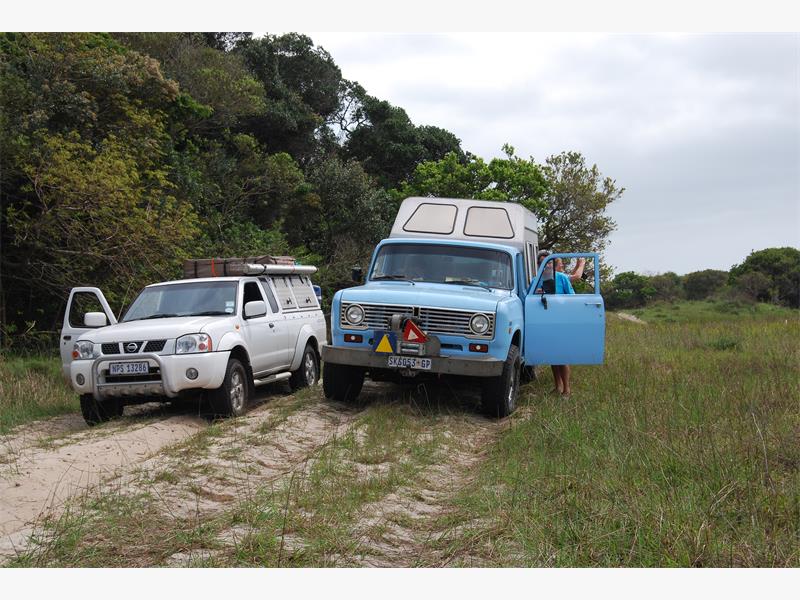
We hardly saw our fishermen neighbours and sometimes we bumped into the two retired couples travelling in an old, well-travelled camper van, who had set up camp near us. Mostly we enjoyed blissful solitude.
The dune-lined beach, a long, flat, uninterrupted stretch of inviting tawny sand, scattered here and there with large cowries and other beautiful shells,was designed for leisurely walks and an early morning beach stroll became a regular daily activity. On our last day at Milibangalala, it was sunny when we set off on our usual walk but a bank of clouds soon rolled in. As we watched, the clouds rapidly grew bigger and bigger and the sky turned an angry purple. There was a strange, electric quality to the light and the sea near the horizon took on a deep bottle green hue. The bruised sky was reflected in the aquamarine waves, the green and purple hues mingling beautifully with the tawny coloration of the underlying sand as the waves hurried to shore.

How fantastic it was, this dramatic prelude to what appeared to be a big storm brewing. We turned around and headed back towards the camp, expecting a deluge any minute. In spite of the big build-up, it was only a small shower that followed us back to camp.
As we neared the pathway that led to our campsite, a frothy wavelet surged up the beach and deposited a gleaming, mottled brown, purple-lined cowry shell at my feet. I picked up this sea gift, turned it over in my hand and was filled with wonder at its beauty and perfection – but not for too long. It suddenly began to rain in earnest and we fled the beach to take shelter in our camp.
We left Milibangalala and the elephant reserve the next morning, in the company of the retired couples in their lovely old camper. Regularly, we saw signs of the recent passing of elephant and although we sometimes sensed they were near none of us spotted any of the reserve’s famous pachyderms.
The route to the southern gate was as lovely as the route we had taken from the main gate to the camp. Before we left the park’s confines we stopped for a coffee break on a rise overlooking an extensive fresh water lake covered in blue water lilies. How lovely it was.
We left the park with many happy memories of this piece of untamed Africa. Although we looked forward to seeing more of southern Mozambique, we knew, even then, we’d seen its best.