Tent Travels: It’s Africa – on a big scale
The drive though Tanzania to Dar es Salaam provided many surprises.
ALTHOUGH Dar es Salaam was the turning point for our 2002 into-Africa camping trip and we didn’t spend much time in Tanzania, this rugged giant of a country with its distinctly African character left a lasting impression on me.
I hadn’t expected the physical beauty we experienced on our first day in the country. From the border post the great road swept up and over a magnificent mountain range. At Mbeya, where we joined the great Tanzam Highway, it flattened out taking us through sprawling towns then onto an intensely cultivated plain.
The road was reasonable although busy and we had to dodge a pothole or two and deal with some erratic driving. Then we encountered our first kamikaze bus. Somewhere between a mini-bus and a full sized bus their small physique gave them far more speed and mobility than was actually good for them. In our rear view mirror we’d see one approaching, gaining on us, driving faster and faster, then nearly pushing us off the road to get past us.
More frightening, though, were the buses we met coming straight for us on the wrong side of the road as we rounded a bend. Tanzanian buses were elaborately decorated with plenty of colourful paint and gilt decoration and usually bore the legends ‘In God We Trust’ or ‘In Allah we Trust’. We hoped these fine sentiments were of some comfort to the frightened passengers.
By midday we’d reached our overnight destination, The Old Farmhouse, Kizolanza, about 50km before Iringa. Our short stay didn’t do it justice and we only met Nicky, the owner and heard her story, on our homeward trip. All the same, we loved the private camping area, with its five-star facilities and spacious, shady and secluded sites, set beneath the African bush. It came complete with all sorts of beguiling birds and other little creatures, and was a perfect little paradise.

The people who worked at the Old Farm House were so friendly and helpful and the whole complex had a very special feel about it. We were also able to buy a basket of lovely fresh produce, grown on the farm by the local community as a self-help, upliftment scheme, as well as homemade brownies and locally produced, beef, sausages and bacon.
Another day of exploration stretched out before as we once again found ourselves driving along the Tanzam Highway. The road took us through the town of Iringa then down a steep pass into the Ruaha River Valley. Although the road was tarred heavy vehicles had churned up the surface creating huge lumpy waves that threatened to scrape the undercarriage of our vehicle.
The valley – we christened it baobab valley – was beautiful. Miles and miles of dry baobab trees lined the steep, rocky hills that towered over the water course, creating a strange mauve haze that contrasted the bright green river banks. It was magnificent country, filled with drama and rugged beauty.

It is not often that you can view game from a national road, but the Tanzam took us slowly, over many speed bumps, through the lovely Mikumi National Park. We were able to see a good selection of game, including zebra, giraffe, wildebeest, impala, baboons and even elephant. In Africa the further north you go the more expensive it seems to be to visit game reserves. Also travelling on a Rand-based budget in lands where the US dollar ruled made park entry fees exorbitant so we appreciated driving though a Tanzanian park for free.
We were doing well and were ahead of our schedule when we reached the attractive town of Morogoro and we thought we would get to Dar es Salaam early. Then we hit the 100km stretch of the worst road we’d ever encountered. After travelling along this rutted, bumpy, dust-laden excuse of a detour that snaked around the original road, Bill became pretty good at dodging the kamikaze buses that came hurtling towards us out of the swirling white pall of dust.
It was a skill he would need when we reached Dar es Salaam – slap, bang in the middle of rush hour. For some reason most of the traffic lights had been switched off at the intersections and one rule held sway – he who dares, wins. We would later discover that traffic congestion is always a problem in the city but first experiencing the Dar es Salaam traffic at rush hour really was a baptism by fire.
It was getting late and we were anxious to get out of the city as soon as possible. We were planning to stay at Silver Sands resort at Kunduchi Beach, some 20kmn out of town, but first we needed some directions. After parking our vehicle and dodging Dar es Salaam’s particularly persistent, sometimes even aggressive hawkers and hustlers we found the information centre but it was already closed. A friendly shop keeper gave us directions and we set off in our vehicle again and began to search for the Old Bagamoya road.

Although we followed the directions carefully, at the same time trying to keep our cool in the frenetic traffic, the road seemed to have completely disappeared. After a few more nerve-racking circuits of the area we stopped next to a stationary ambulance whose driver informed us that the name of the road had changed. With this new information, we quickly found our way out of town. It was well after dark by the time we reached Silver Sands and settled into the pleasant camping area in the well-guarded hotel grounds, a stone’s throw away from a picture-perfect beach.
We’d been on the road for more than a month and so we enjoyed our stay at Silver Sands as a mini-holiday within a holiday. It was a popular resort with both the overlanders and private travellers so it was always busy but we met some lovely people there and enjoyed our stay.
Our first morning set the tone for our daily routine. We were woken before dawn by the muezzin, loudly calling the faithful to prayer but by then it was already pretty warm, so we made a cup of tea and sat watching the sunrise on the beach. The vermillion sky was reflected in the perfectly tranquil sea and a dhow gracefully sailed past the rising sun. It was one of the most beautiful stretches of coastline I had ever seen and the sunrise was sublime. The temperature was rapidly rising, too, so we changed into our swimming costumes and had an early morning swim, a treat we would repeat every morning of our stay there.

One day we drove back into Dar es Salaam- carefully timing our visit to miss rush hour – and took a look at the city. I have to say I did find it a little disappointing at first as it lacked the romance of bygone eras and its multi-cultural history that I’d always associated with the ‘haven of peace’. However, when I began to recognise it for what it was – a vibrant, rather frenetic but attractive modern African city – I liked it more.
After taking a good look at the city we met up with some old friends who were living in Dar es Salaam. Their home was beautiful but life in the quirky city, with its traffic congestion, high crime and erratic services, wasn’t always easy. All the same, they loved Tanzania and were extremely happy living there. They were shocked when we said we were camping and wanted us to pack up immediately and come and stay with them. When we assured them we were quite happy camping, they insisted on us staying for a feast of a dinner, served on their spacious patio overlooking the moonlit sea.
Their warm hospitality and the lovely evening we spent with them meant a great deal to us but they shrugged off our thanks with their favourite catch-phrase:- “In Tanzania, nothing is too much trouble.” And they really meant it.
Although we were tempted to head further north, we were running out of time and going into the parks would be incredibly expensive. Instead, we decided to stick to our original plan, make Dar es Salaam our turning point and spend some of our dwindling time and funds in Zimbabwe. It was a wise decision. When travelling, one is always tempted to do a little too much and our journeys are sometimes poorer for rushing to pack so much into them.
Refreshed after our lazy Silver Beach mini seaside holiday, we headed back down the great Tanzam Raod, dodging the kamikaze busses with skill and flair. Arriving back at the old Farmhouse was like coming home.

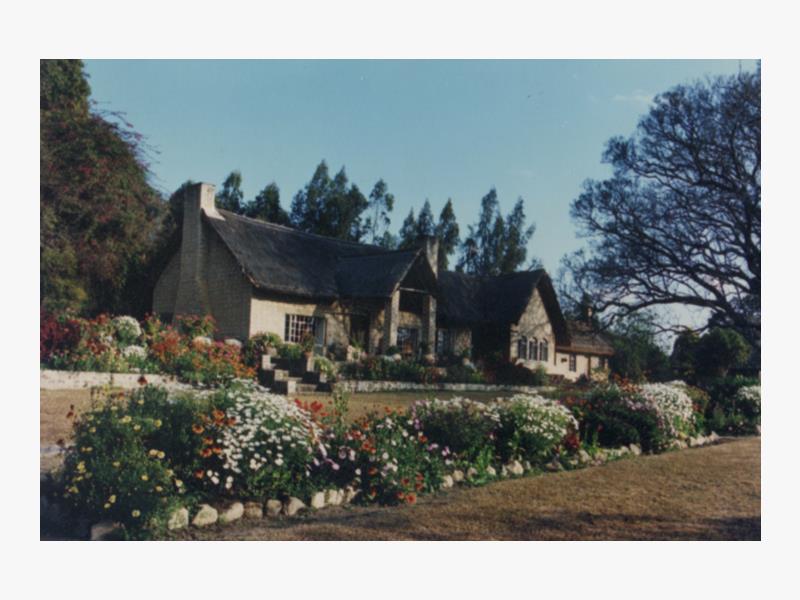
Nicky, the owner, brought over the vegetables, meat, fresh bread rolls and chocolate brownies we’d ordered from the little stall near the campsite and she stayed to chat. The farm had been in the family for more than 60 years and the beautiful old farmhouse that gave the resort its name was built by her father, using bricks made of clay of the farm. It was a gracious homestead – sort of England meets Africa, with what looked like an English country garden gradually melting into the surrounding African bush.
She’d taken over the farm recently, after her 90-year-old mother, who’d still been living there, had died. Nicky had given up a lucrative career in Europe to take over the family’s farm, or as she put it, to keep her family’s slice of Africa in trust for future generations.
Learning to farm had been a huge learning curve but she was making a success of it and the tourism operation was proving a successful sideline. It had started when she’d realised there was hardly anywhere for travellers to stop in that area. She’d cleared a bit of bush, put up a ‘camping available’ sign and people had started pouring in.
There were now two camping areas, one for private travellers and one for overlander trucks, both equipped with excellent facilities. She also offered various self-catering accommodation and ran a wing of the old farmhouse as an upmarket lodge. Her staff offered pre-packed meals for overlander groups and all sorts of home-baked items at the farm stall.
Fluent in Swahili she spoke it with a charming English accent. Her kind, gentle manner towards her staff and people who lived in the area had earned her their devotion and loyalty. We now realised why Kisolanza was so special. The people were all happy.
Interestingly, the sale from the vegetables went into the pockets of the people in the area. “There were many poor families here. I couldn’t employ them all so I helped them to set up vegetable gardens,” she explained. This project had been a huge success. As well as supplying the farm stall the veggie growers sent truckloads of fresh produce to Dar es Salaam. As only top quality vegetables were offered for sale, the slightly blemished ones were consumed by the veggie growers and their families, improving the general health of the local children.
The Old Farmhouse was busier this time around, with two overland trucks in the group camping area and a charming French family in the nearby chalets. We shared the private camping area with a charming German couple – both keen and knowledgeable birders – from Harare.
On our first evening there we spent a convivial evening with a group of older overlanders in the Old Farmhouse pub. A boma with a gap between the thatched roof and low outer walls, overlooking pristine African bush, it was one of the most delightful little pubs we’d come across on our travels. The Tanzanian Highlands can be chilly and the temperatures dropped rapidly after sunset, so the glowing charcoal braziers were most appreciated.
On our second morning there Nicky gave us a hand-draw map of the walking trails on the farm and we set off to explore. Bill was interested in a ram pump he’d seen at the dam and Nicky had an interesting story to tell about it. A few months before, it had broken down and she’d sent a letter and its serial number to its manufacturer in England. The spare part arrived in due course with a letter telling her that, according to the company’s records, it had been installed on the farm in 1892. This was the first time it had needed any attention.
We were sad to say goodbye to Nicky, her staff and our fellow travellers and, back on the Tanzam highway, we discussed why our stay with them had been so special. The people, certainly, had been wonderful but it was here, at the Old farm House, Kizolanza, rather than in Dar es Salaam, that we’d found the African romance we’d been seeking. This romance, we realised, was all about people who loved and were inspired by Africa, warts and all.
As for Tanzania, we decided – as we bumped along the magnificently potholed road to the border – it was Africa on a big scale. CLICK HERE FOR MORE TENT TRAVELS