
THIS is a remarkable month, starting with World Environment Day today, June 5.
The day has been with us for a long time, since 1972 in fact, but not as long as an event that was almost certainly the first ever green happening.
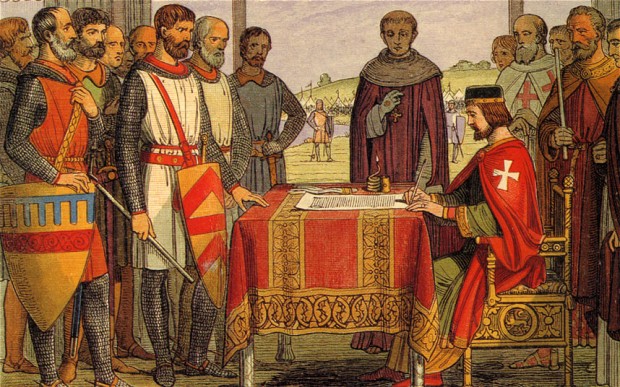
I’m talking about the Magna Carta, the Great Charter that the English barons had King John the First sign at Runnymede on June 15 in the year 1215.
King John has been described as a despotic, disastrous and bankrupt monarch who had alienated his all-important barons, whose power and feudal rights, and therefore their lands and castles, he had been undermining, and at the same time he had alienated and outraged the clergy.
The barons, along with some leading churchmen, had come together to draw up the 63 chapters of what became known as the Magna Carta detailing what should and should not be allowed in the running, and ruling, of England.
It basically limited the monarch’s power over his subjects, both the aristocracy and the so-called free men, the other ranks, dealing with such issues as taxes and blood feuds, but also the royal forests and the rivers and fishing.
Parts of the Great Charter are still in force in Great Britain today, so it was a fairly notable document.
Most importantly, for us anyway, was the Carta de Foresta, Charter of the Forest, which was added to the main Charter five years later to become a companion document, signed on November 6, 1217, by Henry III, King John’s son.
The new Charter specifically reviewed the situation pertaining to the Royal Forests, which spread over much of England and from which were excluded almost everyone and all non-royal activity.
The Royal Forests were not restricted to woodlands either, but included moorland and even common fields and actual farms. Therefore, everyone was affected, but the Carta de Foresta changed all that, opening up access to the barons and commoners alike to hunting (a vital survival activity in those days), the collection of fuel and timber for other purposes, grazing and pasturage, and the utilisation of all the other natural resources of the forests, moorlands and fields, vital areas for the very fundamental activity of foraging for food.
For example, the new Charter guaranteed the rights of free men to ‘the eyries of hawks, sparrowhawks, falcons, eagles and herons in his (the King’s) woods and likewise honey found in his woods’.*
Some of the provisions of the Charter of the Forest lasted for 754 years, until 1971, when they were replaced, or perhaps merely reworded, by modern Acts of Parliament. So yes, a pair of notable documents indeed.
Think just how important is access to the natural environment today, for so many of the reasons quoted in the Magna Carta and the Carta de Foresta of 800 years ago and think how many battles, including legal battles, are still being fought over that access.
So, Bad King John and his feisty barons really started something. Cheers, and here’s to the Charters!
The Week: The Best of the British and Foreign Media, and Wikipedia.

To receive news links via BBM, add us using the pin 2BABF7D1.
The South Coast Herald is also on Facebook and Twitter – why not join us there?



