
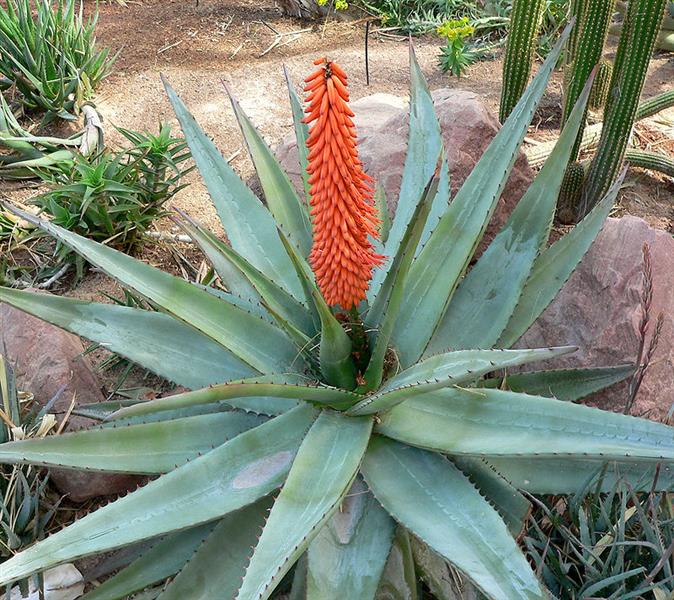
IT is that time of the year when the aloes bloom, providing one of nature’s most spectacular shows and one of the best seats in the house is around Oribi Gorge.
We took a drive around the area recently and although it’s always a lovely drive, we were a little disappointed in the aloes.
Some aloes were in full flower and spectacular, others were yet to bloom and many more had already faded, so perhaps we were too early or too late. Anyway, this is the season.
There were plenty of Aloe ferox with its bright red candle of a flower, and Aloe arborescens or the krantz aloe, the one that has a wide range of colour variations from red to yellow, and a few others which we weren’t able to have identified.
Many of the aloe species are not just renowned for their beauty when in flower, but for their many uses as well, including both medicinal and cosmetic.
The medicinal uses are many and legendary and have been used for centuries. The cosmetic uses have been developed more recently, but are now just as well known (we have been using an aloe product for years for plain, good old skin care).
There are about 125 species of aloe in South Africa, many of them very common, but some critically rare or endangered. It’s important to note that virtually all aloes are protected by environmental legislation and may therefore not be touched in the wild.

Our biggest treat of the day was a troop of samango monkeys on the road through Oribi Gorge.
Samangos are the only monkeys in South Africa, apart from the vervet monkey, and although they may look fairly similar from a distance, there are distinct differences.
The samango is slightly larger and chunkier than the vervet and it is somewhat darker and hairier. It is also described as Rare in the Red Data Book and we all know there is nothing rare about the vervet.
We were thrilled to see our little troop, perhaps 10 of them, and we were able to watch them for a while, but when we tried to get closer they disappeared into the bush, being far less familiar than vervets.
As a point of interest, both the Umzimkulu River, which runs to the north east of the Oribi Gorge, and the Mzimkulwana, which runs through the gorge itself, were looking very low, obviously victims of the prolonged drought we are experiencing.
Having said that, one night last week it started to drizzle, a soft, soaking drizzle, and it drizzled all night to give us more than 40mm by the next morning.
Wonderful stuff and a great note on which to say, cheers!
PS: The finest show of aloes we saw on our day out was in fact in the gardens outside the South Coast Herald offices in Port Shepstone – well done the Herald!
Sources: Guide to the Aloes of South Africa, Ben-Erik van Wyk and Gideon Smith, Briza, Pretoria, 1996 and Smithers’ Mammals of Southern Africa, Editor: Peter Apps, Southern Books, Halfway House, 1996.



