
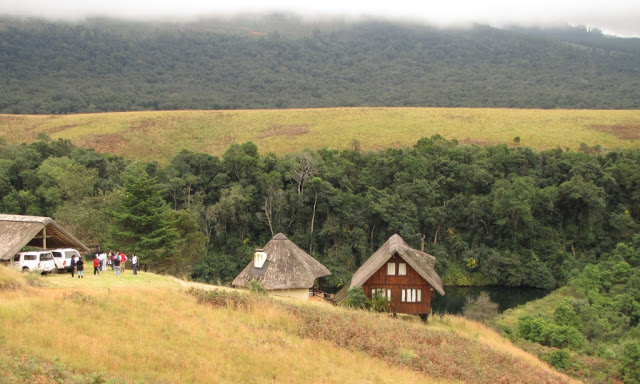
I THINK the expression comes from Canada or maybe Alaska, where pioneers would be house-bound in their little wooden huts for months at a time while winter did its worst outside.
Boredom would eventually take over and all the little irritating things that go with it and they would start to think they were quietly going bananas – they called it ‘cabin fever’.
The comparison may seem a little exaggerated, but it has been winter and we do live in a wooden home. Anyway, the other day we began to feel the onset of a mild dose of cabin fever.
To cure it we headed west, for the hills (well, the interior) and the Ingeli Forest near Harding.
We have driven through the forest many times en route to and from my brother-in-law’s place in the Southern Drakensberg, the other side of Barkley East. We have usually made a refreshment stop at a local hostelry on our way through, but this was our first opportunity to stay over and explore the area just a little.

The drive inland is interesting, the scenery changing as it does from cane and macadamia plantations to forestry plantations (pine and eucalyptus), and then at last the indigenous forests of Ingeli.
Firstly, I must declare that if we thought we were going to be escaping the winter down on the coast, we were very, very wrong. It was freezing up there, but fortunately we had been forewarned and were therefore forearmed and the lodge was well-warmed with lots of roaring log fires.
Ingeli Forest is one of the largest areas of indigenous mist belt Afromontane forest in KwaZulu-Natal, stretching from 1,250m to 1,550m above sea level and therefore that much closer to the snow on the Berg, hence the cold, obviously.
Andy Ruffle of Birdlife Trogons, the local branch of Birdlife South Africa, tells me that the area is great for birding. There have been about 220 species in total recorded there, although realistically only about 70 may be seen in the forest itself.
Among the bird specialties that may be found in the forest are the Cape parrot (something of a specialty in itself as it is regarded as uncommon and is the subject of its own special annual count), then the orange ground thrush and the bush blackcap.
We were only up there a short while so didn’t really get a worthwhile bird list going, except for a black headed oriole chanting so beautifully outside our room, a purple heron in a wetland and a long crested eagle on a telephone pole (why do they always spend so much time on telephone poles, I wonder?)
Something else we saw that was of interest was a large troop of baboons, which are quite common in the forest. We also saw some beautiful stands of aloes in full bloom.
All in all the Ingeli Forest and the hills make a real change from the coast, with new and different things to experience.
It was a great break and certainly cured our cabin fever – well worth the drive. Cheers!

To receive news links via BBM, add us using the pin 2BABF7D1.
The South Coast Herald is also on Facebook and Twitter – why not join us there?



