
WHEN you read this Bill and I should be just about completing a three-week meander around KwaZulu-Natal and I am looking forward to telling you about the wonderful wild places to be found in the ‘garden province’.
Not everyone realises just how many game and nature reserves this province has to offer, including some rather special little gems like Ezemvelo KZN wildlife’s Amatigulu Nature Reserve. Unfortunately, time restraints will prevent us from visiting it this holiday but we know it well and have paid it many visits. It is almost on our doorstep, too, so while Bill and I finish our journey, let me invite you on a little virtual excursion to this little coastal beauty spot.
The panoramic view from the whale-viewing platform in the reserve explains what Amatigulu Nature Reserve is all about. It is a coastal reserve, a narrow strip of our coastline, bracketed by two rivers and adjoining the larger and better-known Umlalazi reserve, a little south of Richards Bay.

From this lofty perch one gazes across lush vegetation to the deep blue sea. Between the platform and the sea are vegetated dunes arranged neatly in rows and running parallel to the coastline. They are a reminder of how dynamic an environment is this untamed piece of coastline that was formed after the fragmentation of the mega Gondwana continent. So much has changed since then. Through the eons the southern edge of the African continent has lifted and fallen and the elements have carved and reshaped it.
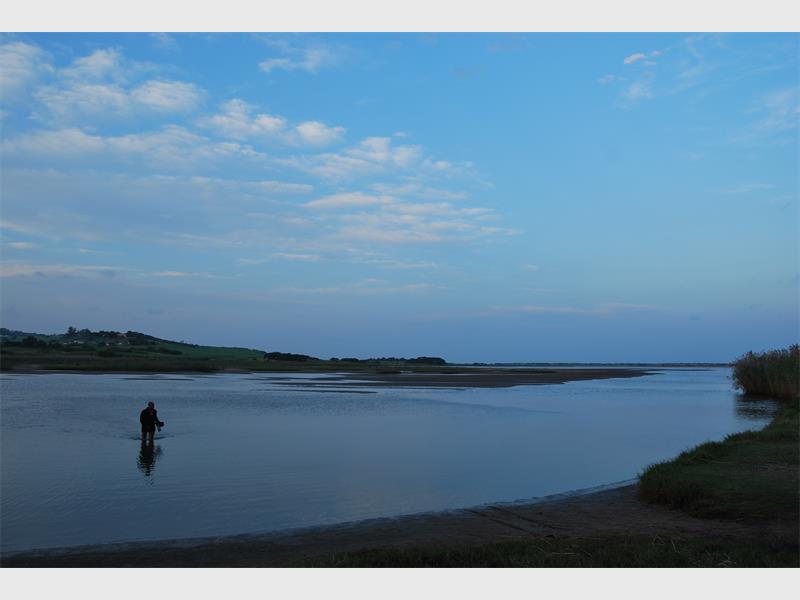
Trapped behind the corrugated shoreline runs the Inyoni River. Once it must have had its own estuary. Now it is forced to travel northwards along the coast to join the Amatigulu River and to share its generous estuary as an escape route to the sea.
This magnificent tidal body of brilliant blue water can best be viewed from the reserve’s Zangazolo Tented Camp or from the rustic little campsite nearby. We first discovered this small coastal paradise on a trip around KwaZulu-Natal in 2001. Since then, we have been lured back by the reserve’s charms, many, many times. On our first visit we stayed in the tented camp, in comfortable tents linked by wooden walkways and perched on platforms set among the coastal forest trees.

The facilities were simple at Amatigulu – a basic ablution block, a communal kitchen come dining room, a little wooden viewing deck and a communal braai area under tall shady trees. That was all we needed when we were staying in such a special place.

We have stayed in Zangazolo since then but we have also discovered the delightful rustic camping ground at the reserve and have often spent lovely long weekends there in our comfy tent. It is a no frills sort of camping area but has all the facilities you would need.
The forest in which the tented camp is set is magnificent, its canopy and undergrowth representing an amazingly rich biodiversity, but it is one of a number of interesting biospheres within the reserve.
The 4X4 game viewing roads and hiking trails take you through wooded valleys, coastal grasslands and acacia woodland. There are lovely walks set out alongside the estuary, too, and into a section of magical swamp forest. Guests can also explore the waterways in hired canoes.

The variety of vegetation shelters a rich and varied bird life, making the reserve very popular with the twitching brigade.Well-trained, skilled local community guides are very knowledgeable and can take you on guided walks in the reserve and to other nearby birding hotspots.
The fishermen enjoy a visit to the reserve as well and there is normally someone dangling a line into the estuary in the evenings when you pop down to the picnic site for a water-side sundowner. Of course, evening birding is always good, too, so at that time there are usually plenty of people strolling around the picnic site with binocs.

Above all, Amatigulu is a lovely family destination and the addition of a few happy families to the waterside sundowner crowd adds to the fun. It also brings home to us the fact that Amatigulu is a little gem with something for everyone.




