
ON our travels through southern Africa, Bill and I are pretty good tourists.
Although our region’s wonderful wild and conserved areas are our main targets, we are interested in southern Africa’s infinitely varied history, architecture and present-day nature. We stop and find out about these things. Each province, city, town or dorpie has its unique character; and plenty of interesting stories to tell, if you care to travel slowly and to take the time to dig those stories out.
One of the best ways of doing this is to visit museums. Bill and I love museums, be they the impressive, well funded ones you find in the larger centres or those small, quaint, sometimes quite esoteric ones found in the more out of the way places. There is even a wind pump museum in the little town of Loeriesfontein, would you believe. It really is worth a visit, this field of shiny steel flowers, and it is a good example of how each museum, whatever its content, not only reflects history but so often captures the very nature of the place.

A glaring omission in our tally of visited museums has, until recently, been the often-recommended Talana Museum in Dundee. As our KwaZulu-Natal road trip route would take us through the town on our way from Weenen to Ithala Game Reserves, we decided to set aside a whole morning to see it.
We were very glad we did. With its extensive and varied exhibits, it proved to be one of the most interesting, multi-faceted and attractive southern African museum we had ever discovered on our travels. It really is worth a visit, particularly if you are travelling with children. Far from the dry, dusty places that some museums tend to be, its imaginative exhibits would really appeal to the youngsters. There is also plenty of open outdoor space, including a tea garden and picnic tables next to the Miner’s Rest restaurant as well as a roomy, sheltered picnic and braai boma.

Actually, the simple name of Talana Museum is a bit of a misnomer. It is more than a museum. A label I’ve seen, declaring it a museum and heritage park is closer to
the mark. For a start, it is built on a battle field. The Battle of Talana took place there on October 20, 1899. It was the first major battle of the Anglo-Boer War Altogether 21 boer soldiers and 52 British soldiers, including the British commanding officer General Penn Symons, lost their lives at Talana. A cairn in the museum grounds marks the spot where General Symons fell.
The museum ground are part of what was once Dundee Farm, settled in 1864 by founders of the town of Dundee, brothers Thomas and Peter Smith and Peter’s wife, Ann. The main homestead and the original farm cottage, milking shed and other buildings have been used as exhibition halls. Smith’s cottage has been restored and lovingly furnished with period furniture and trappings. It offers a window into the past, reflecting the lifestyles of those early European settlers.
In the 1870s Peter found coal on Talana Hill and was soon selling coal in Pietermaritzburg as well as farming on Dundee. Coal eventually became the town’s major industry, bringing wealth and prosperity to the area. Not surprisingly, Peter, who discovered this source of wealth, and Ann are honoured as the father and mother of Dundee. Their son, Thomas, built the attractive main house on the slopes of Talala Hill.

Many attractive and imaginative exhibits at Talana reflect different aspects of coal mining. There is also a very realistic display showing the difficult conditions under which the miners laboured. Coal wasn’t the only source of wealth for the town, though, The Orange Grove Dairy exhibit reminds visitors that the dairy was once a thriving business. Another product that filled the coffers of the town was glass, manufactured in Dundee since the 19th century, although the factory is now closed.
This important money-spinner is well commemorated by a totally intriguing glass museum, featuring a huge assortment of different glassware from different eras and from around the world, ranging from useful household items to some exquisite modern glass art. It really tells a lustrous, many faceted story of a versatile material we often take for granted.
Lovely exhibits are dedicated to different groups of people who have, over the eons, called Talana Hill and, later, the town of Dundee, their home. They include the San, the Zulus and the Immigrants from India who came there as indentured labourers to work on the mines. Different aspects of the lives of these residents are reflected in interesting clothing, cultural village and bead work displays. A memorial to Mahatma Gandhi is a peaceful little spot in the gardens that offers space for quiet contemplation and there is an informative exhibition on Gandhi’s passive resistance movement, which he started in Dundee.
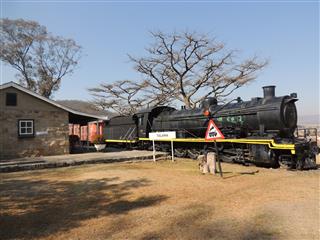
Exhibits also offer insight into the lives of the early townspeople. Younger visitors would particularly enjoy a peep into the town’s past, by strolling through the ‘streets’ past the full-sized replicas of various shops and businesses from Dundee’s formative years. Another delightful exhibit is the ‘Shosholoza’, a Class 13A locomotive and carriage, waiting at the Talala station , built with the stone of the original Dundee post office.

Dundee is a peaceful little town but it has weathered some very violent times and many of its townspeople have found themselves caught up in various horrible wars. There are informative exhibits on Dundee’s involvement with the Anglo Zulu War, the Anglo Boer War, World War I and World war II. I found the excellent Great War hall particularly moving and a very powerful statement on the futility of war.
There is something for everyone at Talana Museum, making it the perfect destination for a family excursion. Give yourself at least three hours to explore the complex and attractive museum grounds. Better still, pack a picnic basket and make a day of it. There are not many picnic sites that offer such a heavenly view.
‘Talana’ is a Zulu work that means a shelf where precious things are kept. It is an apt name for a museum complex that is a treasure house for a fascinating and multi-cultural array of precious artifacts.



