
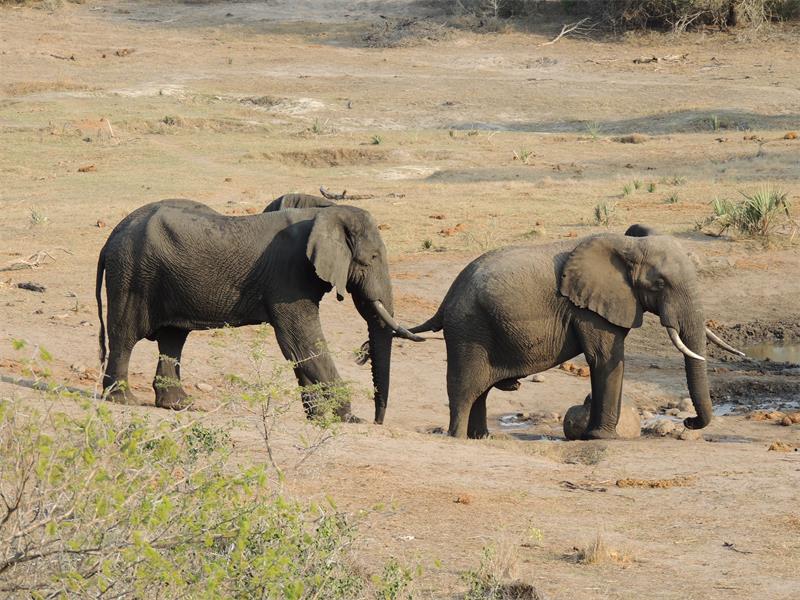
TO Bill and to me, remote and untamed Tembe Elephant Park seems the wildest corner of South Africa.
It is also one of our very favourite places and we were looking forward to visiting it as part of our recent KwaZulu-Natal camping trip. This 30 000ha Maputaland reserve, pressed up against the Mozambique border, was established in the 1980s to protect the famous Tembe elephants, reputed to be the biggest in the world.
The first pachyderm residents were, in effect, war refugees. They were part of a population that followed the ancient migration routes between KwaZulu-Natal and Mozambique. This route was cut off during the Mozambique civil war, when the traumatised animals found sanctuary in their newly opened park.
The good news is that plans are afoot to join Tembe to Mozambique’s Maputo Elephant Park and the Lubombo Conservancy in Swaziland to form the Lubombo Transfrontier Conservation Area. Not only will this re-open the old corridor for the isolated Tembe elephants but they will be reunited with their relatives who live in the Maputo Elephant Park. Years of strife have kept these groups apart.

We discovered Tembe not very long after it was opened to the public in the 1990s, quite a while after it was established. Even then the Tembe elephants were fearful and, because of the trauma they had undergone at the hand of man, inclined to be aggressive if approached too closely. We still keep our distance from the Tembe gang but it has been wonderful watching them growing more relaxed, less shy and happier over the years.
When we first started visiting Tembe, hardly anyone had heard of it, let alone visited it. We could spend a whole day driving round this wonderfully wild place without meeting up with a single soul. It is a little more on the tourist map now, but it remains serene and uncrowded. Only a small number of vehicles are allowed in each day and because of the very sandy roads, entrance is restricted to 4X4 vehicles. Tourist infrastructure is fairly basic, although more than adequate. There are two roomy hides overlooking pans, a couple of peaceful, rustic picnic sites and a good network of roads.
The only tourist accommodation in the park is an upmarket lodge. We have a limited travel budget so we set up camp at nearby Ndumo Game Reserve and do day visits to Tembe as part of our Ndumo trips. It is only about a half-hour drive between the two reserves so if we leave our camp at 6am we are able to enjoy a whole day in Tembe.
Of course, the magnificent Tembe tuskers are one of the main attractions and you would be very unlucky to spend a day in the reserve and not see at least a few elephants, especially if you wait patiently in the hides.
They are not the only reasons to visit, though. With the introduction of lions, a few years ago, it is now a big-five park, so there are plenty of other exciting mammals to see, including the rare, shy and tiny suni antelope.

It is also a good birding spot boasting a suite of unusual specials, but it is perhaps the vegetation that is most interesting, offering dense woodland, a fascinating sand forest section and some lovely swampy areas where the ellies and buffalo like to hang out.
The substantial sand forest patches are worth exploring. In Pooley’s Trees of Eastern South Africa, Richard Boon says these dry, scratchy forests have tropical links and grow on deep sand on old coastal dunes.
This rather harsh environment provides niches for specialised plants that are endemic or near-endemic to the sand forest. As Mr Boon points out, sand forest is at the core of the important floral area known as the Maputaland Centre of Endemism.
Driving through the sand forest area of the park you can see what he means when he says the edges of these forests are sharply defined. In places the forest is neatly edged by strange patches of grassland that look like giant fairy circles.
We dedicated two days of our recent KwaZulu-Natal camping trip to reacquainting ourselves with magical Tembe. On our first day there we arrived fairly late and decided not to do our usual full-day route but to take it easy and do a bit of gentle ellie hunting. Not only was this a successful enterprise but we even managed to see a lion kill.
The park was surprisingly busy that day. We went straight to the Mahlasela, the popular main hide, and found a family group of visitors there who had colonised the hide. They’d decided to spend a quiet day staking it out, waiting for the elephants to come to them. If you have the patience and the ellies are your main focus, it is a good strategy.

A few of the Tembe stars were already in attendance, having a good splash in the substantial pan. A school party had just arrived, too, and it was wonderful watching the awe on the little faces. Although they were local children, many of them said they had never visited the park, let alone seen an elephant, and they were absolutely transfixed by the sight of the bathing pachyderms.
We left them to it and took a slow drive via the eastern marsh road to the smaller, Ponweni hide. The swampy area through which this road passes is often a good place to look for game but now, at the end of winter, it was very dry and there was little to see. We got to Ponweni Hide just in time to watch a small family group of ellies coming through. They didn’t stay long. After a drink and a splash they were on their way.
There was nothing much to see but we lingered a while at the pretty pan, as did the members of a small tour group and two French visitors. We checked out the birds then watched a little red duiker quench its thirst. A couple of nyala came down to the water, too. Suddenly, someone pointed in excitement and a single lioness trotted into view.
Putting on a sudden burst of speed, she pounced and caught herself a nyala, which she dragged into the reeds.
It all happened so quickly we could hardly believe what we were seeing. Eventually she dragged her kill through the reeds and then back up a little rise. For a few seconds she stopped to rest then she carried on dragging the dead antelope for quite a way before she disappeared from sight.
When we looked at the one, poor photograph I’d remembered to snap during those action-packed few minutes, we could see she was lactating so she must have been dragging her lunch closer to her cubs.
Well, that was exciting! Everyone in the hide was wide-eyed. In high spirits we left the hide and drove slowly back to the main Mahlasela Hide via the scenic western swamp road and the Zimambeni Pans, seeing a little more general game and some nice birds along the way.

Back at the hide the family group was still ensconced there and several foreign tourists had joined them. Mahlasela Hide is conveniently near the park entrance and is a great favourite with the ellies. For these reasons it is popular with day visitors just spending an hour or two in the park.
There are usually a few people there, especially in the afternoons, but it really was unusually busy that day. It is a lovely big hide, though, with plenty of room for everyone. The family group had enjoyed some excellent ellie sightings there but were a little disappointed to have missed the lions. Other people had reported seeing lions in the vicinity of Ponweni Hide, too.
There was still plenty off ellietainment going on at the waterhole where three big bachelor boys had gathered. There was some gentlemanly disagreements going on about whose turn it was to sip from the drinking fountain – the fresh water inlet, which no elephant can resist. It was nothing serious – a little shove here and a gentle push there and then – not quite cricket – a sharp jab in a rump with a pair of impressive tusks, the owner of the tusks quickly taking possession of the inlet as his opponent stalked off in a huff.
Of all the animals in our game reserves elephants must be the most fascinating to watch. Dare I say it but the way they show their moods and emotions they are just so very human. They can be funny, cunning, loving, nasty, angry, mischievous, playful, scary, knowing, dignified and quite as undignified as any clown. And, when I look into those lash-fringed eyes, I see an ancient wisdom that always touches my soul.
There were far fewer people around on the second day we spent at Tembe, doing what we have come to call our usual route. In fact we only came across a small tourist group doing a game drive on an open vehicle late that afternoon when we rounded off our visit with a stop at Mahlasela Hide.

Our first stop that day, though, was at the viewing tower near the gate. It offers an incredible view of this far-flung, untamed piece of Africa and an idea of what Tembe’s old dunes with their sand forests are all about.
From there we drove along the Gowanini Loop to the little KuDukuza picnic site in the trees, where we stopped for coffee and rusks. Thus fortified we spend the rest of the morning exploring the various loops and side roads in that area.
The roads wove their way through ever-changing vistas of sand forest, woodland, savannah and open grassy stretches, including a broad swath of scrubby, dry vegetation that had endured a recent burn, whether planned or not, we did not know. As destructive as fire is, it is an integral part of a healthy, working eco-system.
Although there were signs of elephant including fresh ‘ellie messages’ – leafy twigs left in the road – we didn’t see any elephants that morning. However, there were plenty of red and grey duiker around, quite a few giraffe and some nice wildebeest herds. We were more than ready for lunch when we reached the main picnic site.
Of all the magnificent trees to be found in Tembe it is perhaps the pod mahogany (Afzelia quanzensis) that is the most impressive and the main Tembe picnic site used to be situated under a wonderful old giant of this species. Its large, flattish crown gave plenty of shade in summer and in winter it conveniently dropped its leaves to allow sunshine to filter through to the picnic tables beneath its sheltering boughs.
Its dark glossy leaves were lovely in summer but it really came into its own in when it burst into flower, covering itself in showy pastel orange blooms. Its large brown pods, with their red and black seeds, were pretty striking , too.

We’ve always loved this remote picnic spot in the middle of no-where and over the years we got to know the old picnic site tree well. Eventually, though, we realised she was ailing. One spring we noticed that she had hardly put out any new leaves at all so we were not surprised the following year, to see that she had died.
The picnic site seemed to have been closed as well. When we parked our vehicle and went to pay our final respect to the ancient giant, we cheered up when we saw that the old picnic spot has not been decommissioned after all. It has simply been moved a few metres. The picnic tables had been set up in the shade of nearby pod mahoganies, smaller than our old picnic tree, but a beautiful circle of the old tree’s daughters.

This time, when we stopped at the new picnic site we were sad to see that the skeleton of the old tree had been burnt in the fire. All that was left of our old friend was a small burnt stump. Her daughters, though, were flourishing and we enjoyed our picnic lunch in their sheltering circle.
We spotted a couple of distant elephants as we drove the final stretch to the Mahlesela hide where we planned to round off our day exploring Tembe. Usually, it is buzzing by then but we were surprised to see no elephants there. We stayed awhile, enjoying the peaceful spot and watching various antelope and a couple of woollynecked storks at the waterhole. It was getting late, though, and we soon decided to leave.
On the way to the gate we met a couple of polite ellies wandering along the road ahead of us. They looked like two of the three bachelors that had entertained us at the waterhole on our previous visit there. They stepped off the road and let us pass, totally relaxed about our presence. To us their gentle acceptance of human visitors in their sanctuary felt like a final farewell gift from our beloved Tembe.




