
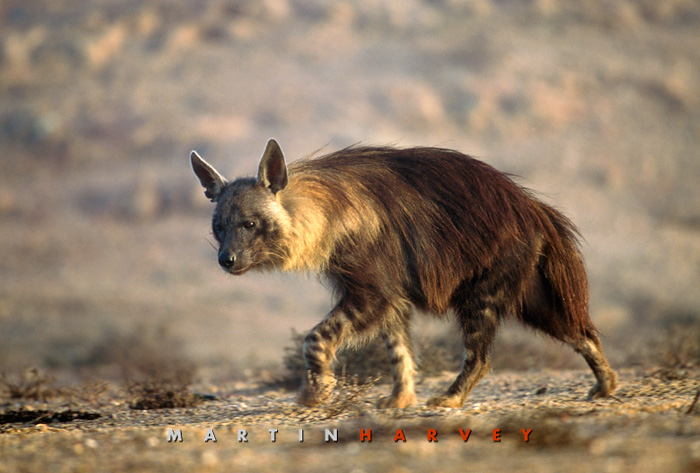
SOUTH African National Parks reports that a group of four brown hyaenas has been relocated from a private game reserve near Grahamstown to the Karoo National Park as part of a programme to re-establish the species in their once historical habitat.
Brown hyaenas originally occurred naturally in the area, but were wiped out, possibly as a result of the historical conflict between farmers and predators.
The new group joins four other brownies who were introduced into the Karoo National Park three years ago, the hope being that the increase in numbers will help to restore a natural population in the park.
Both the existing group and the new hyaenas have been photographed and any distinguishing features noted so that they can be easily identified by both park staff on patrol and visitors on game drives, and this will help in monitoring the progress of the population.
Camera traps have also been set up around the park which will help keep tabs on the hyaenas. The new group consists of two males and two females, one of which was pregnant at the time of the transfer, and rangers have already reported tiny brown hyaena spoor in the park, which can only be good news.
Brown hyaenas have a vital role to play in a natural ecosystem as they are largely and quite natural scavengers, basically doing the same job as vultures, so their re-introduction into areas where they occurred historically is of vital importance to a healthy natural environment.
Their diet is not limited to scavenging, however, as they will also eat insects, eggs (especially ostrich eggs in the areas where they occur), reptiles and natural fruits.
Brown hyaenas do not occur naturally down here, but the Karoo National Park at 93,000ha, just outside Beaufort West in the heart of the Great Karoo, is prime habitat for them
We have a particular affection for brown hyaenas born of various positive close encounters with them over the years.
One such encounter, I must remind you, was a rescue mission to a traffic island on the airport highway in Johannesburg years ago.
I was part of the team (a sort of useful media person) that went out one night to find a brownie that was reported to be living on the island.
We did, he was darted, measured, checked, radio collared and crated for the long journey to a private game reserve in the Eastern Cape.
It was a very strange assignment, on this rubbish covered, partly bushed traffic island with the roar of the airport highway (not to mention the car headlights flashing past) all around us, and us fussing over this magnificent specimen.
I called him Humphrey, or Humph, it seemed right for this fine brownie.
Could it just be possible that Humph was the progenitor of these brown hyaenas now patrolling the Karoo National Park? Wouldn’t that be a wonderful end to that story? Cheers, and let’s hear it for Humph.
Source: SANParks Times magazine.
DID YOU KNOW?
Click on the words highlighted in red to read more on this and related topics.
If you are reading this on your cellphone and there are telephone numbers provided in the text, you can call these simply by clicking on them.
To receive news links via BBM, add us using the pins 58F3D7A7 OR 58F25573. The South Coast Herald is also on Facebook, Twitter, WhatsApp and Instagram – why not join us there



