
AFTER our Ndumo and Tembe Game Reserve interludes, our KwaZulu-Natal wanderings took Bill and me off the beaten track, along a sandy 4X4 road and into a truly magical world, the mystical coastal forest section of the great iSimangaliso Wetland Park.
This substantial wilderness area, deservedly a world Heritage Site, has many marvels and is a mosaic of wonderfully varied ecosystems, waterways, coastal features, game reserves and tourist destinations.
Both Kosi Bay and Sodwana Bay are popular, user-friendly spots, boasting good tourist infrastructure and facilities.
However, the coastal forest section between these busy resorts can only be accessed by a 4X4 vehicle and is probably the most undeveloped, least populated and most back-to-basics section of the whole wetland park.
We’d explored a bit of it briefly, many years ago, when we stayed at the now-defunct Baya camp on Lake Sibaya. One night we’d sat outside our little reed hut and we’d watched as thousands of fireflies had lit up the dark night.

However, we hadn’t returned to the area for quite some time and Mabibi Camp in the coastal forest section, where we’d booked for a couple of days, was a brand new destination. It turned out to be such a lovely spot that we wondered how we’d managed to miss it on our previous explorations of our province.
Mabibi Camp provides visitors with a choice of about ten large, shady, campsites tucked into the coastal forest, all well-protected from the elements by the dense vegetation and the nearby dunes.
There are also a couple of self-catering chalets for the non-campers. It was a very rustic set-up with no electrical points but each campsite had a tap and a useful braai area.
Ablutions blocks were basic but attractive, well-maintained and clean. As with many of our coastal wild places, the water wasn’t really fit for drinking so, as we’d been advised, we’d brought in our drinking water.
The best thing about Mabibi, though, was the amazing amount of wildlife in the camp. The birding was incredible.

My birding friend, Fiona, is involved in the Southern African Bird Atlas Project. On our first morning there, I accompanied her when she did a two-hour spell of continuous birding as part of an atlasing exercise.
We were dumbfounded by what we found. We didn’t manage to tick off the elusive green malkoha, though, so we have a good excuse to get back to Mabibi some time.
Red duiker regularly wandered through the camping area and there were plenty of monkeys about so we had to make sure our food supply was secured.
Our campsite was frequently visited by a delightful pair of red squirrels – beautiful little creatures with grizzled upper parts and striking red underparts. I’d only ever seen this species in Milibangalala in Mozambique before.

When I checked my much-thumbed mammal guidebook, Chris and Tilde Stuart’s Mammals of Southern Africa (Struik), I was interested to see that, in our sub-region, the red squirrel was mostly confined to Mozambique and the extreme eastern parts of Zimbabwe.
However, the Mabibi squirrels were part of one of only two small, isolated populations in KwaZulu-Natal.
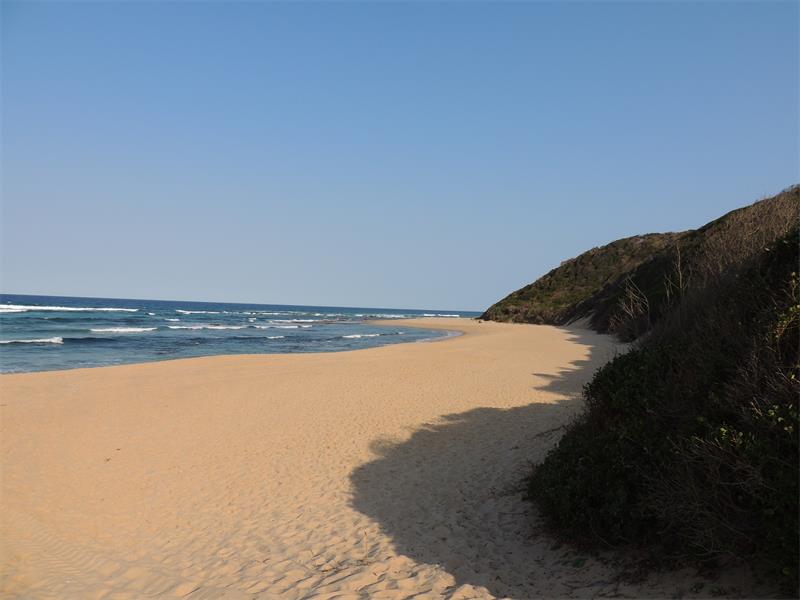
For many people it is the beach that is Mabibi’s most striking attribute – and what a beach it is.
Its one drawback, though, is the flight of more than 100 steps you need to negotiate to get to the beach. It is a long way down – and an even longer way up the steps back to camp – but it really is worth the effort and it is a jolly good, free workout.

Popular with anglers and snorkelers, Mabibi beach is a long, gently curving stretch of perfectly pristine shoreline bordering a denim blue Indian Ocean and edged with the vegetated dunes that are such a striking feature of the Maputaland coast.
The Maputaland dunes are the highest vegetated dunes in the world, in places towering about 180m above the golden beach, and they really are an amazing sight.
Mother Nature has taken about 30 000 years to create these stunning wind sculptures and to wrap them in the climax forests of giant trees, creepers and shrubby undergrowth that keep them stable.
Of course, the beach was just designed for walking and in between birding forays in this twitcher’s heaven, Bill and I and our friends Ian and Fiona, took long walks along the shore. Is there a better way to de-stress than a long beach walk?

Our two marvellous days of beach strolls, birding, tree hugging, splashing in the sea and watching the passing wildlife show went far too quickly. We were sorry to be leaving but while packing our tent we were looking forward to our next KZN adventure, a drive along the 4X4 road through the coastal forest past Lake Sibaya.
From the little we had seen so many years ago, we had high expectations of this route. Would it really be as lovely as we remembered?
It proved to be even better.
DID YOU KNOW?
Click on the words highlighted in red to read more on this and related topics.
If you are reading this on your cellphone and there are telephone numbers provided in the text, you can call these simply by clicking on them.
To receive news links via BBM, add us using the pins 58F3D7A7 OR 58F25573. The South Coast Herald is also on Facebook, Twitter, WhatsApp and Instagram – why not join us there



