
IT would seem that there is no end to bad news coming out of Zimbabwe regarding that country’s once outstanding wildlife heritage.
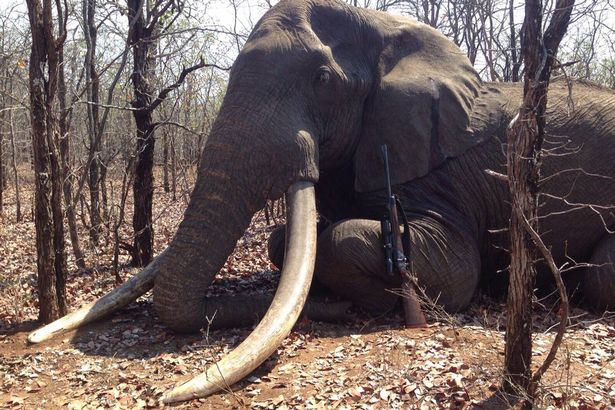
Now it’s reported that one of Africa’s last really big tuskers has been trophy hunted in a concession area just outside the famous Gonarezou National Park in the south east of the country.
The elephant, believed to be in his fifties and quite possibly the biggest tusker hunted in Zimbabwe in perhaps 30 years, had tusks that were record size by today’s standards, being 54.4kg on one side and 55.3kg on the other.
The hunter has been tentatively identified as a 55-year-old German real estate CEO, Rainer Schorr, who reportedly paid $60 000 (about R780 000) for the hunt.
The incident has, not surprisingly, created a furore among conservationists world-wide, bringing back the whole unhappy affair of Cecil, the collared, prize lion hunted outside the Hwange National Park about three months ago.
The Zimbabwe government has declined to prosecute the American hunter, dentist Walter Palmer, who killed Cecil. However, that incident together with this latest news has again put the international spotlight on trophy hunting in Africa in general, but Zimbabwe in particular. It begs the question, just how much of these huge hunting fees ever go back into wildlife conservation?
We were in the Gonarezou (which ironically means ‘Place of the Many Elephants’) perhaps 15 years ago, staying in a lodge just outside the reserve on the other side of the Save River, the reserve’s northern boundary, fording the river and taking game drives through the reserve every day.
It’s an extraordinarily beautiful piece of an extraordinarily beautiful country, with spectacular bush, rivers and rock formations, particularly the massive red sandstone Chilojo Cliffs, visible for 50km.
The reserve covers over 5,000 square kilometres and is Zimbabwe’s second largest game park.
It’s a wonderful corner of Africa – but it was empty. We saw very little in the way of game and just one elephant, and it had had most of its trunk sheared off by a snare. Even in those days the reserve was prime poacher country.
Poaching, particularly of elephants, is a major problem in Zimbabwe. Over the past few days no fewer than 26 elephant carcasses have been found in the Hwange National Park in the west of the country, all victims of cyanide poisoning.
This follows 14 others, found just days before this last discovery. Just two years ago, up to 100 elephants were poisoned and killed by cyanide in and around Hwange.
Experts are saying that Africa’s elephant population, already fewer than 500,000, has fallen by more than 60 percent over the past 10 years and if the poaching continues at this rate the species could disappear from the wild within the next 15 years.
What a thought. Cheers!
Sources: The London Daily Telegraph, the Zimbabwe Conservation Task Force, Save the Elephants News Service.
NB: The Elephant Data Base puts the number of elephants in Africa at just over 401 000, with about 278 000 of them in southern Africa.
DID YOU KNOW?
Click on the words highlighted in red to read more on this and related topics.
If you are reading this on your cellphone and there are telephone numbers provided in the text, you can call these simply by clicking on them.
To receive news links via BBM, add us using the pins 58F3D7A7 OR 58F25573. The South Coast Herald is also on Facebook, Twitter, WhatsApp and Instagram – why not join us there?



