
WE bring rain to Mkhuze Game Reserve – not always but often enough to proclaim ourselves the reserve’s official if sometimes incompetent rainmakers.
And, heaven knows, this very special place so often needs some rainmaking services. Mkhuze always seems to be crying out for a drop or two of rain.
Bill and I have visited Mkhuze after summers of plenty when the animals were fat and an abundance of rains had set the rivers flowing. The African savannah, so dry and scratchy here at times, was transformed into a lush, green park. More often than not, though, Mkhuze is a thirsty place that endures regular dry cycles and not infrequent droughts.
It is always more pleasant to visit Mkhuze and other wild places during their green and pretty phases. It is hard to accept drought and its accompanying discomforts and deadly consequences as part of the natural order of things. Bill and I have learned some acceptance of the natural rules, that for everything there is a season. Our minds tell us that each season (even drought) brings its own benefits and that the rains will always, eventually, come. Still, what the head accepts, the heart often finds so difficult to understand.

So, on our last visit to Mkhuze – part of our recent KZN camping trip – we were prepared to put with up wet conditions should our rain making kick into action. I have to say that rain in Mkhuze is not that pleasant, as a particularly sticky kind of dirty red mud is one of the consequences of inclement weather when you stay at eMshopi camping area.
It was the tail end of winter and we were expecting dry conditions in this summer rainfall area. As expected, the park was still rather winter-dry but was starting to green up in places, perhaps helped along by the little bit of early rain that had fallen not long before our visit. All the same, prolonged drought conditions were starting to make themselves felt throughout our normally green and rain-swept province and we were concerned about the park.
Mkhuze, now a component of the iSimangeliso Wetland Park, was proclaimed as far back as 1912. It is a tough survivor, though, and has overcome far more serious threats than the odd dry cycle. Today, the 40 000ha piece of wilderness teems with life, its grasslands, forests, riverine vegetation, swamps and azure pan nurturing an amazing variety of animals, birds, insects, water creatures and plants.

In fact, boasting more than 400 avian species, it is recognised as one of the most awesome birding spots in South Africa. This park and the many other bird-filled game reserves and wild places in KwaZulu-Natal make our province a premier – but I believe sometime underestimated – birding destination.
Mkhuze, with its abundance of natural life, is a living monument to Mother Nature and her powers of recovery, for this wild place has endured so much abuse. Soon after it was established, government officials decried its proclamation, describing it as a shocking waste of excellent cattle country. It was the first blow the reserve had to weather.
The second was far more serious. It was seen by the powers that be as a reservoir for nagana, a disease spread by tsetse fly. Between 1929 and 1931, some 35 000 wild animals, including many zebra and nyala inside Mkhuze, were wantonly destroyed. Worse was to follow. In 1939, the control of the reserve was passed to the Veterinary Division. Between 1943 and 1950 a second campaign saw the wholesale destruction of game within the reserve. More than 38 000 animals were slaughtered in Mkhuze and its immediate surrounds. The fatalities included rare animals like suni antelope, red duiker and even black rhino.
Then the reserve was lethally drenched in DDT. The aerial spraying of the reserve with the deadly poison began in 1946. By 1949, the anti nagana battle had virtually been won – but at what cost?

The elimination of tsetse fly did not end the fight for Mkhuze’s life. There were still calls for its deproclamation. Illegal settlement problems re-emerged and so did poaching and the incursion of livestock into the reserve.
By the early 1960s, moves were afoot to abolish Mkhuze in exchange for the proclamation of the corridor linking nearby Umfolozi and Hluhluwe Game Reserves. Mkhuze was also threatened by the building of Jozini Dam and Government plans to make it part of an irrigated farmland scheme. Fortunately the fight by province and parks board officials to save Mkhuze was strengthened by a vigorous `Save Mkhuze’ campaign, instigated by the Wild Life Protection Society. We have these people who loved Mkhuze to thank for its existence today.
Perhaps its troubled history has added to its indefinable special qualities and the unique sense of space that make it one of what I call my soul places. How precious are all our wild places but some, like Mkhuze, just stand out as spaces that really touch my soul. I love all our KZN parks so very much but if I am allowed to have a favourite, Mkhuze has nudged its way into the number one spot in my heart.
On our most recent visit we entered the reserve via the newer Ophansi gate, booked in at Mantuma Main Camp, then set off to pitch out tent at the camping area next to the eMshopi Gate. Between Mantuma and the camping site, there is a spot where the road dips, opening up a tree-framed vista of bushveld and blue Lebombo Mountains. We stopped, as we always do, to admire this quintessential African scene and I felt as if Mkhuze was welcoming me home.

The camping area was looking stunning, neat and tidy and generally prettied up. Park authorities had planted a number of indigenous trees a few years ago and these had grown into sturdy teenagers. In recent years, a swimming pool and children’s play area had been built. Now the the ablution blocks were undergoing a revamp.
We spent the afternoon setting up camp in the nearly empty camping area then joined our friends Ian and Fiona for a sundowner at the nearby eThaleni picnic site. It used to be equipped with concrete picnic tables but these had been removed some time ago. Now it was just a grassy, tree-shaded circle in a wonderful piece of open woodland. It was nothing special, perhaps, but it was peaceful and pretty and a good place to share a sundowner with people you love.
On our first full day in the park we did a long and lovely drive to the remote Enxwala vista point then meandered homeward via the sand forest section of the park to Masinga Hide. Mkhuze, as part of one of our proudly south African World Heritage Sites, the extensive iSimangaliso Wetland Park, was benefiting from a general upgrading under the iSimangaliso banner and Masinga and the other hides had been totally revamped.
As we entered the roomy, attractive hide we were greeted by the clicks and clatters of a battery of rapid-fire, mega-lensed cameras. Game-wise, it was rush hour at Masinga and the camera owners were capturing anything that moved. A little brown-hooded kingfisher came within camera range – and must have felt like a movie star.
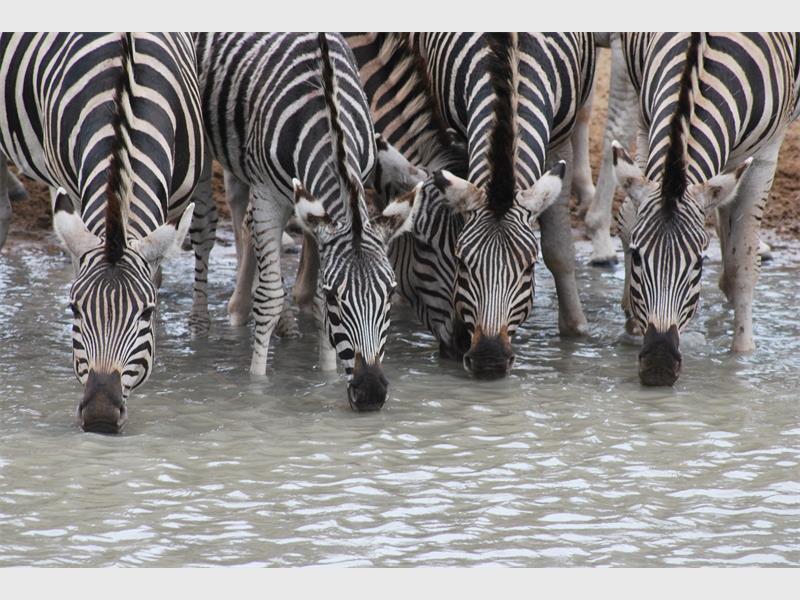
We sat there for ages, from time to time joining in the photo-frenzy, watching as a wonderful assortment of birds and animals came down to drink. It really pays to spend time in the hides at Mkhuze, particularly during the drier months when the water hole action simple never stops. We were particularly charmed by the herds of bouncy zebra and wildebeest that danced down to the pan for a midday drink. The warthog families, dressed in bright red mud, were looking a little on the lean side but, considering the drought, were still in fairly good condition. They so often seem to be the first animals to show signs of stress.

We also stopped at the less populated Mahlahla hide where we drank in the quiet beauty of the place and did a little productive birding.
The next morning we were up early and on our way to one of Mkhuze’s special beauty spots, the extensive Nsumo pan. En route, the game viewing was excellent and when we reached the pan, the two, recently revamped and very attractive bird hides overlooking the water were both fairly productive. However, the birding was better from the picnic site where we breakfasted and spent most of the morning.
Most of the water birds kept their distance, staying on the far shore, with many of them hiding in the reeds, so we had to take our time and look carefully to see what was there. Quite a spectacular sight at one stage was a huge flock of more than 100 yellow-billed storks, African openbills and white-backed vultures riding a thermal. A few flamingos waded in the shallows near the picnic site but we were disappointed not to see pelicans. However, there were hundreds of Egyptian and spurwing geese plus enough waders to keep us merrily twitching.
And eventually a small group of pelican did a fly past for us then landed behind the reed beds, out of sight.
Plenty of hippos wallowed close to the shore and a lively bird party of assorted birds in the trees behind the picnic area had us reaching for our binocs and ticking off all sorts of interesting species.

Masinga was still humming when we stopped there again and the cameras were clicking furiously. Mahlahla was much quieter and we lingered there quite a while – and were privileged to spot one of Mkhuze’s elusive elephants.
By the time we reached camp we’d had such a privileged day of simply amazing game viewing and birding – but we still hadn’t managed to conjure up the rain. Well, as we were packing up our tents early the next morning we weren’t really complaining about the dry weather.
If it is going to rain while you are camping, Murphy usually arranges for a downpour just as you are packing up your tent. He did that for us rather spectacularly on a visit to Mkhuze, 13 years ago, when we were accompanied by Bill’s sister and brother in-law Jenny and Martin from Britain.
It was September and the park was still fairly dry and waiting for the summer rains. The afternoon before we left Mkhuze, Murphy or our rainmaking skills stirred up an awesome thunderstorm. By evening a river of red mud was flowing through our camp and it rained and rained and rained all night long. It was still raining when we woke up the next morning. The tent and all our equipment were absolutely sodden and it was pretty miserable packing up camp. When everything was packed and we were ready to leave, we went to shower off our the mud.

Clean and warm and dry, I returned to the vehicle to place my sodden clothes in a bag. As I opened the back door, a muddy groundsheet unrolled itself and ambushed me. I could have cried, but my distress soon paled into insignificance.
One of the reserve staff members was trying to tell us about something happening in America, something about bombs and aircraft and a tall building. Puzzled we drove off and decided to stop and treat ourselves to breakfast at the Ghost Mountain Inn. At the hotel everyone was glued to the television watching a rerun of the events that had unfolded earlier on the day we now simply refer to as 9/11.
On this, our recent visit, it was sunny and bright when we packed up and left and there were no earth-shaking events to blight our visit. About a week later, while we were staying at Imfolozi for a few days, a little rain fell at last, over Zululand. I hope Mkhuze received its share.
DID YOU KNOW?
Click on the words highlighted in red to read more on this and related topics.
If you are reading this on your cellphone and there are telephone numbers provided in the text, you can call these simply by clicking on them.
To receive news links via BBM, add us using the pins 58F3D7A7 OR 58F25573. The South Coast Herald is also on Facebook, Twitter, WhatsApp and Instagram – why not join us there?



