
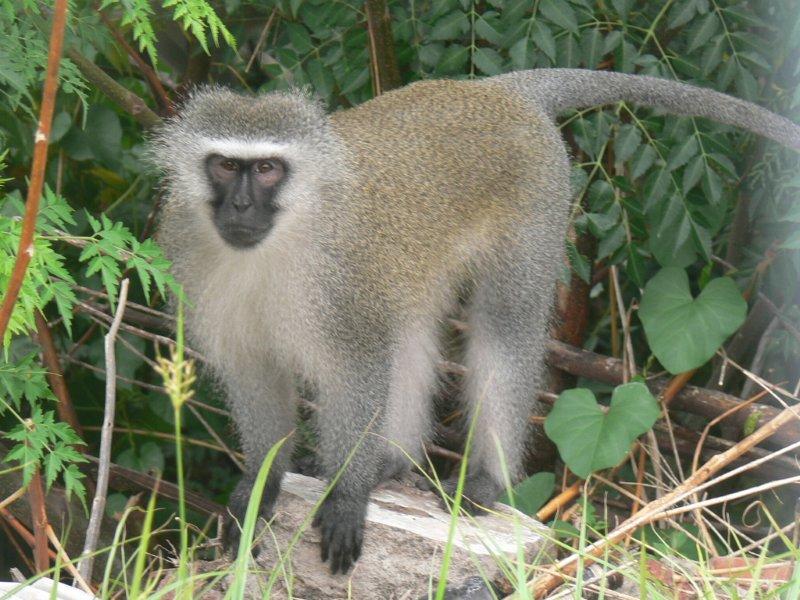
WE had a couple of monkeys scuttle across our roof this morning. So? I hear you ask. Well, that’s exactly it, it was just a couple of them, an adult female and a teenager. They drank the water in the bird’s red plate in The Hide and then disappeared into the forest again. Most importantly, they were the first monkeys we have seen in a while and we can’t help but wonder why.
We are used to full scale monkey raids on our tree house every day, sometimes more than once a day. A raid would mean perhaps 20 or more monkeys playing rugby on the roof, leaping from tree to tree around the house, and most significantly, trying to get in at every window and door in the place.
This would mean immediate and rapid evasive action, a great slamming of windows and doors and the stowing away of anything in sight remotely edible. This, however, hasn’t happened in some months, and we’ve become almost used to seeing a single monkey, or like today perhaps two or three, but never more.
Why is this? Does it have something to do with the drought, have they temporarily migrated to where there are better pickings and perhaps more surface water? (I would somehow doubt this, as surely village gardens are more productive than the farmlands of the interior?). Staying with drought, some species, notably antelope, will not breed if natural conditions are not right, like a drought situation, and very specifically we haven’t seen a baby monkey in a while and this is the full breeding season (I personally doubt this too, as I’ve never heard of primates exercising such control – certainly humans don’t).

Have they been driven away by some human or other agency? Is it just us, are we perhaps out of favour? (apparently not — I have made a number of telephone calls around the village and the overall consensus is that there are definitely fewer monkeys out there). The point is, where have all the monkeys gone?
I have consulted various weighty tomes on the subject of animal behavior, but none of them offers even a hint as to what might be happening. Monkey troops move around in their specific territories and sometimes overlap, generally causing violence and mayhem (again, typical primate behavior), but again, why are there no troops (or at least fewer) in evidence right now? I have consulted monkey experts too, and there are without doubt fewer monkeys about.
Among the possible reasons put forward for this are the drought, as discussed, the fact that it’s the breeding season and monkey mothers and their babies are inclined to keep a low profile (I can’t say we’ve ever noticed this before, as monkey mothers seem to show off their babies) and the possibility of increased monkey kills, although such activities are unlikely to escape notice and would be reported.
So, all very interesting and something of a puzzle. Cheers!
DID YOU KNOW?
Click on the words highlighted in red to read more on this and related topics.
If you are reading this on your cellphone and there are telephone numbers provided in the text, you can call these simply by clicking on them.
To receive news links via BBM, add us using the pins 58F3D7A7 OR 58F25573. The South Coast Herald is also on Facebook, Twitter, WhatsApp and Instagram – why not join us there?



