DESPITE some pretty odd weather, full summer is definitely on its way, and everything that goes with it.
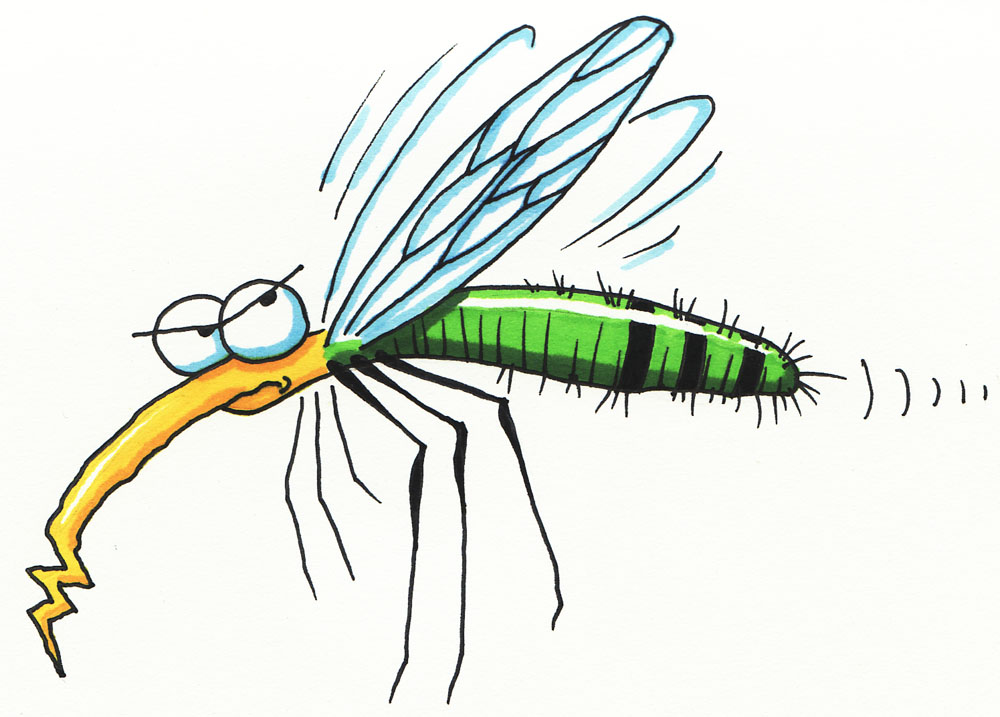
You must have noticed that the mozzies are back too, mainly the rather diminutive South Coast mozzie, but also the occasional full-blown mosquito, the type that favours the bedroom in the dead of night.
This means that the battery of anti-mozzie stuff has been dug out again, the sprays, the roll-ons, the scented candles, the swatters. All to no avail, I’m afraid.
The results of new research done by the University of Washington and the California Institute of Technology in the United States of America suggest that we simply cannot get away from mosquitoes, they are just too clever for us.
Mosquitoes can apparently detect our presence from as far away as 50m by picking up the scent of the carbon dioxide we exhale as we breathe.
They then follow that scent trail towards the source until a vague shape emerges, that’s at about 15m, and then at about 5m they close in on the warmth of our bodies.
In other words, you can spray and roll-on as much as you like and burn dozens of scented candles, but they know you’re there and they are going to get you.
How did the researchers establish this? They used a wind tunnel, parking a bunch of hungry mosquitoes at one end and then introducing various sensory clues at the other. Gradually carbon dioxide provided the answer and they worked from there.*
The researchers have described this strategy of detection and tracking down as ‘annoyingly robust’, in other words, unless you can actually swat it, the mozzie is going to win (even as I type one is buzzing between my nose and my computer screen).

To move on, from the tiniest nuisance to one of our Big Five.
The Cincinnati Zoo in the United States of America has repatriated its last surviving Sumatran rhino to Indonesia, its natural home.
There are fewer than 100 of these magnificent creatures left in the jungles of Sumatra and it is hoped that when the Cincinnati bull rhino is released into the wild he will make up for lost time.
There are a handful of Sumatran rhino on the Indonesian side of the island of Borneo, but decades of poaching and habitat loss has seen them disappear from their former range states India, Bhutan, Bangladesh, Cambodia, Laos, Vietnam, Thailand and Brunei.
The critically endangered Sumatran rhino is one of Asia’s three rhino species, the others being the endangered Indian rhino (found also in Nepal and Bhutan) and the also critically endangered Javan rhino.
The Sumatran rhino is slightly different in appearance to the others in that it is sparsely covered with short, gingery hair (its alternative names are the Asian two-horned or the Hairy rhinoceros).
Well, hopefully good news for the Sumatran rhino, but not such good news about the mozzie. Cheers!
*The Week: The Best of the British and International Media.
**Care2Causes.
DID YOU KNOW?
Click on the words highlighted in red to read more on this and related topics.
If you are reading this on your cellphone and there are telephone numbers provided in the text, you can call these simply by clicking on them.
To receive news links via BBM, add us using the pins 58F3D7A7 OR 58F25573. The South Coast Herald is also on Facebook, Twitter, WhatsApp and Instagram – why not join us there?