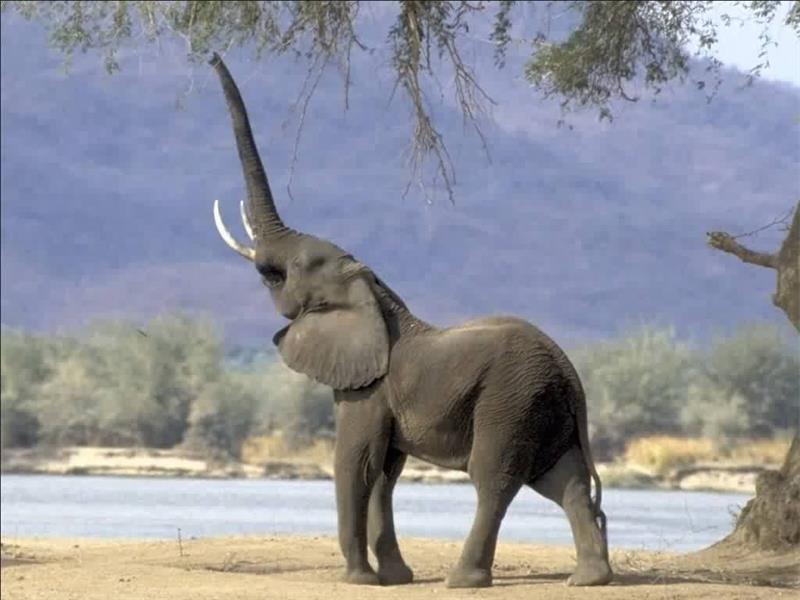
INTERNATIONAL conservation groups have referred to the issue of wildlife poaching in Africa and the Summit of the Forum for China-Africa Co-operation in Johannesburg last weekend as a perfect example of ‘the elephant in the room’ situation.
Some 50 African leaders, including President Jacob Zuma, of course, and President Xi Jinping of China, met to discuss a comprehensive array of industrialisation and developmental issues, including major deals on infrastructure and agriculture, without coming close to discussing one of the major crises facing Africa today – wildlife poaching.
The African Wildlife Foundation said that one could not discuss development without talking about natural resources and primarily wildlife.
The AWF pointed out that China consumed 75 percent of the ivory poached in Africa and asked the question: if China could bring the giant panda back from the brink of extinction, why could it not do something about the African elephant.
The Worldwide Fund for Nature (the WWF), and the International Fund for Animal Welfare have added their voices to the call for China-Africa action, pointing out that up to 40 000 elephants a year are being poached in Africa and that the price of ivory had rocketed to R30 000 a kilogram.
It was also pointed out that the current elephant population in Africa was about 470 000 compared to some 20-million a hundred years ago. The WWF urged both China and the African states to “incorporate clear goals” in the Summit’s final declaration.
It was pointed out that China already imposes severe penalties for ivory trafficking, such as an average sentence of 15 years (I carried a story in this column some time ago about a group of poachers caught with a dead elephant in the southern province of Yunnan, bordering on Laos and Vietnam, saying that they were tried on the spot by the authorities, found guilty, sentenced and executed right there and then), but none of this is enough, say the conservation groups.

In view of the above, it’s interesting to note the final and official Declaration of the Johannesburg Summit of the Forum on China-Africa Cooperation, issued at the end of the Summit on December 5 by the African and Chinese leaders. It is a 30-point document and there is only one mention of conservation, in Point 25.4, Paragraph 2:
‘Implement the “Initiative on China-Africa Cooperative Partnership for Peace and Security”, support the building of the collective security mechanism in Africa and jointly manage non-traditional security issues and global challenges such as, but not limited to, food security, energy security, cyber security, climate change, biodiversity conservation, major communicable disease and transnational crimes.’ That’s it.
This has been about elephants and their ivory, but there has been no mention of the crisis around rhino horn, or the roaring trade in lion bones and body parts (tiger bones and other bits are becoming increasingly difficult to find), or pangolin scales or any of the many other wildlife products that end up in China and South East Asia.
There really isn’t much more to say, is there, maybe at the next ‘summit’ they’ll talk about these issues. Cheers.
Sources: Savetheelephants.org News Service and the Internet.
DID YOU KNOW?
Click on the words highlighted in red to read more on this and related topics.
If you are reading this on your cellphone and there are telephone numbers provided in the text, you can call these simply by clicking on them.
To receive news links via BBM, add us using the pins 58F3D7A7 OR 58F25573. The South Coast Herald is also on Facebook, Twitter, WhatsApp and Instagram – why not join us there?