Tent Travels: Our cradle of conservation rocks
The heavenly twins are the oldest parks in Africa.
AS we packed up our Cape Vidal camp and prepared to say farewell to iSimangaliso after a thorough exploration of the wonder-filled wetlands park we were aware that our KwaZulu-Natal camping trip was drawing to a close. We’d loved all the Ezemvelo KZN Wildlife parks and iSimangaliso sections we’d been privileged to visit so far but we were very aware that no journey through KwaZulu-Natal would be complete without paying tribute to the birthplace of conservation in our province.
You could even go as far as calling the Hluhluwe-iMfolozi Park South Africa’s cradle of conservation. In 1895 iMfolozi was the first officially proclaimed game reserve in Africa. The proclamation of Hluhluwe followed just two years later. The twins would, however, have to wait until 1989 to be united. It was only then that the corridor separating them was proclaimed, allowing the parks to merge and to become the magnificent big-five, 96 800ha game reserve we know and love today. Together they form Ezemvelo’s flag-ship reserve, but, all the same, both sections have retained their own identities and unique characters.

We left the iSimangaliso Eastern Shores section via the Bhangazi Gate then turned right onto the pleasant road to Mtubatuba. It was after Mtubatuba that we found ourselves driving through an environment that was, for some reason, horrifically degraded, the very worst we’d seen on our KwaZulu-Natal travels. The earth looked sore, scraped bare of almost any vegetation except for the hardiest plants, mostly alien invasives. When are we going to start looking after this poor, benighted planet of ours? After all, we only have one Earth!
It was a relief to arrive at Hluhluwe-iMfolozi’s Nyalazi Gate and to enter a nearly pristine environment once again. It is a wonderful park, incredibly scenic and always a treat from both a birding and game viewing point of view. It is also amazing to see how well the alien invasives are controlled within the park’s environs. These troublesome plants are such a curse in our province and keeping them out of our wild places is on ongoing, expensive and difficult task. As much as we love this park we don’t spend as much time in it as we’d like to as there is no camping and an extensive stay stretches our travel budget too much.
Camping, particularly in our extremely comfortable, tourist-friendly game reserve rest camps, makes South African holidays incredibly affordable and pleasant. Anyone with children should consider this option. I do wish the powers that be would consider setting up a camping ground in Hluhluwe-iMfolosi – perhaps in the vicinity of the Mpila day visitor area or just inside Memorial or Nyalazi Gates. There is probably a good reason why this would not be an option, but we would love to be able to spend long holidays camping in this wonderful natural place.

Soon after entering the park we stopped for a coffee break at Umbondwe, one of the really lovely picnic sites in this user-friendly park, then we proceeded to Mpila Camp to book into our delightful little hut. After nearly a month under canvas it seemed very luxurious, attractively furnished, with its own bathroom and kitchenette. And, perched on a lofty slope it afforded us an incredible view. We’ve stayed in a Hilltop rondavel and in one of Mpila’s comfortable safari tents but it was our first stay in one of the Mpila huts and we were most impressed.
After unpacking there was plenty of time to do a little game drive to the nearby Sontuli Picnic Site and to come home via a couple of interesting loops but we were looking forward to a more thorough exploration of the park over the next two days. So far we’d been incredibly lucky regarding both birds and game, On our first afternoon we’d already ticked off four of the big five. Although we’d had a simply wonderful leopard sighting on a previous visit, Mr Spot remained elusive this time around and we eventually had to leave the park without seeing him. We couldn’t complain, though. What with seeing a good assortment of antelope, wonderful birds and plenty of the other big four, particularly buffalo, we really couldn’t complain. And then there were not one but two wild dog sightings – but more about these later.
While for security reasons I don’t really want to talk about if, when and where we’d seen rhino, there were many poignant reminders that the park had for many years been a bastion of rhino conservation. Back in the 1950s the park was the launch-pad of Operation Rhino, spearheaded by a remarkable man, the much-revered Dr Ian Player. He was a world-renowned conservationist who once nobly served as its chief conservationist for both Natal and Zulu-land – now amalgamated into the province we call KwaZulu-Natal. He and his team virtually pulled the white rhino back from the abyss of extinction, in the process developing the sophisticated game capture and translocation techniques that are used today. It was a sobering thought that even here, where Dr Player started his campaign to save the rhino, these gentle giants are no longer safe from poachers.

It was a cold, extremely windy evening so we stayed indoors, making use of the little gas oven to cook a hearty casserole. It would have been lovely to sit outside and enjoy the view but from the little table and chairs next to a large picture window we could watch all the winged and four-footed visitors on our lawn. It was amazing, the passing parade including a spotted hyena and a lonely buffalo.
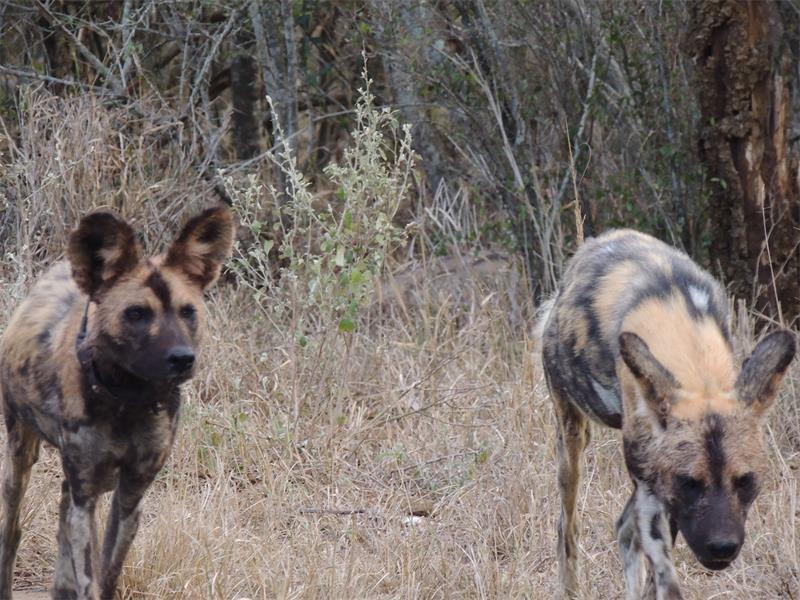
We were out and about early the next morning as we were planning to spend the whole day in the Hluhluwe side of the park, reserving the next day, our final one, for the iMfolozi side. Although I do tend to prefer the iMfolozi section, Hluhluwe is perhaps the more aesthetically pleasing of the two, with rolling hills, dramatic vistas, plenty of pretty scenery, the silvery Hluhluwe River and all the green-fringed lesser waterways. Our day in this section was such a joy, starting with a close encounter with ten gorgeous wild dogs near Siwamakhosikazi picnic site. They were in a hurry and didn’t stay around long but we had a really special sighting of these adorable painted wolves. I think, of all the animals they are my favourite and they are always so hard to find.

Naturally we had plenty to talk about when we stopped for breakfast as the picnic spot. This site and the one overlooking the Hluhluwe river, not far from Memorial Gate, are absolutely beautiful and are excellent places to while away an hour or two doing some camp chair birding and enjoying being out and about in a wild environment.
Soon after our breakfast stop we veered off the main road to do the Nzimane River Loop, one of our very favourite little drives in the park. It meanders over sandy little waterways, through lush, green vegetation and there is almost always plenty to see along the route. At one point, a drift over a river can be a bit of a problem for those without a 4×4 during the rainy season but it is right at the end of the route, giving access to a track that is a short cut back to camp. Those with 2×4 vehicles can always back track and go home the longer way.
We stopped briefly at the lovely Hilltop camp, mainly to admire the gardens. It is a striking, modern camp, set, as its name suggests, on top of a hill and commanding a see-forever view from this lofty situation. The accommodation, restaurant and facilities are really classy and a Hilltop stay feels rather like a visit to a private luxury lodge. I do enjoy Hilltop and the access it offers to some wonderfully scenic drives, but somehow, I find myself preferring the less-sophisticated Mpila Camp in the iMfolozi side.

We took out time, stopping often to admire the dramatic scenery or to look at game and birds, along the main tarred road between hilltop and the Memorial Gate. It runs along a ridge and the views are incredible. Towards the end of this route, we took a scenic detour along the upper Magangeni Loop, stopping at the many lookout points along the way. After doing a little shopping at the excellent craft centre at Memorial Gate, we spent a bit of time birding in the lovely, parklike gardens. Then we turned off the tar again towards the Hluhluwe River and its lovely picnic site. This part of the park is always excellent for game viewing and shouldn’t be hurried. We weren’t surprised, after our extended lunch break, when we turned down a little side road and found a sleeping lion. A big male, he woke up, yawned, had a scratch, padded over to a shady spot, looked at us and went back to sleep.
Another scenic gravel road served as a short cut back to the main road between Hilltop and the iMfolozi side of the park and it offered us a sighting of a really huge herd of buffalo, as well as all sorts of other lovely creatures.
We were pretty tired by the time we reached Mpila but after a refreshing cup of tea we took a little drive to the nearby Umkhaya Viewpoint, overlooking the bridge across the Black iMfolozi River, for a sundowner. A really beautiful little spot, it encouraged us to linger for a while enjoying some peaceful solitude and good game viewing. Back at camp, it was less windy than the previous evening and we lingered outside for a while. However the wind soon picked up again and we retreated inside to watch the velvety darkness descend over the distant mountains. What a wonderful day it had been. We’d explored Hluhluwe fairly thoroughly and were now looking forward to spending time with its wilder twin the next day.

DID YOU KNOW?
Click on the words highlighted in red to read more on this and related topics.
If you are reading this on your cellphone and there are telephone numbers provided in the text, you can call these simply by clicking on them.
To receive news links via BBM, add us using the pins 58F3D7A7 OR 58F25573. The South Coast Herald is also on Facebook, Twitter, WhatsApp and Instagram – why not join us there?