Tent Travels: Living legacy
iMfolozi was the inspiration for Dr Ian Player's wilderness leadership concept.
IF you look at a map of iMfolozi Game Reserve, you will notice that a large section lacks any sort of road and hardly any man-made infrastructure.
It is by design that much of this magnificent park has been left as a piece of true wilderness, untouched by man. Here, nature rules supreme and the few human visitors who venture here, come here on foot, humbly, with reverence and with respect for the pristine nature of the land,
While I love the scenically beautiful Hluhluwe side of Ezemvelo’s flagship game reserve there is just something so special about the wilder, more rugged, less touristy iMfolozi side. Visiting it is an almost spiritual experience that probably has something to do with an unconscious awareness of its vast tracts of pristine space. Also it is almost as if this precious, wild place is touched by the spirit of a very special person, the late Dr Ian Player.
Most people are aware that this great conservationist was the force behind the rhino conservation scheme called Operation Rhino in the 1950s and 1960s. Less people know that he was one of the pioneers of the concept of setting aside untouched wilderness within conserved areas like game parks. Wilderness and its vital importance to mankind were central to Dr Player’s philosophy.
In 1952 he joined the Natal Parks Board, the forerunner of Ezemvelo KZN Wildlife, and so began his long and illustrious career in nature conservation that would see him become a major international influence in his chosen field. Ten years after joining the parks board he was appointed senior warden of iMfolozi and two years after that he was appointed chief conservator of Zululand. It wasn’t long before he was chief conservator of both Natal and KwaZulu-Natal, the two regions that have been amalgamated to become the present-day province of KwaZulu-Natal.

A wise and gentle philosopher, Dr Player brought a humble spirituality to his passion for conserving wildlife. He believed utterly in the transformational value of true wilderness and of the need for people to connect with nature. For him, the Christian Bible was central to his thinking and to his understanding of the connectedness of all things.
“There is hardly a page in the Christian Bible where the influence of wilderness is not apparent,” he once said.
He read widely and studied the belief systems and philosophies of many great thinkers, with both Jung and Laurens van der Post influencing his outlook on life. Perhaps the most profound influence, though, was that of his wise and much-loved colleague and friend, Magqubu Nntombele.
It is here, in iMfolozi that the idea of setting aside untouched wilderness eventually took root in South Africa. From this concept grew his idea of wilderness trails, still on offer in iMfolozi, that allow people to benefit physically, emotionally, intellectually and spiritually through this close and personal type of contact with untouched nature. Dr Player also founded the Wilderness Leadership School and travelled the world promoting the idea of wilderness leadership and raising funds for conservation.

Also part of his amazing legacy is the Dusi Canoe Marathon, originally a six-day event, which he founded in 1951 and which he won three times. A keen sportsman, he saw the canoe marathon not only as a sporting challenge but as a way of raising awareness of nature and the need to protect it.
But let’s go back to wild and wonderful iMfolozi, in some ways a living monument to Dr Player’s pioneering wilderness work. We’d spent the previous day in the Hluhluwe side of the park but had set aside this, out third and final day, to explore iMfoilozi and to revisit all the little spots in this section that we love.
Two rivers, the Black and the White iMfolozi, wend their way through this rugged half of the park, at times cutting through rocky terrain, at other times plaiting themselves across flat, sandy beds. These generous waterways are major geological features and have a great impact on the landscape. At the eastern border of the park they converge to become the iMfolozi River, This major waterway then continues roughly eastward to reach the Indian Ocean at the St Lucia estuary.
Our day of exploring the land of the twin rivers was to be an adventurous one, starting with another thrilling sighting of wild dogs. We’d seen them the previous day so felt we were really spoiled. We left Mpila just after 6am, and were in time to see the pack running across road in front of us soon after we had left camp. They were in a hurry and soon disappeared into the bushy vegetation on the side of the road, leaving us filled with awe. We use the word ‘awesome’ so freely today but seeing wild dogs twice in just two days was truly awesome.
There was plenty of general game en route to Mpafa Hide, but not much happening at this pretty, usually productive spot so we continued on our way. One of the loveliest routes in the park is the wild and remote 4X4 Okhukho Loop in the north western corner of the park.It is pretty rugged territory, offering dramatic scenery, and the route
is fairly challenging at times but it is oh so well worth doing.
Soon after setting off on this loop we hit a road block – in the form of three large male elephants who were making their way slowly along the road, veering off now and then to nibble a bush or tree. They were in no hurry and neither were we. Maintaining a respectful distance we motored slowly behind them for a good half an hour. While stopping and starting to keep pace with them we were humbled by the gentle, peaceful encounter with these amazing creatures. Eventually they moved off the road and slowly disappeared into the bush, leaving us to continue on our way unimpeded.
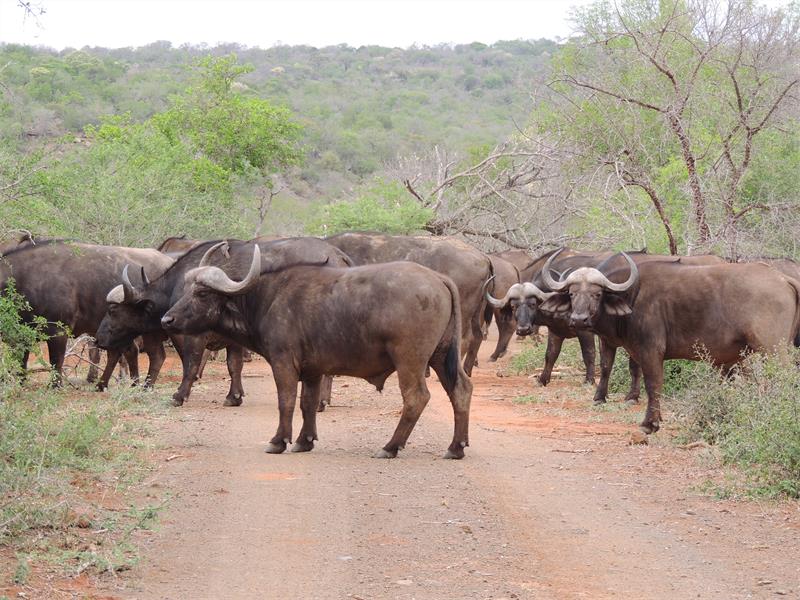
Towards the end of that wonderfully scenic route we were once again delayed, this time by a massive herd of buffalo crossing the road. There were so many it took ages for them to pass and it was lovely to watch them from such a close distance. There was also plenty of other game around, so the route proved exceptionally rewarding.

Continuing on our way we followed the outer loops along a route that offered wonderful views of the Black iMfolozi. With the drought conditions the area was experiencing at that time, the river was very dry but still so beautiful and any stretches of water in the river bed were animal and bird magnets. By the time we reached Sontali picnic site on the banks of the river we were more than ready for a little break from driving and a delicious lunch time braai. Food always tastes so good when cooked and eaten outdoors.
After lunch we slowly wended our way back home through scratchy dry knobthorn woodland, the big acacias looking gorgeous covered in white spring blossoms. They are stunning trees. It was the end of winter and, in spite of the shortage of rain, the park was greening up nicely, the other acacias and the tambotis all sporting new, lime-green leaves.
We’d spent most of the day in the park and it as late afternoon when we got back to camp. We packed some snacks and sundowners and drove across the bridge over the Black iMfolozi to a delightful little viewsite on the bank of the river. The birding and game viewing was magic there and we stayed quite a while. Back home the wind had finally dropped enough for us to enjoy our final night at iMfolozi – and the final night of our KZN camping trip – out of doors, next to a crackling braai fire.

While we were eating our supper some big clouds rolled in and there was a bit of thunder and lightning as we prepared for bed.
The next morning, the air was fresh and clean, scented with that evocative smell of wet earth that comes after rain. On the way out of the park there were puddles on the road and, in the distance, it looked like isolated showers were still bringing some relief from to drought to other parts of parched Zululand.
Near the gate, we drove through a light shower, a final blessing for us before we left the confines of the park and turned towards home after our wonderful month-long KZN holiday. Truly, our province’s wonderful wild places are greatly undervalued. Our beaches are lovely but KwaZulu-Natal has so much more to offer than simple seaside holidays. If you haven’t visited our wild places, it is time you gave them a try.