Dear Laura
Yes, I understand your problem with the main course. You’re very good at cooking a roast, but Mike isn’t very good at carving it! I think that probably applies to most households. In fact, I can only recollect three men (other than professional chefs) who really knew how to carve – my mother’s father, your father, and a passing acquaintance with a long red beard. I remember my other grandfather – I called him ‘Rabbit’ and he called me ‘Pooh’ – taking two kitchen knives, stabbing them both into the middle of a chicken, and prising them apart!
He was a wonderful man, with an IQ higher than yours and mine added together, but he couldn’t carve a chicken! In fact, I don’t think Rabbit really cared much about food at all. He grew it – furiously ‘digging for victory’ from the start of the Second World War well into the 1950s – but I doubt if he really tasted what he ate. He infuriated my mother once by putting strawberry jam on a herb omelette!
In days of yore, carving was an art passed on from father to son. Nowadays it’s more likely (if it gets passed on at all) to go from mother to daughter. So, rather than have your masterpiece hacked to death, carve it yourself! If you have doubts about your knife, take it to your butcher and ask him to ‘set it up’ for you. He will charge you for it, but at least you will know that it has been done properly and (as long as you don’t use it for cutting cardboard) it will stay ‘set up’ for at least the next six months.
You could, of course, ask one of the male guests to do the honours, but this can be dodgy – he might be even worse at it than Mike! The answer is probably to carve the beast in the kitchen, where you won’t have everyone offering advice and putting you off your stroke, and dish it up in slices. This is particularly suitable for pot-roast or gammon, as you can do it earlier and reheat it gently in the sauce.
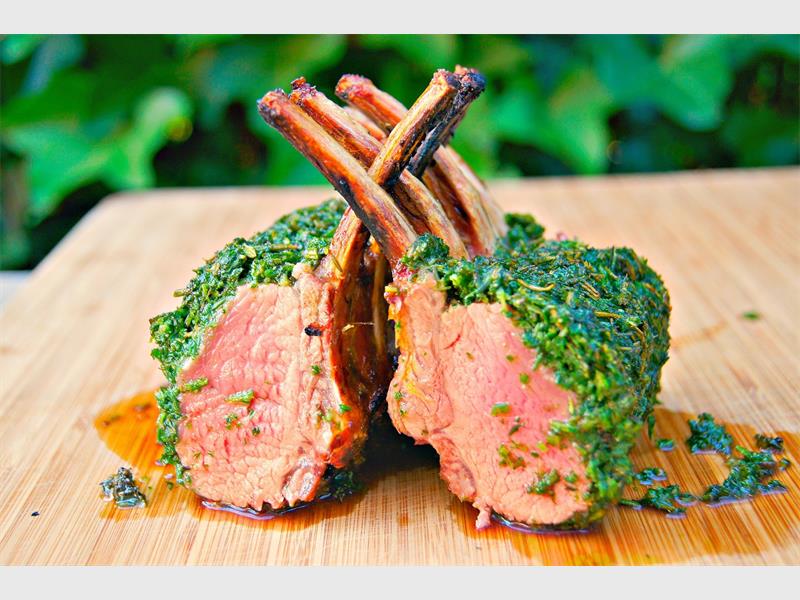
Another good bet is loin of lamb. Any fool can carve that! Provided, of course, that the butcher cut the bones in the right places. If you can’t find an English butcher, you may have to explain very carefully what you want – a certain number of loin chops, with the connecting bone cut through but the meat left in one piece. You may well have to explain more than once, because the idea of separating the chops after cooking them is totally foreign to braai-worshippers! Of course, I have a lady butcher, who is extremely interested in alternative cooking and is now recommending roast loin to her predominantly Afrikaans clientèle!
To be on the safe side, you should allow three chops per man and two per woman. You will probably finish up with a couple left over, but this is not a problem. Whereas a leftover braai chop resembles charred boot-leather, a leftover roast chop is the most delicious thing to take to work in your lunch-box.
Before roasting any joint of lamb, I always score the skin and rub in a mixture of salt and dried mint. At a pinch you can also use dried mint for the mint sauce but you must soak it in a tiny bit (two tablespoons should be enough) of boiling water for about twenty minutes before mixing in the sugar and vinegar. Fresh mint is much nicer, though. I’m sure one of the aunts will have some in the garden.
Redcurrant jelly is also good with lamb, but it’s hard to come by. Rabbit, of course, put strawberry jam on it, but you’re only allowed such sabotage if you’ve got no taste buds and an IQ over two hundred!
Love Mom