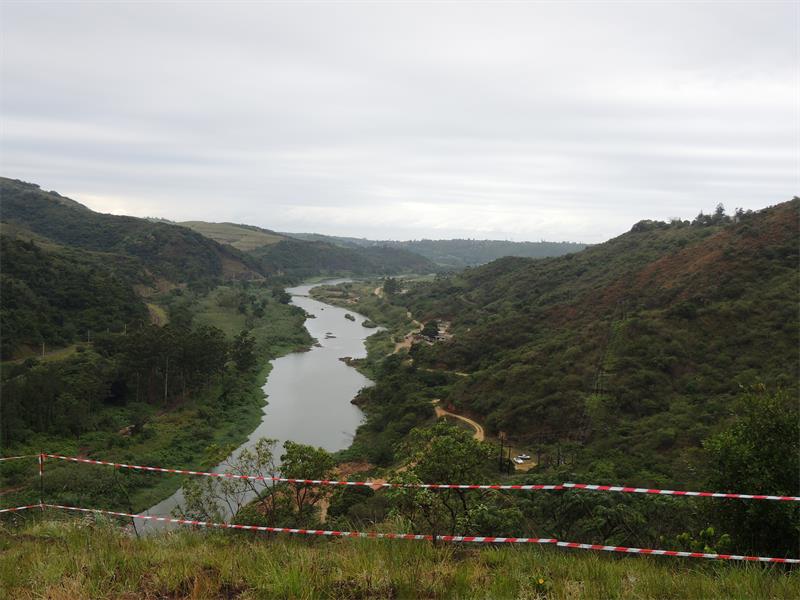
TO reach Port Shepstone from the north, travelling along the R102, you have to drive across a bridge spanning one of the town’s most important landmarks, the Umzimkhulu River Mouth. This twisty waterway rises in the southern Drakensberg near Underberg and is one of KwaZulu-Natal’s largest rivers. It is a noteworthy geological feature, an important source of water supply for many South Coast households and it has played a significant role in the South Coast’s history. And yet. we who live here tend to take the Umzimkhulu for granted. It is a good thing that recently two local conservancies have opened up interesting walking or hiking trails that highlight both the natural beauty and historical interest of this important river.
While it is not widely known the Umzimkhulu once served as one of those unruly frontiers that have spiced up South Africa’s history. Until New Year’s Day, 150 years ago, it was the boundary between the crown colony of Natal and the wild and lawless region known as No-Mans-Land. This unclaimed area was a refuge for all sorts of misfits, fugitives and criminals and neither of its neighbours, the British nor Chief Faku of the Pondos, really wanted it, according to South Coast historian Mary Neethling. Ms Neethling, who lives on a farm in the Oribi area, was for many years the curator of Port Shepstone Museum and she has devoted much of her life to ferreting out the stories that make up the fascinating history of our area. Eventually, after appeals from the local Zulu chiefs, the British agreed to take action. And so it was, on January 1, 1866, with due pomp and ceremony and with a large multi-racial party of what we would today call interested and affected people in attendance, the area between the Umzimkhulu River and KwaZulu-Natal’s present-day boundary, the Umtumvuna River, inland as far as Ingeli, was annexed by Acting Lieutenant-Governor Colonel John Jarvis Bissett.

This almost 4 000 square kilometre piece of newly acquired Natal was officially named Alfred County. It took a while for it to start attracting any significant development. Prior to the annexation some traders and shipwreck victims had wandered through or even made their homes in No-Mans-Land and there was a small trading post overlooking Batstones Drift, just inland from the river mouth. Pioneer farmer Sidney Turner, who operated a ferry across the Umzimkhulu, is recognised as Alfred County’s first English settler. In her article entitled ‘The Romance of the River Road,’ Ms Neethling has this to say about the historical Batstone’s Drift, where a modern-day low level bridge now offers a safe crossing of the river.
“It was at Batstone’s that the wagons crossed the Umzimkhulu River in the old days on their journeys from the Cape to Port Natal. Dick King would have crossed here on his historic ride to Grahamstown. He had been a transport rider so he would have known the way. Sidney Turner lived here in the 1860’s but the gunrunners who crossed the Umzimkhulu at regular intervals seldom crossed here. They would have used an upstream crossing nearer to St Helen’s Rock.” It was, however, William Bazley’s engineering genius that really opened up the new county. By blasting out a channel and building a training wall, he turned the river mouth into what was, for a long time, KwaZulu-Natal’s second most important harbour.

In his book,‘Nil Desperandum’ Denzil Bazley had this to say about his ancestor’s efforts: “The opening of the river mouth to shipping was without doubt the most significant event that ever occurred in the County of Alfred. It was to herald a boom throughout the area and was to attract more and more interest in it as a place to settle.” Stories abound regarding the Port Shepstone harbour’s heyday and it wasn’t until the arrival of the railway line that it lost its importance. The ‘River Road’ was the name given to a road alongside the north bank of the river that was part of a route along which Ms Neethling walked to school when she was a child.
“It came into operation in 1902 when the railway arrived at North Shepstone and its very situation made it a unique road. I always think of it as starting from the Batstone’s Drift end because that was how it would have been built,” she said. The River Road wasn’t always usable. The Umzimkhulu has seen many fluctuations in its levels, including some dry years when it was reduced to a trickle and some massive floods. Ms Neethling remembers the road being under water at times, perhaps during flooding. spring tides or when the river mouth was full and closed to the sea. The building of the River Road involved input from local engineers and, apart from these occasional inundations, it served its community well for many years.
“It was the 1959 flood that killed the road. The steep cliffs collapsed with a landslide that could not be removed; the part of the road that had been constructed by William Bazley was swept away, bringing the river against the krantz once more. Charlie Haajem’s consolidated mud bank proved to be less solid than it appeared to be,” said Ms Neethling. But the good news is that the River Road has been partly restored as a feature of a short, reasonably easy walking trail, thanks to the efforts of the Umtentweni Conservancy. Members have established this walk on the northern bank of the lower reaches of the Umzimkhulu. From Port Shepstone Country Club, walkers follow the railways line through two tunnels to Royston Hall, another historically interesting site.

The attractive home was commissioned by Captain Hitchens as a weekend cottage at the beginning of the 20th century but it was too remote for his wife and was sold to Brigadier John Robinson Royston and remained in his family for 41 years. Galloping Jack, as he was called by the Australian forces under his command in WWI, was a colourful character. He and his first wife, Lillian, who died in 1926, had a son and two daughters. Brigadier Royston attended three coronations as a South African representative. He received his final coronation medal in 1936 when he apparently met his second wife, Mildred Wright, who is believed to have been a novice nun at the time. After they married they returned to Royston Hall where they lived together until the Brigadier died at the age of 82.
Legend has it that at night Mildred would raise her arms to the heavens and dance naked for the watchful spirit of her late husband. And that her ghost would continue to do this after Mildred was murdered at her home. For 50 years after Mildred’s death the old house was intermittently allowed to deteriorate until it was bought by the present owners Roderick and Ria Hackland, who restored it to its former glory. Special prayers were said and Mildred dances no more. She is at peace now, the owners say, and only love, music and happy laughter prevail. Another snippet of history will be encountered by walkers negotiating the longer of the two railway tunnels along the River Road trail.

“Just remember there is always light at the end of a dark tunnel” proclaims a piece of graffiti by world famous artist Anthony Kirkwood, better known as Gasak. Originally from Pietermaritzburg, he studied art in Milan. He chose to express himself through graffiti, not then recognised as an art form. Now he travels the world, making bold politically or socially inspired global street art and is much in demand by institutions. A number of buildings in KwaZulu-Natal have served as canvases for his bold art with a message. Walkers turn at Royston Hall then head back to Port Shepstone Country Club via the cool green riverside tunnel, a pathway that follows the historic old River Road route. It is the pleasant final leg of the very interesting walking trail.
It is the beauty of the river and its surrounds rather than its history that is highlighted by Umbango River Conservancy’s impressive new 10km Tandele Trail, set out on the south bank of the river. With some tricky steep sections it is not for the faint-hearted but doing this trail really is well worth the effort. It offers incredible views of the Umzimkhulu River and surrounding hilly area and is scenic, interesting,well laid out and fairly challenging at times. The trail starts with a brisk, reasonably flat walk on a gravel road alongside the Umzimkhulu River. From there, a sharp ascent takes walkers to a viewpoint offering a panoramic view of the river and the water pump station at Helen’s Rock – but this first steep initial climb is just a taste of things to come.

The trail then winds its way up and up and up the side of a steep valley, seemingly to the top of the world. The carefully prepared trail makes the climb reasonably easy, though, and the views of the surrounding rugged terrain and the confluence of the Umzimkhulu and its tributary, the Umzimkulwana Rivers are quite spectacular. Fortunately, what goes up must eventually come down and walkers will soon find themselves on a gentle downward slope back to the gravel road and, eventually, to the start. Thanks to the conservancy’s efforts the Tandele Trail is a valuable new South Coast amenity and has great potential as a tourist attraction. While both the River Road and Tandele Trails are well worth doing, they go through fairly isolated areas and it it probably not a good idea to do them by yourself. From time to time, the conservancies that look after them arrange group walks and hikes along the trails so if you are visiting our area contact them to find out if any events are planned. You can reach Alex Skene of the Umtentweni Conservancy at 078 5087290 and Morgan Naidoo of Umbango River Conservancy at 076 2389826.

DID YOU KNOW?
Click on the words highlighted in red to read more on this and related topics.
If you are reading this on your cellphone and there are telephone numbers provided in the text, you can call these simply by clicking on them.
To receive news links via BBM, add us using the pins 58F3D7A7 OR 58F25573. The South Coast Herald is also on Facebook, Twitter, WhatsApp and Instagram – why not join us there?