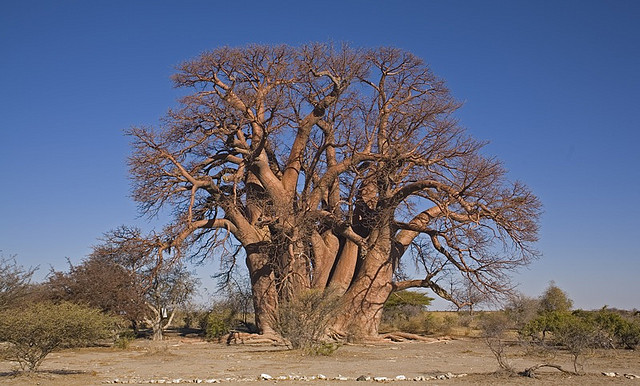
INDEED, Chapman’s Baobab in Botswana, not only one of Africa’s biggest and oldest trees, but also one of the continent’s most historic trees, has fallen.
The baobab, which was 25m in circumference and had at least six main trunks, was estimated to be anything from 1,000 to 3,000 years old. The reason for its sudden collapse is not known, but the Botswana authorities are investigating the incident and hoping there may be some life left in at least part of it – Chapman’s Baobab was a National Monument in Botswana.
Chapman’s Baobab was just outside the small town of Gweta, which is known as the gateway to the Makgadigkadi Pans, about 100km west of Nata, which is about 200km north west of Francistown.
In other words, it is a very long way from anywhere.
Due to its size and the fact that it was the only large tree in the vast plain, it was a well-known beacon for travellers.
It was first recorded in 1862 by James Chapman (explorer, hunter, trader and, obviously some time later, photographer), who was travelling with the more famous Thomas Baines (another explorer, artist, naturalist and cartographer, after whom are named Baines’ Baobabs, perhaps another 50km further on in the Nxai Pan National Park).
It’s understood that Chapman’s Baobab was used as a post box tree by many such travellers, explorers and traders of the 19th century, including David Livingstone.

There is a philosophical question that has been around for about 300 years, being, if a tree falls in the forest, does it make a sound? Well, given its sheer size and bulk, one would assume that Chapman’s Baobab certainly did make a sound.
We have travelled through that part of the world and although we did not get to see Chapman’s Baobab, we did see Baines’ Baobabs. That in itself is a memorable experience, a very special place in a very special area.*
And now for something completely different.
A while back I wrote about the problems New Zealand was having with domestic cats killing wildlife. Well, here’s an interesting report from Australia.
Apparently feline AIDS affects up to 29 percent of the domestic cats in Australia and one in six cats that are allowed outdoors (what cats aren’t?) are estimated to be infected with the Feline Immuno-deficiency Virus.
It has been suggested that domestic cats should be kept indoors 24 hours out of 24, where they will be safer as far as AIDS is concerned (most cross-infections come from cat fights, but feline AIDS is not transmissible to humans) and they will also present less of a threat to Australia’s wildlife, particularly birds.
In the Australian Capital Territory some suburbs already require cats to be kept indoors and if they are allowed out at all, it must be on a leash or in a special enclosure. Well, well, well, I wonder how that would go down among moggie owners on the lower South Coast?**
Cheers!
*Conservationist and Botswana expert, Clive Walker, and Wikipedia. **Noseweek.
HAVE YOUR SAY
Like our Facebook page, follow us on Twitter and Instagram
For news straight to your phone, add us on BBM 58F3D7A7 or WhatsApp 082 421 6033