HAVE you ever visited Aberdeen as a tourist? I don’t suppose that many people do – but perhaps they should.
I’m talking about the South African Aberdeen, of course, not the town in Scotland. It is a small dorpie in the Karoo, near Graaff-Reinet, with wide dusty streets and the peace and tranquility that have become very marketable commodities in recent years.
We passed through Aberdeen, a few years ago, on our way to somewhere else. We weren’t going to stop but we noticed that it had plenty of plenty of interesting architecture, so we decided to take a look at some of the old buildings. The imposing old post office, built in 1898, was pretty impressive and there were many lovely old homes.

Quite a few were good examples of so-called ostrich baron palaces, ostentatious, over-the-top ornate and recalling an era when fine feathers were a massive global fashion trend. For a while the humble ostrich earned farmers small fortunes but fashion is fickle, the ostrich feathers lost their lustre and ostrich fortunes dwindled.
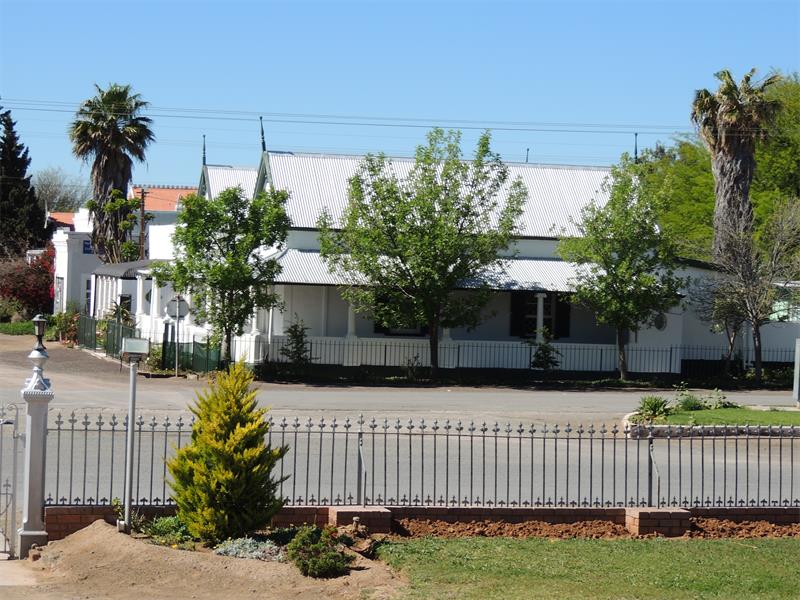
As well as these reminders of the feather boom are the many, more typically Karoo homes, those simple little town houses that are found in most Karoo towns. Some are Victorian in style, complete with the requisite frills and broekie lace, but many are those stylish, flat-roofed town houses that you see throughout the area. The main feature of these homes is usually the shady verandah with its shapely corrugated roof.
We were particularly taken by the rather fierce looking gargoyles on the roof of the old sandstone court house, another noteworthy Aberdeen building. How on earth did gargoyles come to take up residence on top of an official building in the Karoo, we wondered as we returned to our vehicle and drove away.
Recently we found ourselves back in Aberdeen, again passing through but this time we had set aside a couple of hours to get to know the town a bit better. One of the objects of our second visit was to take a look at the town’s rather famous Dutch Reformed church and the even more famous Biblical panels that adorn the church hall. These works of art that a group of local women have lovingly and skilfully created out of fabric and the locally produced wool are well worth seeing and some of the stories behind the different panes are very touching.

The church itself is very beautiful and it has the distinction of having the highest church steeple in South Africa. It is slightly crooked and local people have given it a rather irreverent nickname – the leaning tower of Aberdeen. After we were shown around the church we were taken to see a very special tree in the church garden. It is an olive tree grown from a cutting taken from a more than 2 000 year old tree in the Garden of Gethsemane in Jerusalem.
The imposing church takes centre stage in the town and this is as it should be. It is a symbol of the reason the town exists at all. Aberdeen started out as a new parish, an offshoot of the Graaff- Reinet mother parish, in 1855. Originally a farm called Brakkefontein, the new town was named Aberdeen after the birthplace in Scotland of the Rev Andrew Murray, renowned throughout the Karoo as a dynamic and influential Dutch Reformed minister. The church was built in two phases, the first completed in 1864 and the second in 1908.

We spent quite a long time in Aberdeen on our second visit, thoroughly enjoying the guided tour of the church hall and the church. Then we said goodbye to the kind and knowledgeable parishioner who had given up his time to play tour guide and to show us around .
Before we set off we took another walk around the lovely little town and found a rabbit warren of an old building that had been turned into a charming little craft centre, tea garden and – wait for it – a substantial and well stocked book shop.
The Karoo towns, big and small, really do cater for booksworms, living up to the Karoo’s rich literary legacy. Perhaps there is something about empty spaces and that champagne Karoo air that encourages dreaming and nourishes the love of the written word.

HAVE YOUR SAY
Like our Facebook page, follow us on Twitter and Instagram
For news straight to your phone, add us on BBM 58F3D7A7 or WhatsApp 082 421 6033