EVERYBODY waves to you in Nieuwoudtville.
I am not even sure how we discovered this friendly little town. It is popular with the flower people who make their annual pilgrimages to Namaqualand to see the springtime floral extravaganza but we first visited it in late summer. By then the wild flowers and the tourists that follow them had long since disappeared.
Anyway, Bill and I like little out of the way towns and, even without the flowers, we found plenty to keep ourselves amused. Our first stop was the Smidswinkel Restaurant, which doubled as the local tourist information office and the owner had all sorts of ideas on how to keep visitors entertained – even out of the flower season. He made us promise to come back, though, to see the Nieuwoudtville spring floral show.
It was a promise that we eventually were able to keep.
Nieuwoudtville, even on our first visit, didn’t disappoint. It was nothing special, just a pleasant little Northern Cape dorpie with friendly people and a sunny disposition. Situated on the Bokveld escarpment, it had wide, dusty streets, neat, mainly fifties-style houses and some mellow older buildings, built out of sandstone.
Smidswinkel Restaurant was housed in one of the beautifully restored old buildings and, as well as being an attractive restaurant, was a treasure trove of interesting artifacts including a collection of blacksmith tools – hence its name. The owner also showed us his wonderful library of books on the area, particularly its flora. He was incredibly knowledgeable and passionate about Nieuwoudtville and its surrounds and we chatted to him for ages before he sent us off to have a look at nearby Loeriesfontein.
It was even smaller than Nieuwoudtville. On the restaurateur’s recommendations, we stopped for a quick lunch at the local hotel. The quaint little hostelry, with its battered sixties-style furnishings and faded green drapes, drawn to keep out the sun, probably hadn’t changed much in the last fifty years. We were the only guests but the young woman who showed us to the dining room said that the hotel was very busy during the flower season, when busloads of flower seekers regularly stopped there for sustenance.
After a tasty lunch of roast chicken sandwiches and traditional boerekoffie, made the old way in a coffee perculator, we set off to see what we could find.
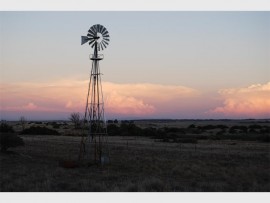
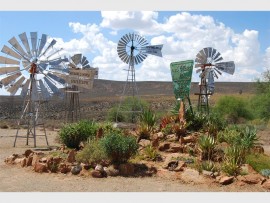
We missed seeing the Fred Turner Folk and Culture Museum as it was closed but we did see the Loeriesfontein windmill or windpump collection. There were so many different models, shapes and sizes, a strange little colony of silvery steel flowers sprouting from the sun-baked earth, their shiny blades rotating gently in the breeze. The impossibly blue sky and fluffy summer clouds formed a perfect backdrop.
Bill and I love windmills. We were thrilled to see so many these slowly vanishing icons of our drylands carefully preserved for future generations to admire.
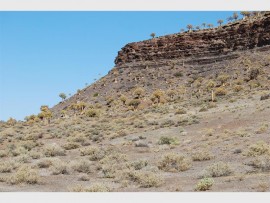
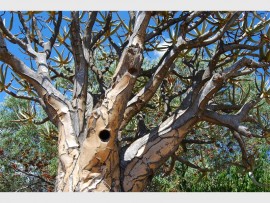
We took a leisurely drive back to Nieuwoudtville, enjoying the scenery and stopping along the way. Although the river was dry the striking gorge and surrounding rocky terrain at the Nieuwoudtville Waterfall Reserve was well worth seeing. We also took time to admire South Africa’s most southerly, naturally-occurring quiver trees or kokerbome – a whole forest of them.
Back in town, we set off on a shopping expedition, which proved most successful. The butcher had good reason to be proud of the local lamb and traditional meat products he sold. We joined the queue at a quaint farm stall selling freshly baked bread and all sorts of pickles, jams and preserves. We nearly got lost in a treasure trove of a junk shop and were delighted to find general dealer stores that reminded us of our childhood.
Our bakkie needed diesel so we stopped at the local filling station. When I returned to our vehicle after a visit to the rest room, Bill had disappeared. I was just starting to think he might have been abducted by aliens when my petrol-head husband eventually reappeared, starry-eyed. He’d been admiring the filling station owner’s amazing collection of about a hundred vintage and veteran motorbikes.
Everywhere we went, the townspeople were chatty and friendly. Heading to the guest farm on the outskirts of the town where we were planning to stay overnight, an elderly man working away in his garden raised his trowel in friendly greeting. A little boy riding his bicycle on the pavement stopped and waved to us and a woman out walking her dog gave us a big, friendly smile. We were beginning to feel like we belonged there.
When we booked into the guest farm, the owner served us tea on her sunny verandah before showing us to our lovely camp site. The level sites, set among little rock gardens and shaded by olive trees, were all equipped with private ablution facilities and kitchenettes, the structures, built out of blocks of sandstone, blending in beautifully with their surrounds. Our site overlooked a windmill and the river that bordered the farm.
By the time we’d set up camp, the shadows had lengthened enough for us to settled down with a well-earned sundowner after our day of happy explorations. When we left the next morning, the old man was already up and working in his garden. He waved us a cheery goodbye and we promised ourselves a return visit to this charming little place.
Fairly recently we did return to Nieuwoudtville and found it as charming and as friendly as it had been on our first visit, but another treat awaited us as we drove into town.
We’d been travelling through Namaqualand hoping to see some of the flowers although it was late in the season and we knew the best of the spring display had come and gone. Wherever we went we’d just missed the best of the flowers but we caught up with them when we reached Nieuwoudtville. We also discovered why the town is known as the bulb capital of the world when we visited its gorgeous new botanical garden.
Created by the South African National Biodiversity Institute (Sanbi), the unstructured , informally laid out Hantam National Botanical Garden is a showcase for many of its famous bulbs – and is a world-class attraction.
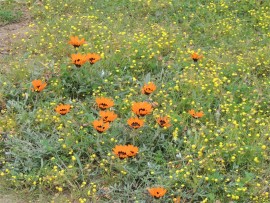
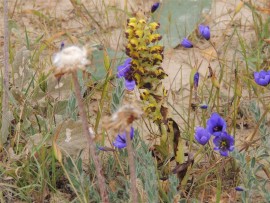
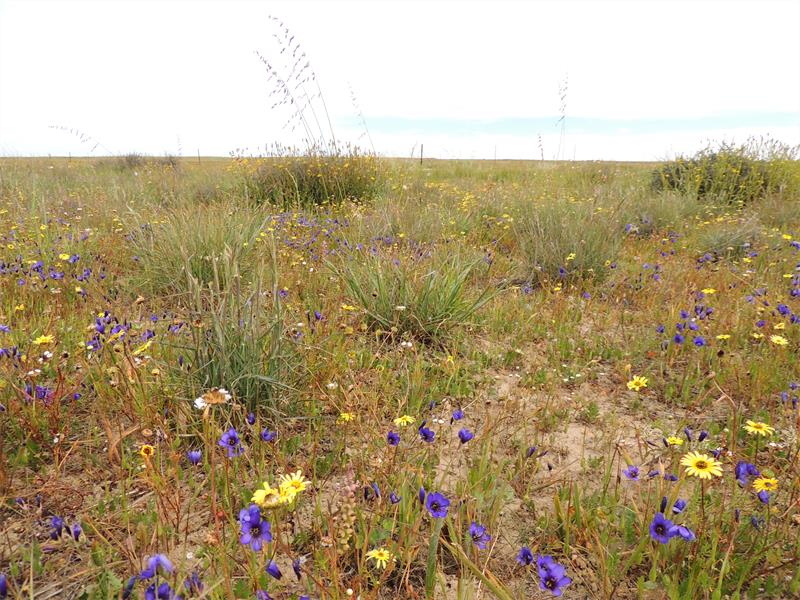
To give you an idea of the town’s floral diversity, an amazing 300 geophytes can be found in that one little area, about a fifth of all of the Cape Floral Kingdom’s bulbs. One of the most beautiful of the town’s bulbs is the Geissorhiza splendidissima, which goes by the common name of blue pride of Nieuwoudtville. A host of other flowers – sparaxis, gazania and arctotis species to name a few – vie for your attention. According to the staff at the botanical garden, whole fields turn into a pink haze in autumn when the Brunsvigia bosmaniae flower.
Glenlyon Farm, the property on which the garden was established, was bought by Sanbi in 2007 and transformed in the institute’s ninth national botanical garden. Unlike the others it is not a cultivated garden as such but has been created to protect the natural biodiversity. There are quite a few walking trails through fields of flowers of every colour and shade. When we were there it was absolutely exquisite.
We also met one of the resident botanists, a young man who had been involved in the establishment of the garden. He was so enthusiastic and generous with his knowledge. The information we gleaned from talking to him made our visit to the garden even more interesting.
On this our second visit, we didn’t spend the night at Nieuwoudtville as we were in a bit of hurry but we stopped at the butchery on the way out of town and bought a couple of lamb chops to toss on a braai. The meat was just as good as we’d remembered it from our first visit- and the people were just as welcoming.