A LINE of bulbuls took turns at the dripping tap, patiently quenching their thirst by sipping the slow-forming droplets of water.
Bill and I had just arrived at the neat, inexpensive, extremely well-run municipal camping and caravan park in Arniston, in the Cape Overberg, South Africa’s most southerly region. It was our first visit to a village that, we were soon to discover, was rich in history, natural beauty and culture. Overall, we agreed, it was the prettiest South African seaside town we had ever found.
We’d had a couple of days of really windy weather so we found a sheltered corner and set up camp. Our camping kit always includes a couple of shallow plastic pot plant drip trays. Taking pity on the thirsty birds, Bill dug them out, filled them with water and placed them under a nearby tree. They make excellent portable bird baths and are a great way of attracting winged visitors to our campsites.
It was amazing how quickly the news spread. Soon we had a constant and varied stream of grateful birds splashing about in our make-shift bird baths. For the rest of our two-day stay, we were able to enjoy excellent twitching from the comfort of our camp chairs. The interesting variety of birds that dropped by was just one of many reasons why Arniston – or Waenhuiskrans as it is also called – was such a special place.

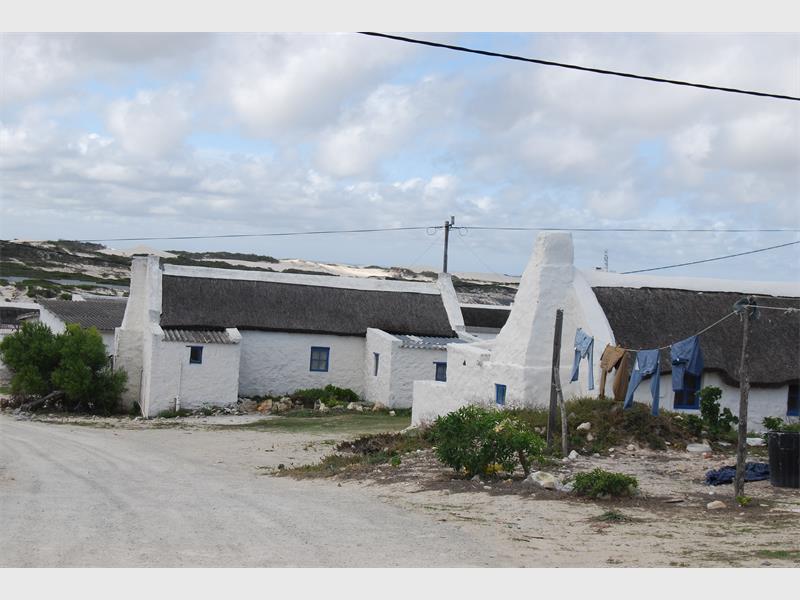
We’d been on the road for quite a while so we decided to park the car and explore the village and its surrounds on foot. It is really the best way to get to know any town. I think most people who have been to Arniston will agree with our high opinion of the picturesque little coastal village. Its most charming feature is Kassiesbaai, a 200-year-old fishing village of stone or whitewashed thatched cottages that has been declared a National Heritage Site. Most of its residents still earn their living from the sea and I doubt their lifestyle has changed very much since the first of the cottages were built.
That afternoon we strolled around Kassiesbaai, admiring the little rocky gardens and the simplicity of the cosy homes. When we chatted to some of the residents they proudly told us all about their village, truly a living museum. The following day we returned to Kassiesbaai to spend the evening at a quaint restaurant where we had an excellent seafood curry, washed down with a good Cape white.
We explored the rest of Arniston and found it just as lovely as Kassiesbaai, its seafront, harbour and neat residential streets all absolutely gorgeous. Arniston’s modern dwellings take their palette from Mother Nature – the clear turquoise sea, the biscuit-tinged sand, the washed-out greys and apricots of the cliffs and rocks and the greens and browns of the surrounding fynbos.
As for the architectural style, the designs of the generally simple but attractive homes often take their cue from Kassiesbaai, echoing the humble fishermen’ cottages and other early buildings. Most of the houses are painted white or are built out of the pastel stone quarried in the area. Doors, window frames and shutters add a little colour. They are generally painted various shades of blue, turquoise or heritage green. The gardens are so pretty, featuring plenty of the Overberg’s indigenous fynbos species. Even the elegant old hotel on the sea-front blends with its surrounds.

When we were there we saw no brash shopping malls or ugly signage marring the gentle charm of this timeless little village – and we hope it will stay that way. There was one tiny shop selling basic supplies. The only bright colour was provided by the brilliant rainbow of painted wooden fishing boats alongside the harbour. Arniston is one of the best examples of a town growing up in perfect harmony with its natural environment.
Walking along the seafront we discovered the story behind one of the town’s names. Like so many names given to our seaside towns, `Arniston’ harks back to a terrible tragedy at sea, reminding us just how treacherous our South African seaboard can be. In May, 1815, the Arniston, a 54m English East Indiaman, hit heavy seas and gale-force winds that separated her from her convoy and shredded her sails. In those days, navigation was not the exact science it is today. For four days her sailors battled the elements then, thinking they had reached Table Bay, they changed course. Too late, they realised their mistake. They ran the ship aground. The Arniston came to grief on the needle-sharp Agulhas Reef, breaking up and ending the life of 372 passengers, including many wounded soldiers. Only six survivors reached the shore. The victims of the wreck were buried in the lonely sand dunes overlooking the site where the ship had foundered and, later, a stone tablet was erected there. The stone has since been moved and incorporated into a small monument on the seafront. It faces the dunes where it originally stood.

The sands of time have covered the wreck, although occasionally it is exposed by the fierce, southeast storms that still batter these windswept shores. We took a closer look at these wild shores when we visited the amazing natural phenomenon, on the outskirts of the town, that gives Arniston its second name. Waenhuiskrans means wagon house cliff. Within this cliff is a massive limestone cave, only accessible at low tide, that is said to be large enough to accommodate the turning around of a wagon with a full span of oxen. The one and a half kilometre walk through the dunes to the cave was a sheer delight. This fragile place of sparkling white dunes, tufted with scrubby restios and grasses, has thankfully earned conservation status as the Waenhuiskrans Nature Reserve.
A pathway down the cliff took us to a rocky beach and the entrance to what we hadn’t realised was the first of two caves. It was impressive, but then we noticed the small opening at the back of the cave that led to the Waenhuiskrans Cave. Wow! This cave was huge! Its high domed roof was weathered in patterns that made it look like the ornate ceiling of a concert hall. Bats flitted around the cave and at its broad, low opening, the sparkling sea reflected watery splashes of sunlight onto the walls. It was such a magical place.

Back at our campsite after our walk to the cave, we discovered that a large group of motor homes had moved into the caravan park. They were all parked together on the upper levels, well away from where we had set up camp. We went for another stroll around the town and came back to find our fellow campers enjoying a lively game of boules. It seemed to end in a shouting match, then everyone went quiet. We spent the rest of the peaceful afternoon communing with our feathered friends until the shadow lengthened with the setting sun, then we took a long, rambling walk through the town to the Kassies restaurant.
The next day we were sad to be leaving, but there is much to see in the Overberg and our time was limited. We packed up camp and apologised to the bulbuls, the pied barbet, the hoepoe, the Cape robins, the confiding pair of boubou shrikes and the assorted weavers, sparrows and starlings for taking away their water supply. Then we took a slow drive to a vantage point in the Waenhuiskrans Nature Reserve. From there, laid out before us like a picture postcard was the town and the bay and the turquoise sea, the almost white beaches and the undulating dunes where the Arniston victims rest. Below us was the rock pools we waded through to reach the magical cave. Arniston or Waenhuiskrans, this town by any name would be as sweet.

HAVE YOUR SAY
Like our Facebook page, follow us on Twitter and Instagram
For news straight to your phone, add us on BBM 58F3D7A7 or WhatsApp 082 421 6033