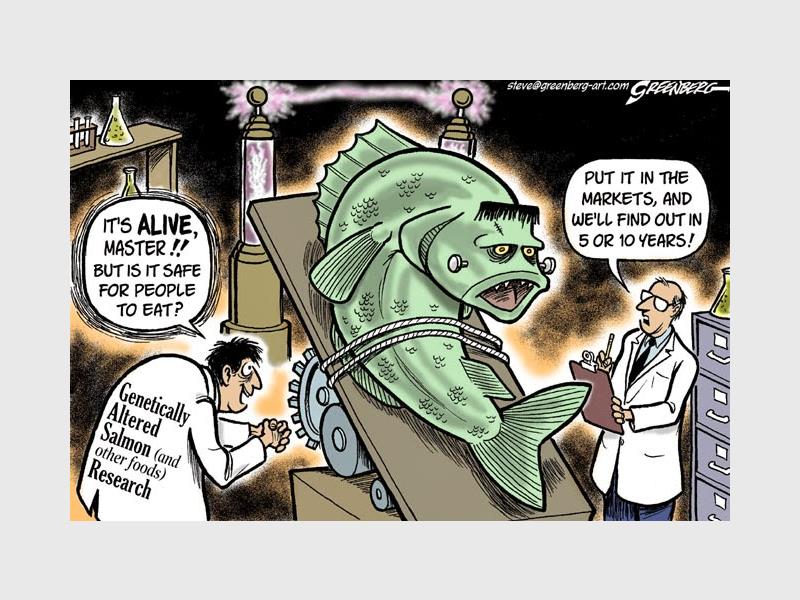
A NEW breed of salmon has become the first genetically modified animal to be approved for human consumption. The species has been approved by the United States Food and Drug Administration (FDA) after 20 years of to-ing and fro-ing.
The new ‘Super Salmon’ is a genetic cocktail of the Atlantic salmon, a slow grower, and the Pacific salmon, a much faster grower, and can reach sellable size in about 18 months, twice as fast as its genetically unmodified Atlantic predecessor.
‘Super Salmon’, known as AquAdvantage, has also had its DNA spliced with anti-freeze protein so that it can continue to grow in the cold North Atlantic throughout the year.
The FDA has imposed all sorts of restrictions on the two companies licensed to breed the salmon, one in Canada and one in Panama, both of which are land-based tank systems designed to minimise the risk of ‘Super Salmon’ escaping into the wild and causing havoc. In its wisdom, the FDA has declared that it need not even be labelled as GM.
In similar vein, the world’s biggest animal cloning factory is about to open in China. It will produce anything from sniffer dogs and race horses to genetic copies of cherished pets, but its main function will be to produce cloned cattle to meet (sorry!) China’s growing demand for beef.
There is apparently nothing new about the commercial cloning of livestock, in the United States they have been selling meat and dairy products from cloned animals since 2008, but it is the sheer size of the project that is overwhelming. The ‘farm’ will cover 14 000 square meters of land south east of Beijing and will start by producing about 100 000 cattle embryos a year, rising to one-million.
As a matter of interest, ‘Super Salmon’ is unlikely to make it to the European Union, where regulations covering GM foods are much more stringent than in the US, and again as a matter of interest, Chinese cloned beef is not likely to make it into European supermarkets either as the European Parliament late last year voted against the cloning of farm animals, mainly out of concern for animal welfare.
I really don’t know what to make of all this or whether I should comment at all. Many of my early formative years were spent on a farm in Devonshire, England, in the 1940s and 50s and what appeared on the dinner table was pretty much what came off the farm – chicken, wild rabbit (my Dad had a shotgun), and every now and then a feast of pork.
The butchering of a pig was a big event in the district with neighbouring farmers coming in to help with the proceedings, which included the making of miles of sausages, the curing of bacon and the salting (lots of salting) of most of the other bits.
It was very much a family and festive affair and would invariably end with a glass of cider and a grilled and very fresh pork sausage or two. I’m quite sure the terms GM and cloning had not yet come into existence. Good. Cheers!
Source: The Week: The Best of the British and Foreign Media.
HAVE YOUR SAY
Like our Facebook page, follow us on Twitter and Instagram
For news straight to your phone, add us on BBM 58F3D7A7 or WhatsApp 082 421 6033