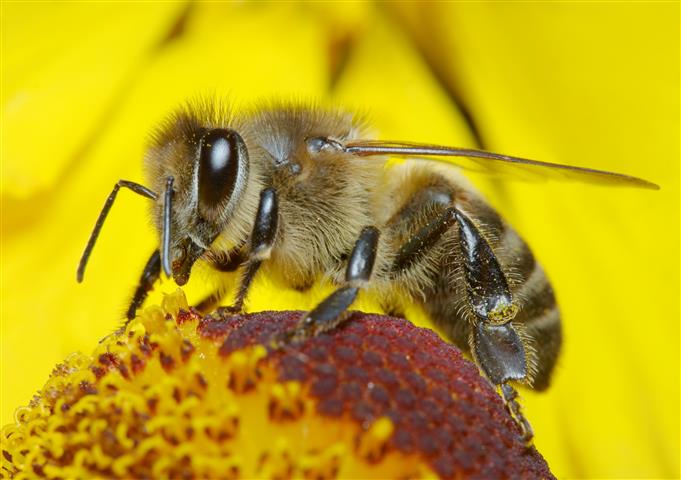
PROBLEMS with global honey bee populations have been making the news for a long time, but a report to hand indicates that the situation is getting a lot worse.
It has been recorded since the early 2000s that honey bee populations in Europe and north America have undergone dramatic changes.
It’s known as CCD, or Colony Collapse Disorder, but scientists are now saying that over the past couple of years honey bee populations have dropped by up to 36 percent in Europe and a staggering 45 percent in the United States of America.
The reasons put forward are many, but the main one is the use of agricultural pesticides, which don’t just kill pests, but honey bees too, and it must be borne in mind that in Europe, for example, more than 80 percent of agricultural crops and wild plants are pollinated by bees.
So, falling bee populations spell a potential disaster as far as food security is concerned, among other things.*
South Africa is not immune, as declining bee populations have been recorded here too.
Interestingly, it seems that man’s association with bees is a very old business.
Researchers at the University of Bristol in Britain have established that people as far back as the Stone Age, around 8,500 years ago, were apparently exploiting bees for their wax and honey and coincidentally that is more or less when settled farming first emerged.
Traces of both wax and honey have been found in archaeological digs across Europe, the Near East and North Africa, and there is even some evidence of bees and humans in prehistoric rock art in those areas.**
Meanwhile, some weeks ago I wrote about the burgeoning world population being a severe environmental crisis.
Well, in a piece of extraordinary irony, considering the report on honey bees and agricultural crops, here’s an interesting comment I have picked up.
A British environmental journalist says that the real population crisis from an ecological point of view is not human numbers but the growth in the global population of farm animals, which is in fact happening twice as fast as human population growth.
He says that raising livestock for human consumption requires vast amounts of natural resources, including 75 percent of the world’s farm land, a third of all cereal crops grown and it accounts for 14 percent of all greenhouse gas emissions (more than all the world’s cars, trains, aircraft and ships put together), a very interesting point.**
On the subject of food, we had occasion to be in Pennington at lunch time recently, and popped into the kiosk there run by the Pennington Conservancy, one of the most active and effective conservation groups on the South Coast.
The kiosk is just one of their many projects and being virtually on the beach, what a great project it is too. Please remember it next time you are up that way, you can support conservation while having lunch and enjoying the view (call 0399752123 for directions). Cheers!
*Care2Causes.
**The Week: The Best of the British and Foreign Media.
HAVE YOUR SAY
Like our Facebook page, follow us on Twitter and Instagram
For news straight to your phone, add us on BBM 58F3D7A7 or WhatsApp 082 421 6033