HAVING packed our tent and spent a second camping holiday in Australia, my husband, Bill, and I feel we are starting to get to grips with this puzzling, paradoxical land Down Under. We first headed for Australia in 2013 to attend my son’s wedding in Sydney, a beautiful city that we thoroughly enjoyed exploring. After the wedding we spent some time camping in New South Wales, staying in magnificent coastal resorts and some lovely inland spots with our family. My son, his wife and their toddler son have now moved to Brisbane so this Queensland city and its surrounds were the focus of our most recent, month-long explorations.
It takes a while to start understanding what Australia is all about. For a start, you need to do a little travelling to realise just how big it is. South Africa, boasting a substantial surface area of 1 221 037 sq km, is dwarfed by Australia’s 7 692 024 sq km. Even Queensland, Australia’s second biggest state, where we spend much of our holiday, is 1 727 000 sq km in size, about 500 000 sq km bigger than the whole of our country. Something that makes it an interesting place to visit is Australia’s huge cultural diversity. Amazingly, one out of four of its citizens was born in another land. The ethnical melting pot is most apparent in the urban areas where society is infused with a spicy mix of assorted Asian, European and British influences.

Australia is also a land of contrast – a country with a bit of a split personality, we thought. We discovered this when we left the rather frenetic coastal areas with their crowded, cultured, cosmopolitan towns and cities to head inland for a while. Here we found small towns with wide streets, open spaces, friendly people and a gentle, less sophisticated rural lifestyle that charmed us with its sense of timelessness.
We also found lots of gum trees.
Although it is a dry continent, some 16 percent of Australia’s surface area is covered with natural forest. Coming from a country where the gums trees are alien invasives and are considered pests, it was difficult at first to get my head round the fact that they were supposed to be there and to appreciate the beauty of the widespread and amazingly diverse eucalypt forests. We are also starting to learn about the other interesting native Australian plants and we were privileged to stumble across some of the continent’s remnant, magical rain forests.

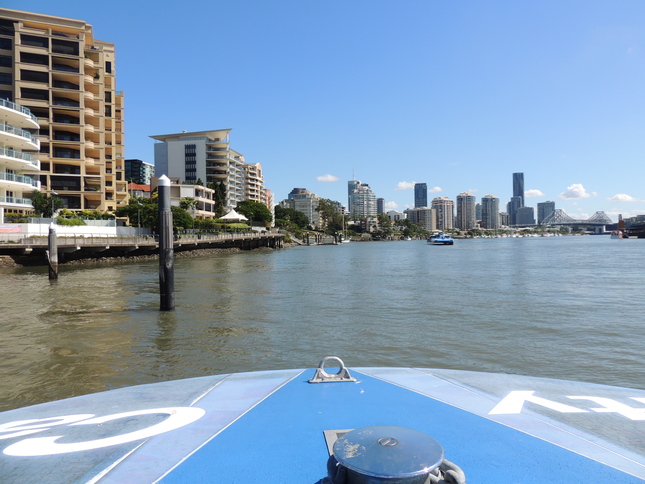
With visiting our family our main reason for being in Australia, we spent quite a bit of time in Brisbane, getting to know this lovely, laid-back city and the curvy river around which it has grown.
We did manage to get away from the city to enjoy two lovely visits to the sunshine coast with our family and two shortish camping trips by ourselves. To tell the truth,“packed our tent”, the phase I used at the beginning of this blog, was a bit of poetic licence.
While in Australia we had the use of our son’s soft-roader, a capable and comfortable Nissan X-Trail, equipped with a rooftop tent and comprehensive camping gear.
Camping in Australia is in some ways rather different to South African travels with a tent but it is fairly easy and not too expensive, even when travelling on South Africa’s diminished rands. Camping sites – and prices – vary enormously. Most of the privately owned camping and caravan parks are extremely well-equipped and comfortable and some of them can be extremely up-market. This time round, we stayed in a few rather lovely middle range parks, which charged around R300 to R400 per couple per night, However, we saved a bit of money as with our pared down camping outfit we did not need electricity so could stay in cheaper non-electrified sites. We also brought down our camping costs by spending a few nights in some of the many free camping sites available. One riverside free camping area was well equipped with toilets, showers and washing up area but usually facilities are pretty rudimentary, often only a long drop toilet.

During our two Australian walkabouts we have managed to find limited camping accommodation in a couple of National Parks and camping fees are very reasonable there although entry permits often have to be purchased, adding to the costs. When in South Africa, we have incredibly easy access to wild places and our tent spends most its working life in the well-equipped, comfortable camping areas in our wonderful national, provincial and private game and nature reserves. However, we did find trying to access Australia’s National Parks and other wild places for an extended camping stay a bit difficult. It is something we will research more thoroughly when next we wander off down under.
Another big difference is Australia’s and South Africa’s camping style. Rigs and camping gear are often very different to the products available in South Africa and it was most interesting to stroll through the camping grounds. Most places forbid open fires but electric or gas barbecues are usually available. Of course, no self-respecting South African would call cooking on these devices a braai.

An Australian phenomenon that is also seen in South Africa, is what they call the grey nomad movement. Many retired folk buy campers and head off on extended travels, sometimes even giving up their homes. They usually have huge caravans, converted buses or motor homes with all the home comforts including toilets and showers. Thus equipped, many of them are able to spend extended periods in the prettier, rural free camping areas, a good way of cutting down their costs of living.
One thing Australian and South African camping areas do have in common, though, is the friendly atmosphere that makes camping in either of these countries such a pleasure. For the next couple of weeks join me for a little virtual camping and exploring in the magical land down under.

HAVE YOUR SAY
Like our Facebook page, follow us on Twitter and Instagram
For news straight to your phone, add us on BBM 58F3D7A7 or WhatsApp 082 421 6033