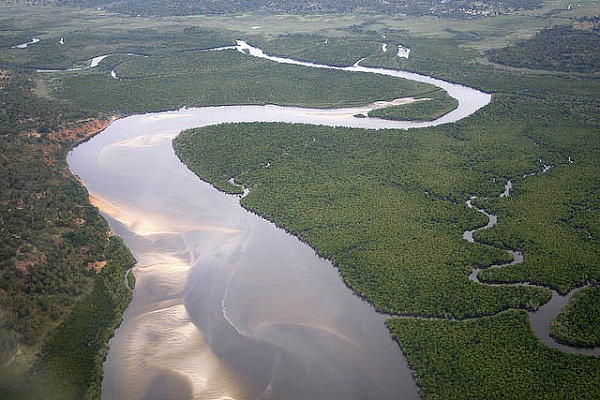
I’M quite sure that anyone who has seen the Limpopo, and many millions of others who have not, know that wonderful turn of phrase by Rudyard Kipling in his Just So Stories, ‘The great, grey-green, greasy Limpopo River, all set about with fever trees’. It is of course quoted in this new book on the River of Gold, as the authors call it.
The Limpopo is not always set about with fever trees, however, as it is generally accepted that its head waters originate on the Witwatersrand, whence it flows gently north-westwards as the Crocodile until it reaches the Botswana border and the Marico River at Olifantsdrif, where it becomes the Limpopo.
From here the river forms the border between South Africa and Botswana, flowing north-easterly now until it joins the Shashe, which in turn forms the north-easterly border between Botswana and Zimbabwe.
The Limpopo now heads east between South Africa and Zimbabwe to cross into Mozambique, eventually to degorge into the Indian Ocean at Xai-Xai. The river’s journey from its source on the gold belt that is the Witwatersrand to the sea, covers about 1,750km.
But of course it’s not just a river.
The authors, Peter Norton, Michael Gardiner and Clive Walker, all of whom are Limpopo aficionados, have spun a tale that not only covers the river, the natural environments through which it flows and its biodiversity, but also the all-important human links to the river, both historical and modern.

There are Bushman rock art paintings in the caves and cliffs along the river, ancient and great kingdoms have grown up on its banks, think Mapungubwe near Tuli, where three modern countries meet, South Africa, Botswana and Zimbabwe, and Thulamela in the northern Kruger.
Then jumping perhaps a thousand years to that extraordinary place, Crook’s Corner, where again three countries meet, this time South Africa, Zimbabwe and Mozambique.
It’s been a trade route for over a thousand years, carrying ivory, animal skins, copper, iron and even gold from the interior to meet Arab traders on the coast bartering glass beads, textiles and other goods from the East. From its source to the sea it has also been the stamping ground of hunters, adventurers, colonists and soldiers.
Rivers of Gold is full of wonderful photographs by Peter Norton and Clive Walker, Clive’s inimitable paintings and sketches, and regional maps. There are also many historical photographs.
There are important notes on birds and birding, other wildlife, fish and even cattle (an economic necessity to so many of the people living along the river), geology and the dreaded tsetse fly. It’s an enthralling read for those who love their history, but it’s also a great reminder of the importance of water in general to the whole of southern Africa, and that would include the fragile river system, riparian environments and international agreements, and other areas of significance, like catchments and wetlands.
It’s a great book, get it and read it. Cheers!
Rivers of Gold: Narratives and Exploration of the Great Limpopo, Peter Norton, Michael Gardiner and Clive Walker, Jacana, Johannesburg, 2015.
HAVE YOUR SAY
Like our Facebook page, follow us on Twitter and Instagram
For news straight to your phone, add us on BBM 58F3D7A7 or WhatsApp 082 421 6033