BRISBANE, the capital of the Australian state of Queensland, is all about the glittering, serpentine river that winds its way lazily through the heart of the city. My younger son and his family live in the suburb of Coorporoo, about 4km south east of Brisbane’s compact but high-rise central business district, so on our recent Australian walkabout we spent quite a bit of time exploring this eye-catching, modern city. We liked its multicultural nature, its relaxed, laid-back feel, its striking Queensland and modern architecture and its gentle country manners but most of all we loved the way the river dominated it, both geographically and spiritually. The city was named after the Brisbane River and it grew up around this impressive waterway, its central business district nestled into a river bend.

When we first explored the glorious river frontage we did so in disjointed bits so it was initially difficult for us to form an overview of Brisbane’s premier tourist attraction. We made acquaintance with the river and its frontage at the South Bank parkland where we did a parkrun soon after arriving in Australia. With its bougainvillea-lined arbour, man-made beach, wonderful water playground and its extensive gardens it was most impressive. This area is also something of a cultural centre. We also did a parkrun at New Farm Park, a quieter but particularly nice section of the riverfront. Initially a farm, this park served as a race course from 1846 until 1913 when the city council took it over. Also situated there is the Brisbane Powerhouse, now used as a striking theatre complex. Davies Park is a bit of a mecca for sporty types, with outdoor gyms, boat clubs, walkways, cycle tracks and facilities for other outdoor pursuits. It also hosts a regular Saturday morning market. We did a lovely long early morning walk there and we also visited the market after completing the New Farm parkrun.

However, extensive paths, walkways, cycle tracks and pedestrian bridges make the whole of the river frontage a magnet for walkers, runners, strollers, pram pushers, well-behaved leashed dogs and cyclists so it is no wonder that Brisbane has a very outdoorsy, keep-fit sort of culture. There is plenty of opportunity for outdoor pursuits and most the people who live in the city seem to take advantage of this.
A lively pavement cafe, coffee-drinking culture thrives there, too.

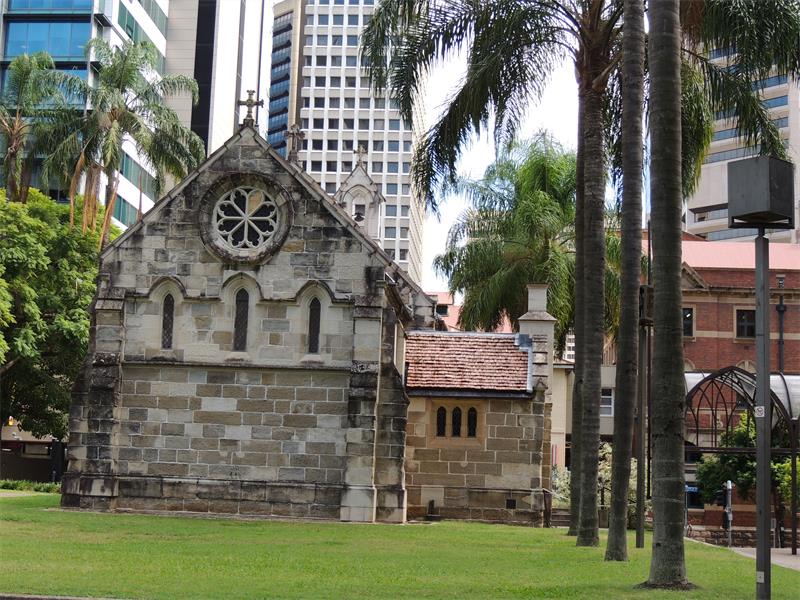
The central business district with its impressive skyscrapers almost has its feet in the water so is very much part of the river frontage. We spent a day exploring this area. One of the particularly interesting buildings was the magnificent Cathedral of St Stephen and its pretty little chapel, built in 1842. A beautiful, rough-hewn statue of Mary MacKillop, Australia’s only saint, can be seen there. It was sculpted by John Elliot out of a sliced up then reconstructed,100-year camphor laurel tree and reflects the tough pioneering environment in which she worked.

Another interesting section of the river frontage is Teneriffe. once the centre of Australia’s thriving wool industry. Today, the handsome, well-maintained woolstore warehouses, now converted into premises for restaurants, malls and offices, are reminders of this area’s former economic importance. During World War II the Teneriffe wharves served as Australia’s largest submarine base, too. Right next to the somewhat frenetic business area, another world is to be found in the peaceful, elegant riverside Botanic Gardens, also known as the city’s heritage gardens. They were established in 1855 and have a lovely, somewhat old-fashioned layout with formal gardens, ornamental ponds, a bamboo grove and some wonderful old trees collected from all over the world. We also visited the Brisbane Botanical Gardens at Mount Coot-tha and were particularly impressed with their indigenous plant displays and a perfectly lovely little Japanese garden.

It was the river, though, that most impressed us, but it has at times been cursed by the people of the city. Because of its slow, curvy nature it is prone to flooding and has on occasions wreaked watery havoc in the business area. The construction of the Wivenhoe Dam has helped a bit but three major floods have occurred fairly recently, in January 1974, January 2011 and January 2014. Perhaps January isn’t the best time to visit Brisbane.

The source of the Brisbane River is Mount Stanley, 344km from where it enters the sea at Moreton Bay. We took a drive out to Wellington Point which extends into this bountiful bay. It was a pretty, the tan shades of the low tide mud flats mingling with the perfect turquoise and blue of the crystal clear sea. We met a local family there and the young father told us stories about growing up in that once-isolated, peaceful spot. We also took a drive out to where the lower reaches of the river and Fisherman’s Island become the Port of Brisbane, Australia’s third most important port.

Towards the end of our stay we took a long river ride on the CityCat ferry, all the way from the Apollo Road terminal to St Lucia, ducking beneath the 16 road, railway and pedestrian bridges that span this wide water way. People hopped on and off all the time and we could see that the ferries were a well used part of Brisbane’s well-developed public transport system. Quite a few tourists were, like us, simply riding the CityCat for the fun of it. However, by riding the ferry we at last felt we had got to grips with the river. Our magical ferry ride had melding together our many snap shot impressions of the beautiful waterway at the heart of a beautiful city.

HAVE YOUR SAY
Like our Facebook page, follow us on Twitter and Instagram
For news straight to your phone, add us on BBM 58F3D7A7 or WhatsApp 082 421 6033