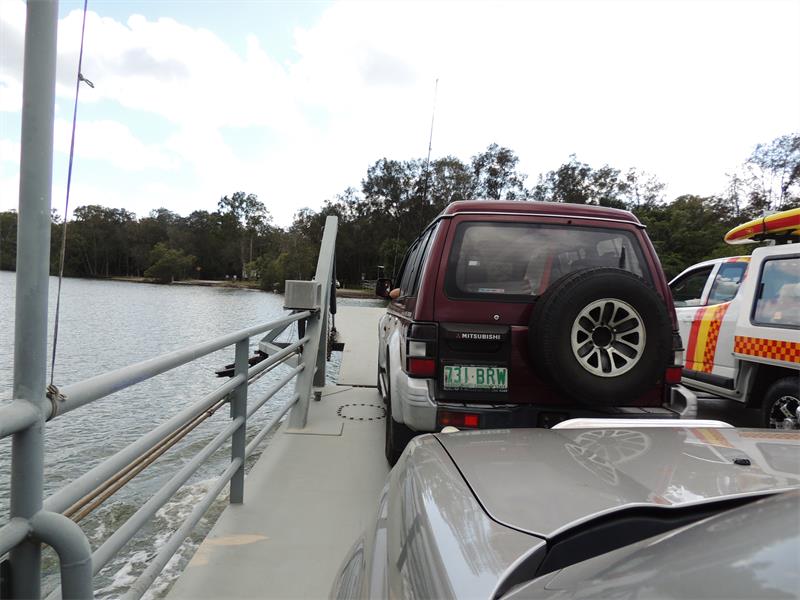
THE queue for the ferry across the Noosa River Estuary was short. Soon we were heading across the water and into the Cooloola Recreational area of Australia’s Great Sandy National Park. Divided into two distinct sections, the park boasts plenty of gorgeous beach, impressive sand dunes, heathlands, rainforests, swamps, streams, fresh water lakes and mangroves. The Cooloola section is a broad swathe of protected coastline and its immediate hinterland, about 18 400ha in size, between Noosa Heads and Rainbow Beach in the north.
The other section is the 56 000ha Fraser Island, north of Rainbow Beach. We’d been told it was absolutely beautiful and were sorry that time restraints would mean we’d have to give Fraser Island a miss. Our drive through the Cooloola section would have to suffice. We’d had such a lovely long weekend with our family in beautiful but busy Noosa. Now we were looking forward to some wide open space, in the form of an approximately 40km drive along the pristine Cooloola beach.
I must say, coming from South Africa where the beach driving ban seems to have had such a positive effect on our shoreline environment, we did feel a bit uncomfortable as we turned off the road onto the sand.
Cooloola beach drive.
However, we were soon exhilarated by the sense of freedom as we headed towards the misty horizon along that perfectly straight, perfectly beautiful bit of shoreline. There was quite a bit of traffic around – more than we’d expected. We’d been warned that speed limits and other road rules applied along this regularly patrolled beach route but with speed limits ranging between 35km and 80km, pretty fast for beach driving at the best of times, we didn’t think many drivers would fall foul of the law. It was such a beautiful beach. The fine, white sand, so great for driving along at low tide, bordered a perfectly clean sea and some high vegetated dunes. It was still Queensland school holidays and there were quite a few large encampments in the designated camping areas. We’d been tempted to camp somewhere along this route, but we were due back in Brisbane in just four days, so our time was limited and we needed to push on a bit further that day.
View from Hervey Bay.
At the Fresh Water camping area we turned off the beach and followed a sandy road through a section of eucalypt forest. Soon we were back on tar and returning to civilisation. Ready for a lunch break, we decided to take a look at Hervey Bay, a delightful little town with a pretty, neatly maintained beachfront. The wind had picked up and was blowing quite strongly but we found a sheltered corner for a picnic lunch, then we headed towards Bundaberg, best known for its massive rum distillery and for its renowned ginger beer. Needless to say, rum and ginger beer is a popular concoction in this corner of Australia. A modestly sized Queensland city on the Burnett River, it was attractive, with good infrasgtructure. With the strong wind we thought an inland rather than a coastal campsite might be an idea but didn’t find anything that really appealed to us. Instead we found a sheltered corner to set up camp in the picturesque little village of Burnett Heads, just north of Bundaberg, at the mouth of the Burnett River.
Heading inland along the Fresh Water Road in the well-named Great Sandy National Park.
We stayed in the simple, well-equipped and beautifully maintained Lighthouse Holiday Park, overlooking the town’s little harbour and a stretch of grassy flats. It was a tranquil little resort, not too crowded, that offered us some interesting birding and lovely coastal views. After puzzling out the workings of our son’s roof top tent – much newer and easier to erect that the one we have at home – we set up our first camp of our holiday then took a delightful little stroll along the shoreline and into the attractive little seaside village. The wind had dropped by the time we returned to our campsite and we were able to enjoy a warm, pleasant evening out of doors before heading off to bed.
Our first night under canvas set the tone for a great four days of camping.
The propeller of the1 625 tonne Cherry Venture that came to grief near Hervey Bay in 1973 during a 125km per hour cyclone. The 14m high seas and heavy rain drove her onto the beach. The captain, the 24 crew members and two pet monkeys survived.