YES, I’m afraid it’s yet another World Day, this time for the world’s beleaguered oceans and although it was officially on June 8, I can still report some positive developments.
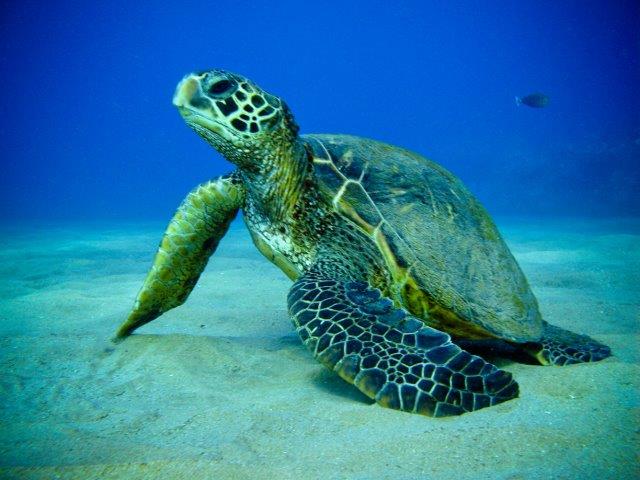
Firstly, the National Marine Fisheries Service and the United States Fish and Wildlife Service have announced that the green sea turtle is making such a good recovery that it can actually be downgraded from ‘endangered’ to ‘threatened’ on local listings.
Their particular concern is the green sea turtle populations that nest on the beaches of Florida and on the Pacific coast of Mexico.
Sadly, the green sea turtle is globally still listed as endangered, one of the main reasons being rising sea levels causing the loss of vital nesting beaches in other parts of the world, a direct result of global warming.*
Green turtles may be found off South Africa’s shoreline from the Cape Peninsula right up to northern Zululand and on into Mozambique.
We have seen one in a tiny inlet in the Mkambati Reserve in the Transkei, but I also have a very happy memory of a pair of green turtles off the Comores in the Indian Ocean beyond Madagascar.
I was on assignment to the islands (my career has sometimes led to some really tough assignments) and during some free time I went out on what I think was called a pedalo with a colleague.
We were on the western coast of the main island, the Grande Comore, and had paddled quite far out when we saw the green turtles below us.

We both dived off the pedalo to spend a few wonderful minutes swimming with the turtles, which didn’t seem to mind at all, and then decided to get back on board and head for the beach.
Have you ever tried to scrabble aboard a pedalo in deep water? It was a very awkward experience, but at least we had swum with the turtles.
Ocean news from London is that the British government is to create a marine reserve in the South Atlantic that will be almost as big as the UK.
The reserve will cover about 230,000 square kilometres, more than half the waters around Ascencion Island, a British Overseas Territory.
Fishing in the reserve will be prohibited, protecting some of the world’s biggest blue marlin, rare sea birds and significantly, green turtles.**
More news from the UK capital is that a blue belt of protected waters is to be created around the British Isles.
The 23 new marine conservation zones (MCZs) will cover a total of nearly 11,000 square kilometres, where local fishing vessels will be allowed to operate, but not industrial fishing boats.
The main MCZ will be what has been described as Britain’s Great Barrier Reef, a 35km long chalk ridge rich in sea life off the Norfolk coast and another near Land’s End in Cornwall, which will protect whales, dolphins and turtles.**
Good news all round I would say. Cheers!
*Care2Causes.
**The Week: The Best of the British and Foreign Media.
HAVE YOUR SAY
Like our Facebook page, follow us on Twitter and Instagram
For news straight to your phone, add us on BBM 58F3D7A7 or WhatsApp 082 421 6033