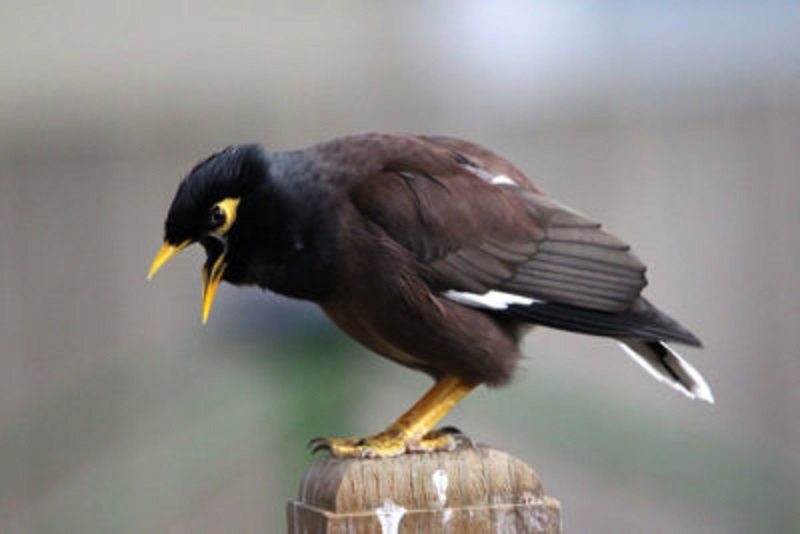
FEW would argue that the Indian mynah is a desirable addition to our already remarkable diversity of avian life – nearly 900 species on the sub-continent, about 10 percent of the world’s total.
Yet it is here and here to stay.
It probably came across from the Indian sub-continent in the 1860s along with the great influx of migrant workers from that region.
It spread from Durban throughout much of what was then Natal and up onto the Highveld, following urbanisation, becoming a firm and permanent part of the urban jungle.
Sadly, it seems to like people.
Its origins are a region stretching from Afghanistan to South East Asia, and although we call it the Common mynah, it is in fact a member of a whole group of mynahs, including the Bank, the Jungle, the White-vented and the Hill mynah, although the Common is the most common.
It’s a remarkable bird – although it’s an alien it is arrogant, aggressive and just plain cheeky.
It drives other birds, our own birds, from our gardens and in general just takes over.
When we lived in Johannesburg we were in a constant state of war with the mynahs, being firmly on the side of our own indigenous avifauna.
The trouble is, the mynah has its fans.
Like the parrot, it can be taught to speak in a very limited way, and like parrots, usually not the choicest of language either.
Anyway, the old hide was happily free of them, but then the old hide was pretty much free of people too, so held no attraction for the mynahs.
But here they are, in the new hide, which is in a somewhat more urban situation.
Of course, the Indian mynah is not the only avian illegal immigrant.

The house sparrow, which everyone knows and usually equates with the good old Cape sparrow, the mossie, is an illegal that is pretty much ubiquitous in South Africa.
Then there’s the house crow, also often confused with our indigenous crows, and they are a problem in parts of KZN and around Cape Town.
The common starling, or European starling, is another one and found throughout much of the west, the south and the east of the country, while the common pigeon is the one that is also known as the urban or the feral pigeon.
So, keep an eye open for these birds and please don’t encourage them.
And now for something completely different.
It’s reported from Phnom Penh that the Cambodian royal turtle might be in such trouble that there may be as few as 10 individuals left in the wild.
They exist only in the Sre Ambel River and the main problems are the raiding of the nests for eggs by the locals and illegal logging along the banks, leading to habitat destruction.
The local authorities are trying captive breeding programmes and trying to educate the locals to leave the nests alone, but it’s an uphill struggle and the Cambodian turtle is probably doomed.
Cheers!
*Birds of India, Grewal, Harvey & Pfister, Christopher Helm, London, 2002. **Care2Causes.
HAVE YOUR SAY
Like our Facebook page, follow us on Twitter and Instagram
For news straight to your phone, add us on BBM 58F3D7A7 or WhatsApp 082 421 6033