STILL revisiting memories of camping in South Africa, let’s take a virtual trip back in time to one of South Africa’s greatest natural treasures, a place I believe has the potential to rival Kruger National Park as a tourist attraction. On our recent trip to Tembe Elephant Park recently, Bill and chose the route via Mbazwana, then did a small detour into the Coastal Forest section of a wonder-filled place, KwaZulu-Natal’s World Heritage Site, the iSimangaliso Wetland Park. We travelled through a cool green tunnel alongside the huge vegetated dunes, catching glimpses of Lake Sibaya from time to time. As we’d left home very early that morning, we were more than ready for breakfast by the time we reached the lakeside picnic spot.
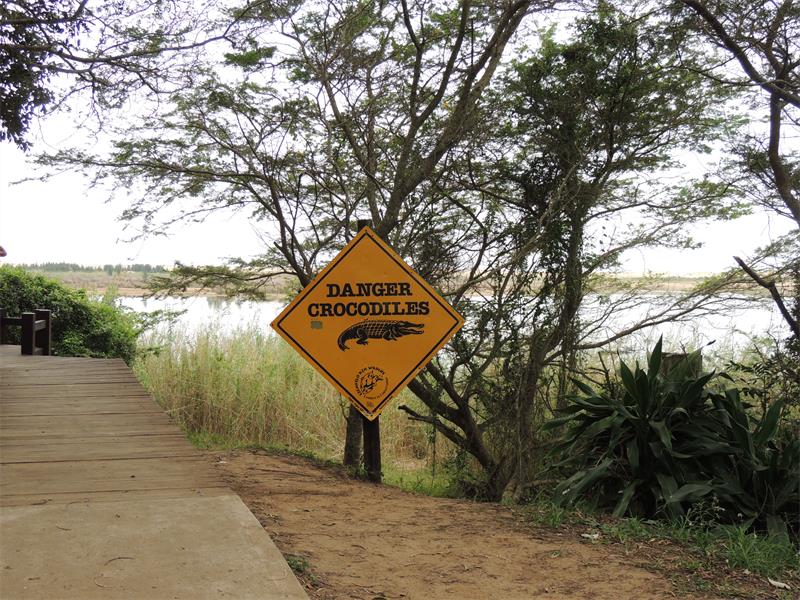
Lake Sibaya is South Africa’s largest freshwater lake and is home to a huge population of hippos, crocodiles and various water birds.
It is a place of great beauty, its aquamarine water edged by snowy white sands, and it well deserves to be officially recognised as one of iSimangeliso’s ten jewels. In case you are wondering, the other nine are Kosi Bay, the Coastal Forest, Sodwana Bay, uMkuze, False Bay, the Western Shores and Charters Creek, Eastern Shores and Cape Vidal, Maphelane and, its centrepiece, the magnificent Lake St Lucia. What an amazing variety of habitats the wetland park has to offer. Visiting any of these wonderful and varied iSimangaliso components is always is a treat and over the years we have spent many happy hours exploring sections of this vast conserved area. While I was enjoying our lakeside al fresco breakfast I found myself remembering a rather special visit to the wetland park, many years ago.

We were travelling around our beautiful province with Bill’s sister, Rosey, and niece, Nikki, from England, both of whom have African roots. We found the ideal way to introduce them to Lake St Lucia, one of our province’s most amazing natural treasures and the largest estuarine lake in the world. Along with a League of Nations assortment of foreign tourists, we hopped on board the good ship Santa Lucia and proceeded to cruise the estuary’s sparkling waters. It was great fun and proved to be a truly wondrous little cruise.
Not long after setting off our guide drew attention to a massive crocodile, sunning itself on the nearby bank.
Everyone rushed to the side of the boat to see it. Oblivious to the battery of cameras firing away at it, the super-reptile seemed to take its celebrity status for granted. I couldn’t help wondering if he regularly posed for tourists as a bit of a publicity relations exercise. I hoped so. The Lake St Lucia area was, at that time generally under-appreciated by both domestic and foreign tourists. Soon a pod of harrumphing hippo drew the attention away from the croc, with the tourists scurrying over to the other side of the boat to take a look.

We chugged along this wild and beautiful waterway, until our trusty vessel reached the turning point. Ahead was a no-go area for tourists. I could only imagine how wild and wonderful the lake ahead of us would be, free of human imprint, uncluttered by tourist facilities. How I would have loved to wander further into the pristine heart of this great estuarine lake. And yet, as we headed back to the launching site, the curio shops and the neat tourist facilities at the entrance of the town of St Lucia, I was happy to know that large, pristine sections of this green wonderland remain inviolate.
Today, much of the World Heritage Site still remains untouched and, much to our joy, more land has been added and reclaimed.
Over the years we have watched with joy as thousands of hectares of thirsty exotic tree plantations have been banished and more and more territory added to the park. Massive rehabilitation programmes have wrought miracles and many animals that once strolled or prowled the grassy plains and forests have been reintroduced. Humans also have benefited. Since that long ago visit to iSimangaliso, tourist facilities have been dramatically improved and the park really offers today’s visitors a world-class wildlife experience.

I still remember hearing that the Greater St Lucia Wetland Park, as it was then known, had been declared a natural World Heritage Site in 1999. This recognition was well deserve. It truly is a global treasure and its new name, iSimangaliso, suits it perfectly. It means ‘a marvel’ in Zulu, a good description of this massive green wonderland on the northern coastal plain of KwaZulu-Natal. Today, the park stretches all the way from the southern end of the St Lucia Estuary northward to Mozambique. In the near future this extensive complex will be part of an even greater conservation initiative, a peace park that will be known as the Ponta do Oura-Kosi Bay Transfrontier Conservation area, shared between South Africa, Mozambique and Swaziland.
Already a huge and varied patchwork of wilderness, it is about 328 000 hectares in size, making it South Africa’s third largest conservation area.
It encompasses an amazing variety of different eco-systems, including the massive estuarine lake, its lush eastern and drier, fossil-rich western shores, 280km of pristine, dune-lined coastline and adjoining marine reserve and the vast Mkuze Swamps. Here can also be found inland lakes, rivers, grassy planes, mangroves, soggy wetlands, dune, coastal and riverine forests, savannah, thornveld and even mountains.

The sand dunes that line the pristine shore are natural works of art, some 30 000 years in the making. They are the highest vegetated dunes in Africa, some of them exceeding 180m in height. With such a wide variety of habitats, the park sustains a rich, diverse mix of fauna and flora. Mammals found within the park include elephant, hippopotamus, lion, leopard, black and white rhino, many antelope species, buffalo, whales, dolphins and a host of smaller creatures. Once a year, some 500 loggerhead and 150 leatherback turtles come ashore to lay their eggs on the beaches within the park. The coral reefs and diverse marine life make the coastal resorts magnets for anglers and divers. Birders, too, have plenty to chirp about. As can be imagined, this kaleidoscope of habitats make it a twitcher’s heaven – and a paradise for flower people and anyone inclined to hug trees.
Soon after our recent breakfast break alongside Lake Sibaya, we left the wetland park and headed towards Tembe.
On the way home again, a few days later, we enjoyed a final short sortie into iSimangaliso, doing a quick drive through the recently opened Western Shores section. It is a particularly lovely drive, made all the more enjoyable by the knowledge that what is now rolling coastal grasslands and swampy wetland, was once sterile exotic plantations. Thinking back to our early visits as we enjoyed the Western Shores drive we realise, once more, just how much has been achieved over the years by all those dedicated to making iSimangaliso the global attraction it deserves to be. It has been a long haul, but they have all achieved a massive conservation victory.

HAVE YOUR SAY
Like our Facebook page, follow us on Twitter and Instagram
For news straight to your phone, add us on BBM 58F3D7A7 or WhatsApp 082 421 6033