
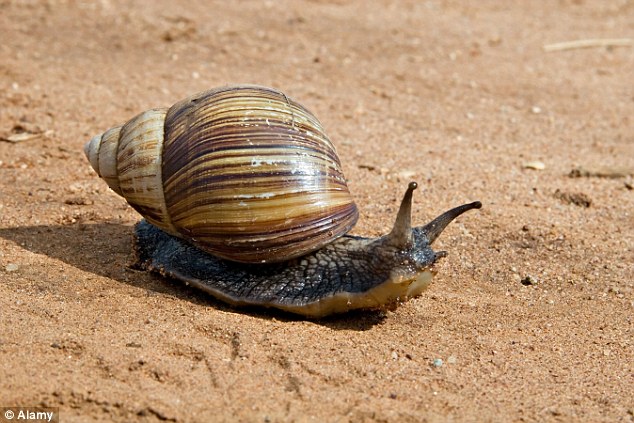
I HAD a phone call from a reader in Ramsgate the other day enquiring about the giant African land snail and its habits.
We had a most interesting chat about the snails and what they get up to, and it sent me on a search for information.
Apparently the giant African land snail (Achatina fulica) is a significant pest virtually worldwide.
It hailed originally from East Africa – Kenya and Tanzania – but it spread throughout Africa and as far afield as India, the Himalayas and the Indian Ocean islands, China and the Pacific Islands, the West Indies and North and South America.
Its wide distribution came through the pet trade (a pet snail?), because it was and is a food source and by accidental introduction.
It is a voracious feeder, but a vegetarian, causing extensive damage to agricultural crops and indigenous vegetation.
It’s a nuisance in domestic gardens and can even spread human disease.
In fact, it is one of the top 100 invasive pests worldwide.
It’s a formidable creature, reaching an overall length, including its huge shell, of 20cm.
The shell coloration is highly variable, but it’s the size that is the giveaway, if you see it you’ll recognise it.
They are not, however, Dear Reader of Ramsgate, cannibal or even carnivorous.
Having said that, we do have lots of cannibal snails.
A wide variety of snails are predators, hunting down their prey. Many are cannibal, but not all of them.
There is, however, one species that very definitely eats its own kind and it glories in the name of the common cannibal snail (Natalina caffra).
It is a large snail reaching an overall length of 15cm, including its large shell, and it is to be welcomed in the domestic garden because it is another voracious feeder on other, smaller snails, which are in themselves a garden pest.
Apparently it creeps up on its victim, slowly, I would imagine, pounces and eats it whole.
The common cannibal snail is also protected, so leave it alone.
As a matter of interest the common brown snail (Helix aspersa) is an introduced species originally from Britain, south western Europe and the Mediterranean region.
It arrived in South Africa in a barrel on a French warship that stopped off in Cape Town in about 1850 (it presumably formed parts of the officers’ diet).
A French priest stationed in Cape Town bought the barrel full of snails with the intention of introducing them as a food source in the Cape Colony.
For some inexplicable reason the idea did not catch on and the snails became naturalised South Africans.
It’s a pity they never caught on because today table snails are only available in expensive tins from various parts of the world, including France of course.
I must confess to really enjoying them, grilled and quite naturally covered in traditional garlic and parsley butter, soaked up with crispy bread.
Bon appetit and cheers!
Sources: Wikipedia and Suburban Wildlife in KZN, Jason Londt, WESSA KZN, 2009.
HAVE YOUR SAY
Like our Facebook page, follow us on Twitter and Instagram
For news straight to your phone, add us on BBM 58F3D7A7 or WhatsApp 082 421 6033


