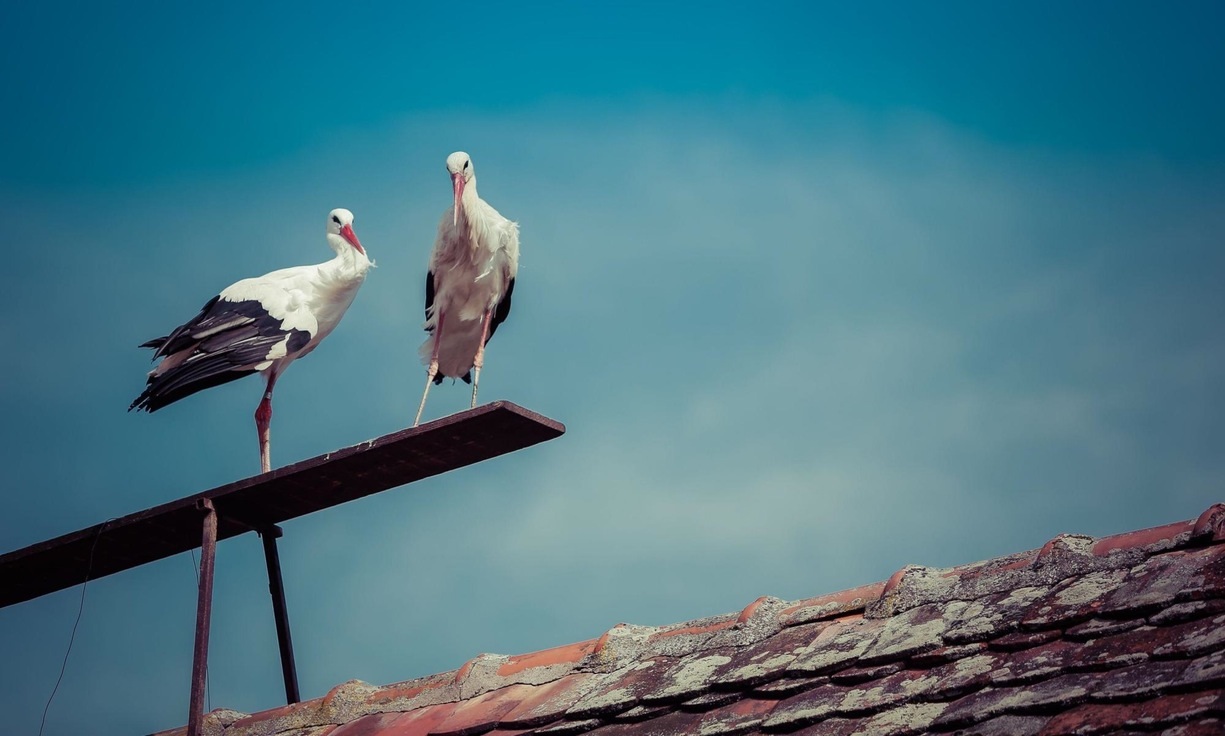
OUR skyline is dominated by three birds; the hadeda, the woolly-necked stork and the Egyptian goose, all really interesting birds in their own right.
I’ve dealt with the hadedas in this column – except perhaps to point out that the other day we had two of them trying to squeeze into our standard size bird bath, looking rather silly in the attempt, so perhaps we’ll look at the woolly-necked stork this week.
Like the hadedas and the Egyptian geese, they perch on surrounding rooftops, keeping an eye on things.
They tend to stand on one leg, rather like a Maasai warrior leaning on his spear waiting for an unwary lion to amble past, and they march around the place, usually in pairs, inspecting the roads and paths, and of course the lawns.
According to Roberts,* their main diet is large insects, frogs and lizards, also molluscs and crabs, which they are unlikely to find in the lawns.
I also happen to know that they like cheese, preferably a good cheddar.
A friend of ours in Trafalgar has a pair of woolly-necks which come to the front door regularly for a cheesy snack.
Interestingly, they take the proffered cheese, march over to the fish pond and dip it in the water before swallowing it.
And that’s not the only tale of cheese-eating woolly-necks I’ve heard either.
They range through much of Africa south of the Sahara, including South Africa of course, and then through parts of tropical Asia, such as Indonesia and the Philippines.
They are migratory, but some of them prefer to put up with what we on the South Coast call winter – ours are clearly in that category.
Unlike the hadeda and the Egyptian goose they are not noisy birds, but go about their business with quiet dignity.
Even as I type, there are five of them standing in a row on a nearby rooftop, as my wife put it, clearly a stork party.
What a pleasure to have them around.
And staying with storks, from Croatia comes a story if not of love, most certainly of devotion.
A male white stork has been returning to the same rooftop and nest in the village of Slavonski Brod for 14 years, after his lonely migratory journey for the South African spring, 8,000 kilometres away.
His homecoming is always to the same female crane, which was badly injured by a hunter 14 years ago and which still cannot fly properly.
Every year they have a clutch of eggs and rear a pair of chicks before he takes off yet again for South Africa.
They have become celebrities in Croatia and their every move is followed with keen interest and reported in the national media.**
What a delightful story, and behavior that many human couples might think of emulating.
Meanwhile, watch out for the white storks in spring this year, one of them must be a Croatian. Cheers!
*Roberts Bird Guide, Hugh Chittenden, John Voelcker Bird Book Fund, Cape Town, 2007
**Daily Mail online.
HAVE YOUR SAY
Like our Facebook page, follow us on Twitter and Instagram
For news straight to your phone, add us on BBM 58F3D7A7 or WhatsApp 082 421 6033