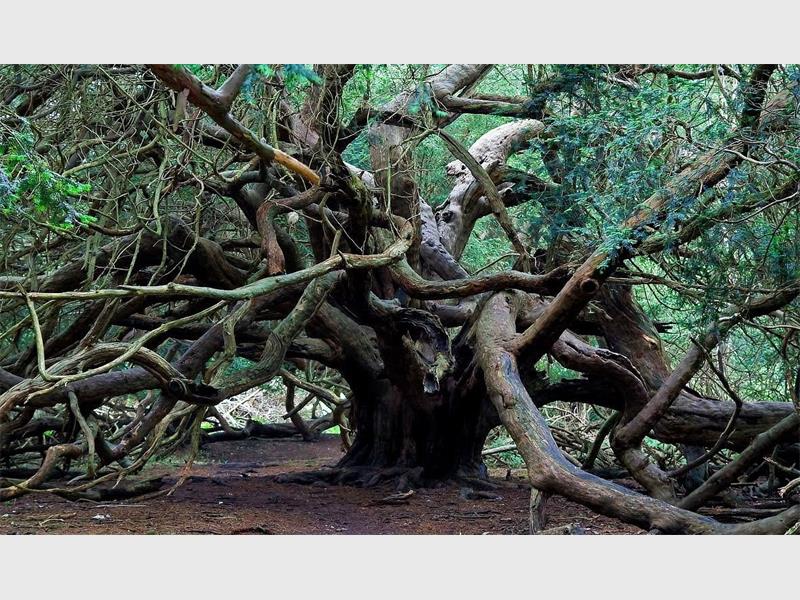
TREES are just wonderful things, a great source of joy, interest and (in this case) news.
An interesting bit of conservation combined with history crossed my desk the other day.
A deep valley filled with a forest of ancient yew trees in the county of West Sussex in England has been declared a nature reserve just for the trees.
The yews are at least 500 years old and might be much older, some of them possibly going back to Roman times.
The yew tree had become almost extinct throughout Britain and northern Europe by the late 1500s because it was the favoured wood for the famous long bow.
The long bow in the hands of English archers became almost a WMD (Weapon of Mass Destruction) in the 14- and 1500s, winning battles and fame for England (think Agincourt in 1415).
The English long bow could kill at a range of 800 metres and could easily penetrate body armour, so it was indeed a fearsome weapon.

The Kingley Vale Nature Reserve also protects fallow deer, butterflies and flowering plants such as orchids. It all sounds rather pleasant.*
It is understood that another famous weapon, the Zulu assegai or Ixwa, was the cause of the decimation of the forests that once covered much of what was then Zululand.
Shaka re-armed his fledgling army with his designer spear in about 1816.
This required a great deal of charcoal to fuel the forges in which the spears were made and that charcoal had to come from somewhere.
Also, the tree now known as the assegai tree, Curtisia dentata, was the favoured wood for making the shaft of the stabbing spear.
Today the assegai tree is a popular garden plant and the bark is also very important in traditional medicine.
It is a protected tree.

Moving on, the next CITES (Convention on the International Trade in Endangered Species of Fauna and Flora) meeting or COP 17 (Conference of the Parties) starts in Johannesburg later this month and high on the agenda will be elephants.
The poaching of elephants for their ivory has become such a major problem in both Africa and Asia, although it’s worse in Africa because elephants here are simply so much more numerous and widespread, that organisations like CITES are focusing more and more on efforts to save the species.
As a matter of interest, in the 1930s there were perhaps 5-million elephants in Africa, but that figure is now something like 400,000.
About 100 elephants are killed in Africa every day for their ivory, which eventually finds its way onto the illegal international market.
This means that within about 10 years the African elephant will be gone forever.
So bad has the poaching crisis become that it is now rated fourth in the line-up of international crimes, behind drug trafficking, illegal currency deals and human trafficking.
Something really does need to happen if the children of today want to see elephants in the wild – what a thought.
*This England magazine.
HAVE YOUR SAY
Like our Facebook page, follow us on Twitter and Instagram
For news straight to your phone, add us on BBM 58F3D7A7 or WhatsApp 082 421 6033