IT would seem to be an incontrovertible fact that no one enjoys a visit to the dentist, except possibly the dentist.
A member of the household has just been to the dentist (a relatively pain free and perfectly amicable visit, I hasten to add), but it sent me in search of a little history of dentistry.
Firstly, take courage in the fact that things have improved in that area over the years.
However, archaeologists in many parts of the world are working on startling new evidence that very early man practised dentistry.
In Italy they have been studying a skull that is 14 000 years old and there is definite evidence that the poor chap had been to the dentist.
One of his teeth had been scoured out and scraped clean with a flint micro-tool, or similar, in what must have been an attempt to remove rotten tissue.
An interesting aside here, people living before about 10,000 years ago, when all men were hunter-gatherers, had very little trouble with their teeth, presumably because of their very natural diet (you picked it and ate it or killed it and ate it).
At 10 000 man started to settle and farm, which meant the growing of grain, which in turn meant the large-scale consumption of carbohydrates and the beginnings of serious problems with the teeth.
In Pakistan, the discovery of a 9 000 to 7 500 year old burial site has revealed a stock of skulls, and yes, many of the owners had been to the dentist.
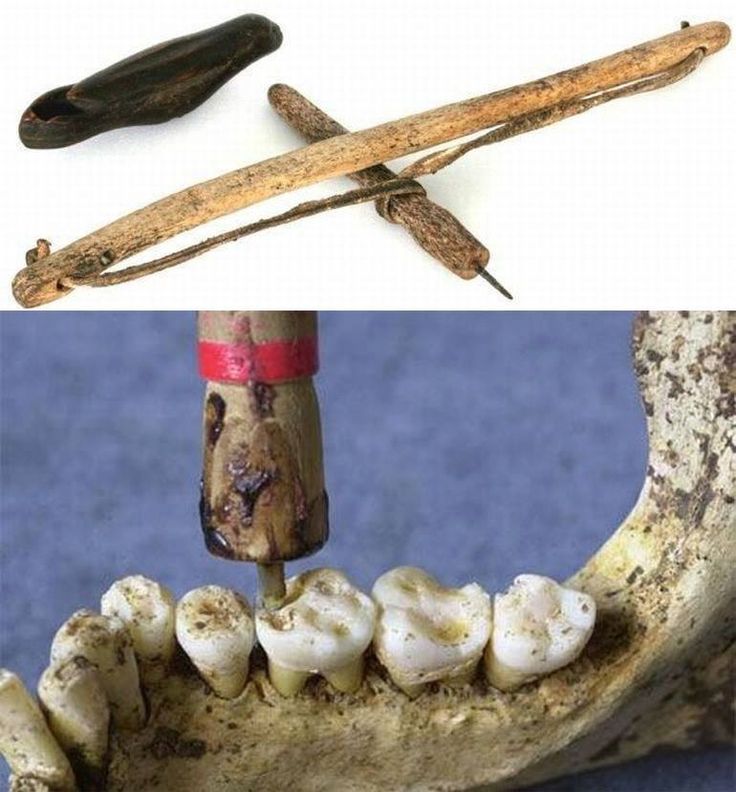
Some of the bad teeth had obviously been drilled. A 9 000 year old drill, before we had invented the wheel or writing?
Apparently so.
The device was almost certainly a bow drill.

You may have seen them in the making of fire – a vertical rod tipped with one of those flint micro-tools (for dentistry), then a traditional miniature bow with the string looped around the vertical stick; pull the bow back and forth and the vertical stick will spin at high speed.
The Pakistanis have tried it and it works, drilling a hole through human tooth enamel in seconds.
In Peru some 650 years ago, before the arrival of the Spanish, exactly the same method of drilling out cavities was used, but with the added twist that the ancient dentist may well have prescribed coca leaves (from which is derived cocaine) to act as an anaesthetic.
Finally, what about fillings?
Well, there is evidence that beeswax was sometimes used – it is malleable so may be squeezed into small holes, but apparently sets hard and stays hard once it is at body temperature.
So, when next you have to go to the dentist, realise that it could be worse.*
But leaving the dentist’s chair far behind, a tiny Arctic tern has set a new record for a migratory flight, by flying 96 000 kilometres from Northumberland in England to the Weddell Sea in the Antarctic and back.
This 100 gram morsel of a bird was tracked by scientists at the University of Newcastle, who attached a miniscule device to one of the tern’s legs.**
What an amazing journey. Cheers!
*BBC. **The Week: The Best of the British and Foreign Media.
HAVE YOUR SAY
Like our Facebook page, follow us on Twitter and Instagram
For news straight to your phone, add us on BBM 58F3D7A7 or WhatsApp 082 421 6033