OUR braai at peaceful Tsendze Rustic Camp, after another action-packed Kruger day, was interrupted by an apparent hijacking attempt by a short, stocky guy, with peroxided hair – and a lot of attitude. He apparently hangs around Tsendze so keep an eye out for him next time you are there. If wildebeest are the clowns of the animal world then this little fellow and his ilk are the thugs. They are endearing thugs, to be sure, but you don’t mess with a honey badger. That is why when we were first alerted to his presence by a strange noise coming from beneath our vehicle, we weren’t quite sure what to do.
We shone a torch in the direction on the noise and saw a snarly little muzzle resting on a pair of dainty paws equipped with a formidable set of long black claws.
Quickly we shut the camper’s sliding side door but didn’t notice the driver’s door was slightly open. Our mischievous visitor did notice. He scuttled out from under the vehicle and slid into the driver’s seat, resting those formidable claws on the steering wheel, looking, for all the world, like he was planning to drive our vehicle away. Okay, now what? It really was an amusing sight but the last thing we needed was a badger in our vehicle. Knowing his fierce reputation we didn’t want to provoke him and anyway, if we tried to evict him we might inadvertently chase him further into the vehicle.

That was the last thing we needed. A badger in a confined space can wreak havoc without blinking an eye. For a while we kept our distance and our uninvited visitor seemed to consider his options. Then, much to our relief, he calmly slid out of the vehicle and strode off in the direction of the neighbouring campsites. In the morning we discovered he’d taken out his frustrations on a rack of pots and pans and dishes left to dry overnight outside the caravan next door.

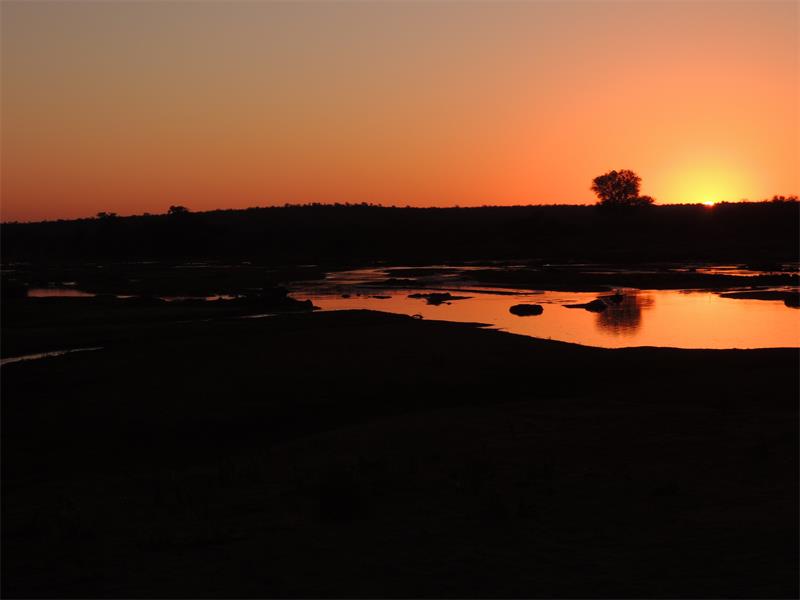
Our encounter with the honey badger wrapped up a day of excellent game viewing that started almost as soon as we’d left Balule. We were back on the road when the gates opened and we stopped on the drift to marvel at a most magnificent dawn. Heading along the H1-5 towards Letaba through a section of rugged, rocky terrain, we were thrilled to spot two dainty klipspringers. They are my favourite antelope and are such beautiful little creatures. Small, stocky, spiky-haired and yellow-grey in colour, they leap about on their tippy toes and are amazingly agile.
They are so well adapted to their rocky homes.
I always think of the big, popular Letaba Rest Camp as the gateway to Kruger’s exciting northern areas. I was reminded of this when we started travelling through stands of the multicoloured mopani trees that are so much a part of the northern landscape and its unique sense of space. How I love the mopani, a tree that can be short and scrubby and rather untidy but, given the right conditions, grows tall and slender. These dark-limbed trees are best seen in spring when they put on their seasonal finery and the undulating mopani woodlands turn copper, orange, yellow and acid green. Letaba has one of the nicest day-visitor areas in the park, a large, roomy well-treed area equipped with plenty of sheltered picnic benches. It is also a great birding spot so breakfast there was a rather drawn out affair.

We could have continued along the H1-4 to Mopani Rest Camp, where we had to book in for Tsendze. It would have been the shortest route. However, we had decided on a long detour, along the tarred H9 to Sable Hide via Masorini picnic site then north along the H14 and back onto the H1-6 to Mopani. All the same, you can’t leave Letaba without stopping on the Letaba River Bridge, where you can alight from your vehicle and peer at the river from the rails. You have to do it. This is one of Kruger’s time-honoured traditions.
The bridge is only a couple of kilometres from Letaba along the h1-6 so it was hardly out of our way but the game viewing and the lovely scenery from the bridge and the riverside loop roads was just too amazing for words and this little detour took us quite a while.The Letaba River is just so magnificent and not far from the bridge we came across another hippo carcass, this time attended by a large flock of white-backed vultures, a pack of hyenas and quite a few marabou storks. As confirmed tree huggers, we also enjoyed acquainting ourselves with some of the magnificent green giants growing alongside the river. Kruger’s mighty riverine trees are among its many marvels.
The dry, scratchy, rocky Masorini area was a contrast to the well-watered, tree-endowed Letaba area but it really is quite breathtaking in its own way.
It is harsh country and the strange, grey tepee-like termite mounts that litter the landscape add to the other-worldly feel of this place. For some reason the zebras always seem to like this area and quite a sizeable herd had gathered at the Masorini waterhole near the picnic site. Their black and white stripes, dulled by a layer of dust, provided the perfect camouflage against the grey mud surrounding the pan. I love the Masorini picnic site that nestles at the foot of a rocky hill. Although it is situated in such a harsh, hot area, it has a wonderful atmosphere, perhaps because it has been a place of human settlement for many centuries.

Some implements found there date back to the stone age but its more recent inhabitants were the Baphalaborwa who made a living from smelting iron ore and producing iron goods. Their late Iron Age village, near the picnic site, has been restored and there are regular guided walks to see it. There is also a small museum in the picnic grounds. After our Masorini lunch break we stopped at Sable Hide, a pretty spot overlooking a dam that has happy memories for us. We have twice spent a night in blissful isolation at this, one of Kruger’s two ‘sleepover hides’. It is highly recommended.

The last leg of our trip for that day, north along the H14, was another very pretty route, through mopani and riverine woodlands interspersed with more scrubby areas. We were still seeing plenty of ellies and quite a bit of general game and towards the end of this route we came across a bit of a lion traffic jam. However, the big cats, five of them, were quite a distance away, sleeping in the long grass and hardly visible from the road. We decided not to linger as we’d been on the road for many hours. Eventually we reached the modern and very attractive Mopani Rest Camp where we booked in at Tsendze after stopping at Shipandani Hide to watch a big herd of buffalo come down to the river for a drink. A couple of youngsters in the herd were indulging in a rather boisterous game of tag, much to the disapproval of some of their elders.
We also took a quick look at Pioneer Dam from its hide, but nothing much was happening there and it was now 3pm so we decided it was time to set up camp.
After such a long day on the road it was wonderful to spend the rest of the afternoon beneath the Mopani trees at Tsendze, one of the park’s newer camps and an incredibly peaceful and beautiful little bit of heavenly wilderness. Tsendze is designed for campers who wish to avoid the busier camps and who want to get away from the madding crowds. Kept as rustic as possible, it offers simple, basic facilities (including lovely outdoor showers), no electricity, shops or restaurants and plenty of roomy, shady and private camping sites.

Tsendze also offers an abundance of natural beauty and wonderful wildlife. It is a particularly good birding spot and is well known for its resident owls. Sadly, we didn’t spot any during our overnight stay there but we heard both the African scops owl and the pearl-spotted owlet during the night. And then of course there was our special visitor. It was ages since we’d seen a honey badger, so we were quite delighted when he interrupted our supper, even if he did cause us a few anxious moments. Seeing him was a great way to end such a lovely day of exciting game viewing and an amazing variety of stunning scenery. What a truly wondrous place is our Kruger National Park.
Even its thugs are cute.