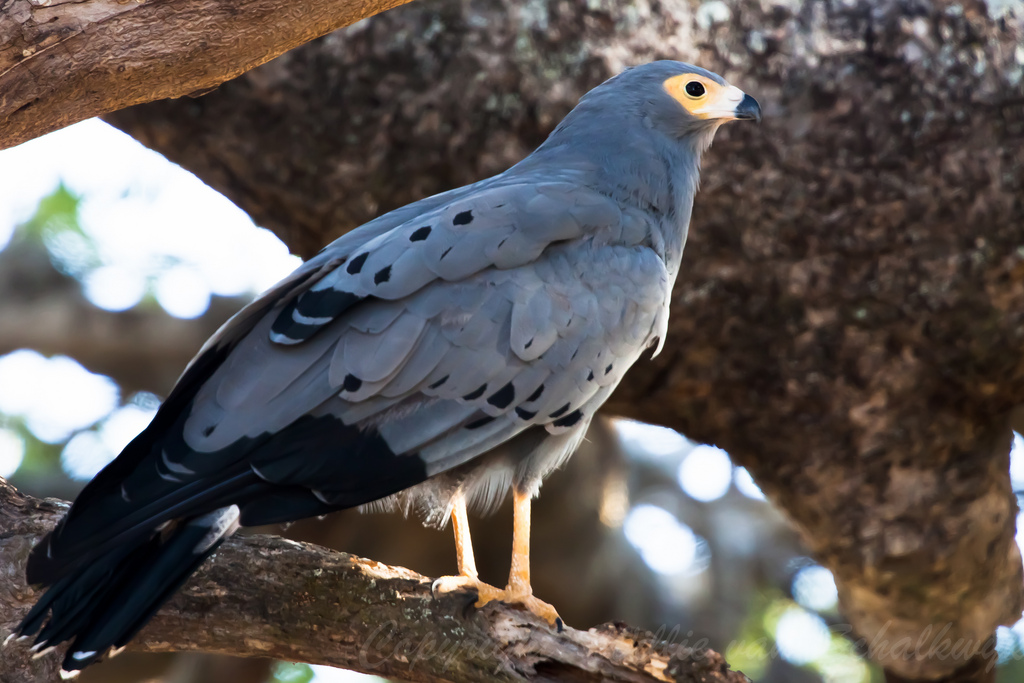
WE were sitting over a cup of coffee in the Hide the other day when there was a loud crash in the fanned fronds of a nearby palm tree.
We didn’t need the binoculars to tell us what had happened – it was a crash alright, a gymnogene had made a crash landing.
We have of course seen gymnogenes (African harrier hawks) in the bush, but have never associated them with a semi-urban situation.
They are spectacular birds, specialising in the robbing of other birds’ nests for eggs and nestlings with its adapted legs.
We’re not at all sure what this one was after as all that was visible at the top of the palm tree were the fruits.
We spotted it a couple more times and it made a great addition to our bird list.
Another avian visitor, actually more of a permanent resident, is the pin-tailed whydah.
We had difficulty identifying him at first, but the game was given away when he suddenly started growing his characteristically long tail.
We’ll have to keep an eye on him because the cock birds are notorious bullies, claiming sole rights to feeding spots for himself and his hareem, and we certainly don’t want that.
As a matter of interest, with summer now fully upon us garden pests abound.
Do not use chemicals that kill wildlife, like birds, along with the pests.
Check with the nursery or other supplier where you buy the pesticide and make sure that it is wildlife friendly.
There are options, however. That great birder, Ken Newman, has the answer: “A really safe garden spray for flowers, vegetables and fruit can easily be made at home. To 20 litres of tepid water add a heaped tablespoon of bicarbonate of soda, two tablespoons of Jeyes Fluid and one-fifth of a bar of blue mottled soap. The soap must be flaked and thoroughly mixed into the solution”. *
Good old Ken, he is sorely missed.
Staying with birds, everyone loves a talking parrot, they are the stuff of legend, ask Monty Python.
African grey (YouTube)
There was a pub down here that had one, Squeaky, until recently and she (I think) was the star attraction.
Sadly, however, the parrots of today may be the last of the line.
It’s reported that the world’s most popular pet parrot, the African grey, is facing extinction in the wild.
The problem is the international pet trade and although there have been restrictions in force since 2009, tens of thousands of African greys are captured in the rain forests of West and Central Africa every year and are smuggled into South Africa, Europe, the Middle East and China.
Apparently these intelligent birds may fetch anything up to perhaps R18,000 in the pet trade, but it’s a trade that is seeing them facing extinction.**
A very birdy column this week, but then birds are the most common form of wildlife that can be enjoyed by us all without having to leave home, or the Hide.