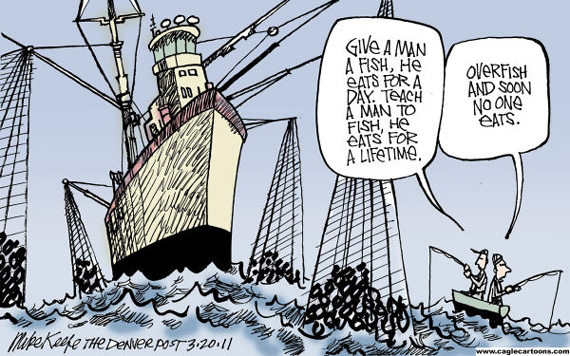
MARINE scientists have again issued a warning about the permanent damage to the world’s oceans being caused by over-fishing.
They have pointed out that the high seas (those areas not covered by national territorial waters) cover about 64 percent of the world’s oceans, and under international law are described as a common heritage of all mankind, and yet less than one percent of that area is formally conserved.
This means that there is a general plunder of the high seas by the world’s fishing fleets, particularly by countries like the United States, France and Spain.
The industry is worth in the region of R240-billion a year, resulting in over-fishing of about 90 percent of the high seas’ fish stocks to sustainable limits or beyond.
They say that the best case scenario would be a total ban on fishing on the high seas, but realistically that is not going to happen, so the concentration should be on limiting catches and much better policing.
More commercial fish farming would also help (farmed fish now accounts for more than fish caught on the high seas).
As a matter of interest, demand for fish is rising with every human being, and there are now 7.4-billion of us, each eating 20kg a year.
The scientists have called for greater international control of fishing on the high seas by limiting subsidisation of national fishing fleets, particularly by the richer countries, and the establishment of far more MPAs (Marine Protected Areas).
Many countries with coastlines have these, but it has been recommended that they be hugely increased to cover perhaps 30 percent of the world’s oceans.
As an example, last year Britain declared the world’s largest MPA, an area over 20 times the size of the Kruger National Park, around the Pitcairn Islands in the South Pacific.*
A specific example of environmental problems with the oceans comes from Melanesia, that’s the area surrounding Papua New Guinea, the Solomon Islands, New Caledonia, Vanuatu and Fiji in the south western Pacific.
This huge section of the Pacific is under threat because of over-fishing, human population growth and climate change.
A WWF (World Wide Fund for Nature) report says this section of the Pacific is in environmental decline, with physical and chemical conditions changing faster than at any other time in history, and not for the better.**
As far as South Africa’s seas and our fishing industry are concerned, next time you buy fish or shellfish, note where it originated and whether it is farmed or wild caught, you may be surprised at the result.
A cursory survey here showed us that there is farmed fish from Vietnam, a variety of shellfish from China and India (farmed, presumably) and Argentina, and if you always wanted a Patagonian meal but never made it there, you can buy Patagonian prawns.
A final one with a sting in the tail, on the coast famous for its Greatest Shoal on Earth, the sardines are from Portugal.
Cheers and bon appetit!
PS: South Africa has 24 MPAs covering about 15 percent of our 3,000km coastline.
*The Economist, **Daily Maverick.
HAVE YOUR SAY
Like our Facebook page, follow us on Twitter and Instagram
For news straight to your phone, add us on BBM 58F3D7A7 or WhatsApp 082 421 6033