RECENTLY, when the Umtamvuna Honorary Officers held a delightful info day at Umtamvuna Nature Reserve, near Port Edward, we decided it was the perfect excuse to pay this scenic spot a long-overdue visit.
We’d hoped to do one of the reserve’s scenic and interesting walks but the weatherman was not being very co-operative and we decided not to brave the mist and rain. Instead we chatted to the honorary officers, enjoyed a boerewors roll breakfast with them and looked at their interesting displays. Sunshine would have been nice but the misty reserve had a special magic that day. I was reminded once again of how physically beautiful and intriguing was this remote and very special place.

Rugged Umtamvuna Nature Reserves, administered by Ezemvelo KZN Wildlife, is situated in the deep gorge carved into the rocky ground by the Umtamvuna River, the natural border between two provinces. Geographically, the nature reserve falls within KwaZulu-Natal but its heart is in Pondoland in the Eastern Cape.
As a haven for plant life it is of immense importance as it falls within what scientists call the Pondoland Centre of Endemism. In laymen’s terms this means it is part of an internationally recognised botanical hotspot, boasting a huge variety of grasses, wild flowers, trees and shrubs, many of them not found anywhere else on earth – and new plants are still being found in this wondrous floral region.

In fact Umtamvuna is a flagship of one of South Africa’s most valuable areas of plant diversity, right up there with the much-touted Cape Floral Kingdom.So don’t expect to drive around, ticking off the big five, when you visit Umtamvuna. For a start, there are no real tourist roads in the reserve, just a network of short walks and more challenging hiking trails.
You will probably encounter troops of wary baboons and perhaps some antelope, small mammals and reptiles. Primarily, though, Umtamvuna is a floral reserve and you need to stroll it to appreciate fully what it has to offer. Outside the reserve, mankind and his activities have impacted on the Pondoland centre. Sadly, in unprotected areas, humans have probably hurried to extinction plants that have never even been discovered. That is what makes Umtamvuna so very important and so very interesting when you walk its trails.

The whole of the Kruger National Park boasts about 2 000 plants, quite an impressive tally. Now consider this. Relatively tiny Umtamvuna gives shelter to about 1 250 flowering plants, including about 300 trees and shrubs. It is simply amazing!
Many of the plants in the reserve are extremely rare, including a large forest tree with the Latin name of Catha Abbottii, only discovered in 1986. It is named after a South Coast botanists who is inextricably linked with the reserve. The late Tony Abbott dedicated much of his adult life to collecting and classifying the plant life in the reserve.

Tony, assisted by a wonderful group of local `flower people’, was also the curator of the herbarium at Umtamvuna, a gift to South Africa and an indispensable asset to scientific research. As I always do when I visit the reserve I think of Tony, a true gentleman with a wonderful sense of humour and a profound love of the natural world. Fortunately he was always so generous with his knowledge and his legacy lives on in the many people who gained from his teaching and in whom he instilled an abiding enthusiasm for the grassland floral treasures.

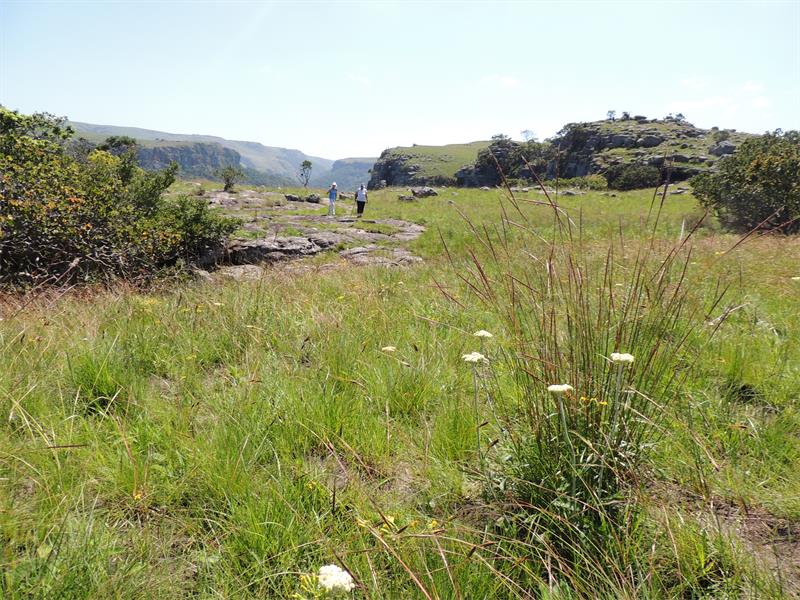
So, you are not a tree hugger? You don’t have to be to appreciate this wild and wonderful place. Even if you can’t tell a daisy from a daffodil, you would be bowled over by the reserve’s spring wild flower display. Every year the extensive grasslands are transformed into a multi-coloured patchwork quilt. The rolling terrain is also dotted with rugged outcrops of weathered rock, sheltering scrubby trees and shrubs. These attractive features add to the beauty of the reserve and provide shady resting places when walking the more challenging of the trails.

The forest sections are cool and inviting on a hot summer day. Walk slowly, though, and quietly. Seemingly empty, the forested sections are alive with small creatures – shy forest birds, tiny blue duiker, rare samango monkeys and many more.
Grassland, forest, scrubby outcrops, kranses, rivers, springs and wetland – the reserve boasts many different habitats. And a variety of habitats means a variety of birds. With more than 250 different feathered species- and a good selection of `specials’- the reserve has a well-deserved spot on the Southern KwaZulu-Natal Birding Route.
The best way to appreciate Umtamvuna is to go armed with a stout pair of walking boots, a hiking stick (there are many steep sections) and a broad-rimmed hat (the gorge gets pretty hot in summer).

However, don’t let that put off the less gung-ho nature lover. You can drive right up the picnic shelters next to the new information centre at the Beacon Hill entrance. Take a quick look inside the centre where a display of Tony’s flower photographs will give you an idea of why the reserve is so important. Then unpack your picnic hamper, light a braai fire and, without taking another step, enjoy the beauty, the birdsong and the unspoilt sense of wilderness that make Umtamvuna Nature Reserve the very special place it is.
HAVE YOUR SAY
Like our Facebook page, follow us on Twitter and Instagram
For news straight to your phone, add us on BBM 58F3D7A7 or WhatsApp 082 421 6033