ELEPHANT once walked alongside the Umzimkulwana where this unassuming river has patiently cut a deep, forest-filled, 24km gorge into the surrounding sandstone. The elephants are no longer there but an echo of their ancient path remains. It has been turned into a good tarred road through the Oribi Gorge Nature Reserve. Recently Bill and I took a drive out to the Oribi area to visit the inaugural Oribi Farmers Market and enjoyed the privilege of driving along this, perhaps the most beautiful road in Southern KwaZulu-Natal. I remembered that it was not just the elephants we had to thank for it.
Before it was built, the farmers on the surrounding Oribi Flats were cut off by Oribi Gorge from the coastal town of Port Shepstone.
In 1917, a footpath through the gorge was widened to give them better access to town. A causeway over the river was built in 1920. It wasn’t until 1932, after much lobbying of Government by the Oribi Flats farmers that the present tarred road, which follows the old elephant route through the gorge, was finally constructed. It is such a gorgeous road. It winds its way through pristine indigenous forest, across the river via the low-level bridge then up again out of the gorge to the grassy plains beyond. In places, it narrows into a cool green tunnel where samango monkeys play.
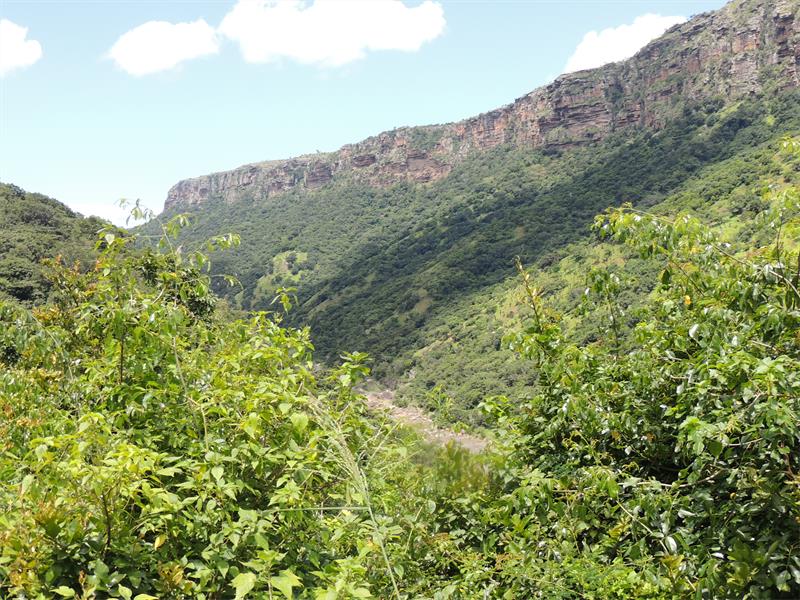
View of the gorge from the Baboon Trail viewsite,
Massive cliffs, the walls of the narrow gorge, tower over the bridge and nearby picnic area. Driving through the gorge is always a treat. The 850ha Oribi Gorge Nature Reserve, through which the road runs, is 22km inland from Port Shepstone. It was proclaimed in 1950 and is administered by Ezemvelo KZN Wildlife. A little off the beaten tourist track, it is one of South African lesser known beauty spots and is one of the destinations on the Southern KwaZulu-Natal Birding Route.
Although the economy of the community surrounding the gorge relies heavily on agriculture, in recent years the area has rapidly opened up to tourism.
More and more people are discovering the reserve and its lovely setting. We love spending a night or a weekend camping at the reserve’s hutted camp, next to the start of the road through the gorge. It is a charming, unsophisticated camp that offers stunning views of the gorge, tranquility and a wonderful natural experience. Camping facilities are basic but more than adequate and there are chalets, a rustic cottage and a rather upmarket lodge available if you don’t want to camp.
The towering walls of the gorge.
The camping sites and chalets are surrounded by mature trees and an attractive indigenous garden, which in turn attracts an amazing variety of birds.
Many of the trees, shrubs and aloes are labelled, much to the delight of visiting tree-huggers. The Oribi hutted camp is also the start of the reasonably easy 1km circular Baboon Walk. The first half is flat as it winds through flower-filled grasslands to a viewpoint above the gorge. If you are spending the night in the reserve, this is the perfect sundowner spot. After the viewpoint the trail drops steeply into dense coastal forest. However, the descent is stepped and the climb out of the forest, back to camp, is gradual.
The Umzimkulwana River has patiently cut a deep gorge into the surrounding rock.
The Baboon Walk is just one of the many walks and hiking trails criss-crossing the reserve. Some are quite challenging and all are interesting as Oribi Nature Reserve shelters a wide diversity of fauna including about 250 species of birds. With many `specials’ flying around and waiting to be ticked, it is one of the premier birding spots in the region It is the best place in KwaZulu-Natal to see the Knysna woodpecker and it boasts a string of interesting endemics including Natal francolin, Knysna turaco, chorister robin and Barratt’s warbler.
A green tunnel through the gorge.
The Oribi area is also home to a breeding colony of Cape vultures and these endangered birds are carefully monitored by Oribi farmer, Mike Neethling. He maintains a feeding station on his farm and offers visiting birders and other groups fascinating talks on vultures at the ‘vulture restaurant’. Recently, our local birding club, Birdlife Trogons, and Ugu South Coast Tourism erected the Barry Porter Hide overlooking the feeding station.
It has become a major tourist attraction in our area but to safeguard these amazing birds access to the hide is strictly controlled through the co-ordinator of the project. Contact 072 8933794 for details.
The Oribi Gorge Nature Reserve hutted camp.
The reserve is also a botanical treasure house, filled with semi-deciduous forests, vegetated rocky outcrops and splendid, flower-filled grassland. More than 500 plant species have been identified there. The elephants that laid the foundations for the magical road through the gorge have long disappeared but more and more evidence is coming to light showing that leopards still live there. Unlike the stately pachyderms, these secretive cats seem to have survived the march of progress.