WE insulted the cook on our first night at Hluhluwe. We didn’t mean to, but we hadn’t realised the extent of the facilities and we were somewhat taken aback when the young Zulu asked us for our meat so that he could cook it for us.
We had only tinned food and that upset him. He assured us that he was a very good cook and said that there was a butcher’s shop in the village. We promised to make amends next day by going shopping.
So straight after breakfast David and I set out to track down the butcher, leaving Margaret with books, binoculars and a backlog of laundry.
Hluhluwe Game Reserve is a beautiful spot, set in the rolling, green KwaZulu-Natal countryside. Before the amalgamation with Umfolozi it was not particularly large, but boasted a fine selection of animals.
The camp – there was only one in 1973 – was on the top of a hill, overlooking this glorious 360-degree panorama. Arriving, as we had, after dark, we had not really appreciated anything more than the comfortable beds, working refrigerator complete with ice cubes and the smiling Zulu staff.
The lush vegetation, smelling clean and sweet from recent rain, opened up to meet us as we wound our way down the sand track from the camp to the eastern gate and, ultimately, the village.
We were entranced with the wildlife we saw on the way. While everything was new to David, some species -nyala and duiker, for example – were new to me as well. And the animals here did not seem so quick to turn and run. As we stared at them, they stared curiously back at us. They were people-watching!
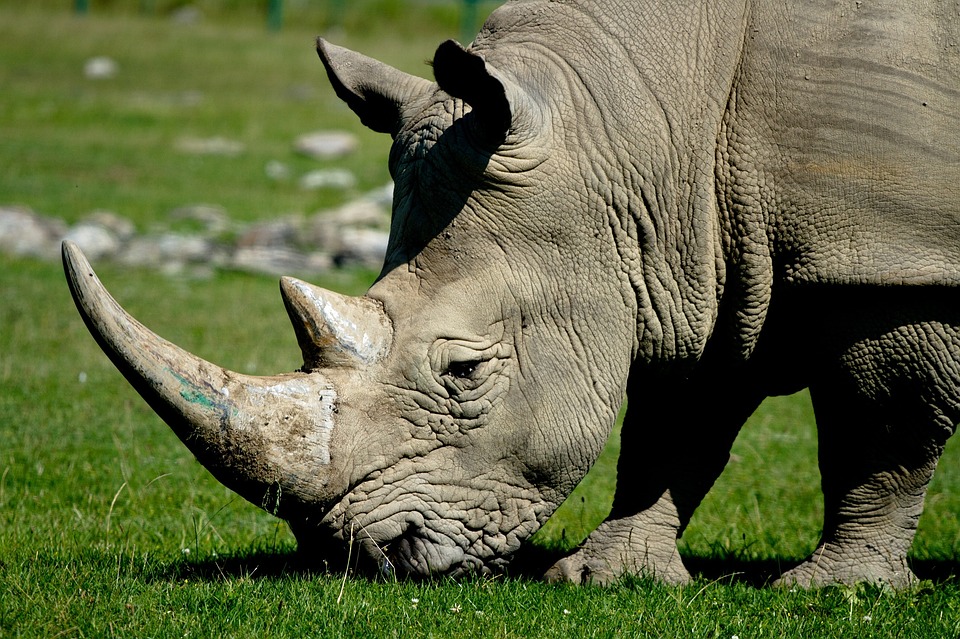
On the way back we saw our first rhino at a wallow some distance from the road. Black rhinoceros or white rhinoceros? How could one tell, when it was covered in brown mud?
The book later enlightened us. Colour has nothing to do with it. The word ‘white’ as a description, is a corruption of the Afrikaans word for wide. It refers to the shape of the mouth, which is typically that of a grazing animal, as opposed to the more pointed mouth of its browsing relative, the black rhinoceros.
Even if we had known that the white rhinoceros is also known as the square-lipped rhinoceros, we would still not have been able to tell the difference from that distance. Never mind. It was a rhinoceros and something to tell Margaret about when we got back.
Margaret, meanwhile, had been having fun of her own. Having dealt with the dirty washing and arranged everything in the cottages to her satisfaction, she settled down under a tree with a cup of coffee and a book.
No sooner was she comfortably ensconced in her camp chair than she was surrounded by a family of warthog – father, mother and four little piggies.
It has been said that only a warthog could possibly love another warthog, but I know I am not alone in finding them fascinating creatures to watch, especially when they head off with their tails straight up in the air like radio antennae, a signal flag that can be seen above the high grass by even the tiniest piggie.
It was a long drive to the village, and the expedition took most of the morning, but it was worthwhile. Not only did we see plenty of game and purchase some excellent meat, but we also found that the young Zulu really was a good cook.
He only made one, very minor, mistake, when he poured custard over the apple sauce before serving it with the pork chops!
HAVE YOUR SAY2020
Like our Facebook page, follow us on Twitter and Instagram
For news straight to your phone, add us on BBM 58F3D7A7 or WhatsApp 082 421 6033