“YOU can’t come in on this passport,” said the immigration officer at the Beit Bridge border post. “It isn’t in your name. How long have you been married?”
I consulted my watch. “Twenty-seven hours.”
He gave us a broad grin as he stamped our papers.
Having started out later than planned, we had to do the last part of our journey to Bulawayo in the dark. Just short of Balla Balla, Corrie, who had done all the driving so far, asked me to take the wheel while he had a cat–nap. He was one of those lucky people who could sleep for 10 minutes and wake up sufficiently refreshed to carry on for hours.
Which was a good thing on this occasion, because it was barely 10 minutes later that I crashed his brand new car into a black-backed jackal.
Luckily the jackal was killed outright and didn’t suffer, but I was still too upset to carry on and Corrie was worried that I might pick on something bigger next time. He was quite right. When he swerved to avoid a kudu later, I had to admit that I hadn’t even seen it.
We had decided not to go to one of the modern hotels in Bulawayo, but to patronise our old favourite, the Greys Inn, where the friendly atmosphere more than made up for the well-worn state of some of the furnishings. We arrived very late and very tired.
But not too tired. After all, this was our honeymoon.
I flopped onto one of the beds. It squeaked loudly. Corrie tested the other one. The noise from that one prompted someone in the next room to bang on the wall. When we found that the floor squeaked too, we retired to the bathroom and made love in the bath.
Next day we moved on to Wankie Game Reserve, where we had the privacy of our own little thatched cottage and it was equipped with everything we needed. Consequently it was only on our second morning there, when we set out at dawn and cooked our breakfast at a picnic site some miles from the camp, that we found we had forgotten to pack any plates. Undaunted, we grabbed a fork apiece and attacked the food straight from the frying pan.
On the way back, the elephant in front of us just didn’t feel like hurrying.
Looking neither right nor left, he plodded on down the middle of the road. The point at which we decided to stop and let him get well ahead of us, was also the point at which he decided to relieve himself. Now we found ourselves parked next to a steaming pile while the elephant slowly lumbered off down the road.
A few minutes later, a duiker popped its head out of the long grass and regarded the pile with something akin to terror. To the tiny buck it must have looked like a mountain. For 20 minutes it hesitated, advancing a few paces and then retreating, until it finally summoned up the courage to dash past it to the waterhole on the other side of the road.
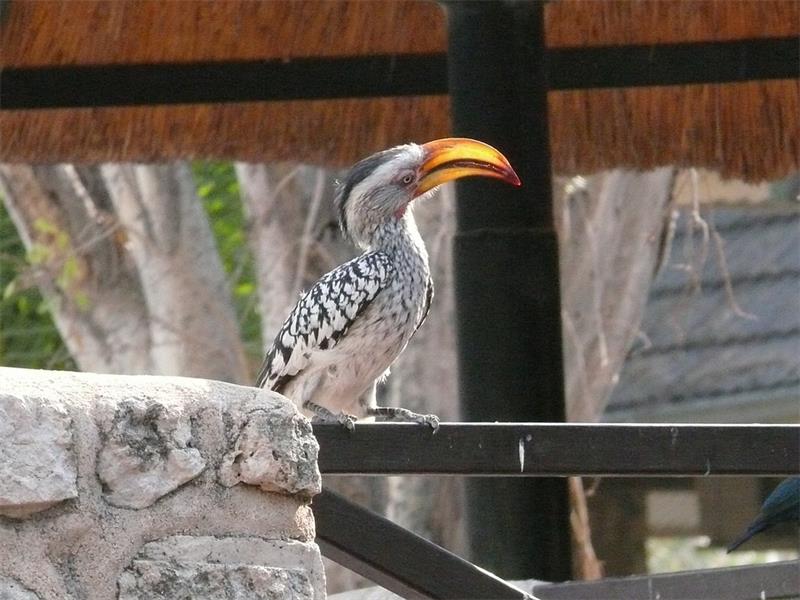
The next day we drove right through the park and, for the first three hours, saw no animals at all. Even the bird life lacked variety. At one point I turned to Corrie and said: “If I could have a dollar for every yellow–billed hornbill I’ve seen, I’d be a millionaire.”
Corrie said he was a bit short of dollars, but he’d give me a kiss for each one. The habit stuck with us and, years later, when it became necessary to choose a personal emblem, the ‘Koro Bird’ (koro being the Setswana name for the hornbill) was the only contender.
We spent 10 wonderful days in Rhodesia. I saw my first wild lion and my first – and, for a long time afterwards, only – leopard, made my first visit to Victoria Falls and won at roulette. There was supposed to be a war going on, but the Rhodesians were not going to spoil their tourist trade by letting it show. Later, things hotted up and many of the hotels closed down, but then the only sign of trouble was that the border with Zambia was theoretically closed.
I say theoretically’ because, although no complete train crossed the bridge, a Rhodesian engine would shunt the trucks – a mixture of Zambian, Rhodesian and South African rolling stock – to the middle of the bridge, where they would be hitched up to a Zambian engine to continue their journey northwards.
But honeymooners are not noted for letting politics worry them and we were no exception. We had waited a long time for this, and we were not going to have our fun spoiled by a mere war.
HAVE YOUR SAY
Like our Facebook page, follow us on Twitter and Instagram
For news straight to your phone, add us on BBM 58F3D7A7 or WhatsApp 082 421 6033