MUCH favoured by gardeners as a pretty and hardy ground cover, the purple and green creeper, Tradescantia zebrina, commonly known as ‘wandering jew’ is another imported plant that has found its way onto the Wildlife and Environmental Society of South Africa’s emerging weeds list.
Its tendency to creep into natural areas and to spread itself out, to the detriment of naturally occurring plants, is causing concern in environmental circles.
A good example of this is the mass of thriving Tradescantia zebrina in Voigt Park, the little patch of natural coastal bush in Shelly Beach. It is quite alarming to see how invasive this innocent-looking garden subject can be.

If you have it in your garden it is probably doing a good job of filling garden beds and quickly covering large sections of bare ground. However, it is best to evict it before it can get up to mischief and to replace it with some more innocuous plants.
There is a long list of indigenous ground covers that would be just as useful as this emerging weed.
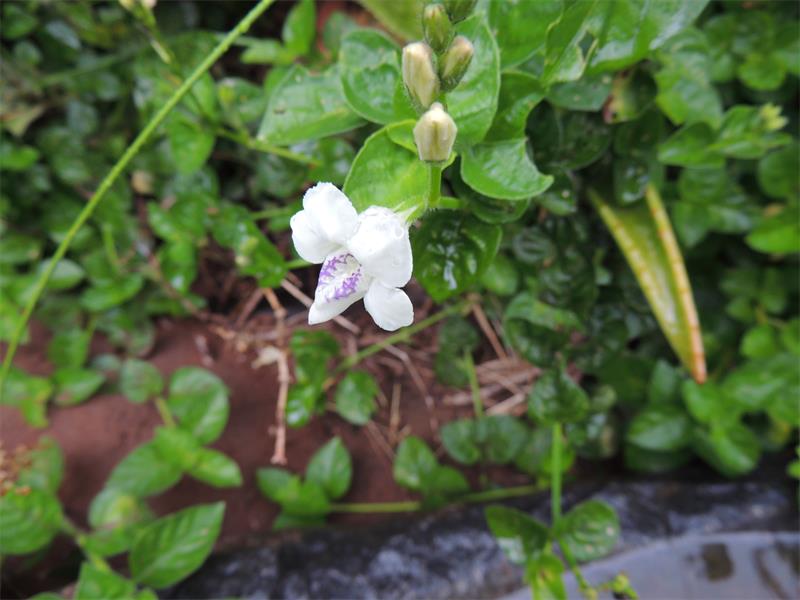
If you are looking for a really rapid spreader, particularly for the shadier areas of your garden, it would be hard to beat the green and leafy creeping foxglove or Asystasia gangetica. I have also heard it referred to as wild foxglove.
It is a showy ground cover that decorates itself with attractive foxglove-shaped white flowers. The mauve-coloured marking at the throat of the flowers is there to guide its pollinators, including the many butterflies that it attracts.

According to Pitta Joffe’s ‘Creative Gardening with Indigenous Plants’ (a Briza publication) the caterpillars of the mother-of-pearl, clouded mother-of-pearl, brown and soldier commodore and the pansy butterflies feed on its foliage.
The creeping foxglove is easy to grow from rooted runners but be warned – it needs lots of space and would soon overrun your more dainty garden beds.
It is best planted in shady spots under your trees as it is naturally a forest dweller. It is not too fussy, though, and can tolerate a bit of sunshine.
Another good ground cover is the easily propagated fairy crassula (Crassula multicava), a pretty succulent ground cover that is attainable from most nurseries. Pippa Joffe describes its flowers as as a “misty mass of tiny starry pink flowers”, an apt description of the display it offers in my garden during the winter months.

Even when not in flower, its succulent leaves are attractive. Perhaps you are looking at replacing the problematic, purple foliaged Tradescantia zebrina with something similar in colour? A lesser-known relative of the fairy crassula is the gorgeous Pondoland crassula (Crassula streyi), a striking Pondoland ‘special’.
It looks very like the fairy crassula, but the back of the leaves of this lovely species are purple.
Both these crassulas like a bit of shade, but when it comes to indigenous ground cover for sunny spots, South African gardeners are spoilt for choice. We have a huge range of water-wise vygie type plants to choose from and then there are all the plants with daisy-like flowers like all the brightly coloured gazania, arctotis and osteospermum species and cultivars.
With all the lovely indigenous ground covers queuing for space in your garden there is really no excuse for not giving Tradescantia zebrina and other potentially invasive ground covers the boot.
HAVE YOUR SAY
Like our Facebook page, follow us on Twitter and Instagram
For news straight to your phone, add us on BBM 58F3D7A7 or WhatsApp 082 421 6033