AS well as it gracious hospitality and its lesser known wild places, art and culture are among the many KwaZulu-Natal Midlands attractions and there are some interesting historical sites that tell this pretty region’s story. To me, one of the most poignant places is the Spioenkop battle site, on the crest of a high hill, offering panoramic views of the surrounding terrain. It is peaceful and pretty and hauntingly sad for this lofty spot was the site of one of the major battles during the Second Anglo-Boer War.
It took place in January 1900 during the siege of Ladysmith when the British were trying to break through the defensive Boer line along the Tugela River to relieve the town.
The clash saw 1 550 men killed, wounded or taken prisoner. The Boers, under General Louis Botha, had managed to foil a surprise attack by the British and only lost 230 men. With its monuments, headstones, pathways and neatly delineated mass graves, it is all so tidy and orderly now, up there on the top of Spioenkop, so it is hard to imagine the post-battle carnage. An immensely moving illustration on a monument gives an inkling of the horror of that senseless war. It shows a trench filled with bodies awaiting burial. Dumped into the trench, the dead soldiers look like discarded rag dolls yet once they were living, breathing, dreaming young men. Here, in this beautiful place the horror of the fighting still seems to linger like a sort of cosmic echo. Visitors cannot but be aware of the blood-soaked soil beneath the waving grass.

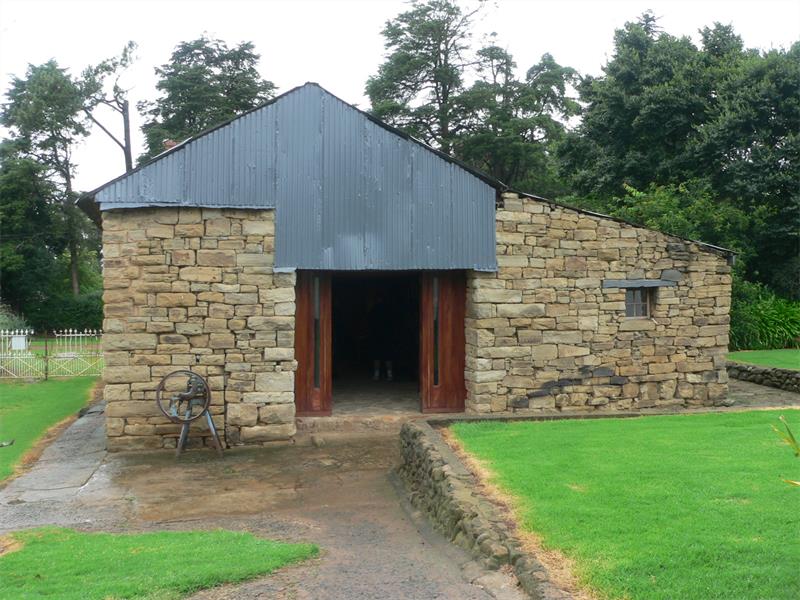
There is a delightful little town called Fort Nottingham that is also a part of the rich Midlands history. Some of its story is bloody, some of it is sad, but the hamlet is a much happier place than Spioenkop. When we visited it some years ago we followed a sign to Fort Nottingham and found ourselves in a green and pretty enclave – hardly a town really – with a fabulous little museum, overseen by history boffin David Fox.
He told us that Fort Nottingham had celebrated the 150th anniversary of its founding in 2005.
There was photograph display of the grand banquet, held by candlelight in the museum, that formed part of the lively celebrations. The fort was established in 1856 when the Acting Governor of the Colony of Natal sent a small detachment of the 45th Foot, the Sherwood Foresters, a regiment from Nottingham in England, to establish an outpost there.

In the Durban area, the names, 45th Cutting and nearby Sherwood, also acknowledge the influence of the 45th Foot in KwaZulu-Natal and the province’s Robin Hood connection. The building of Fort Nottingham was in response to the constant raids by the San on the early settlers’ farms. The museum, we learnt, was actually the Fort Nottingham stable.
Other thatched building arranged around the square and some of the houses along the one road leading into Fort Nottingham, were part of this early settlement.
The town’s development was arrested by the coming of the railroad and the establishment of its sister town, Nottingham Road, which grew up around the railway station. However, its lack of progress has preserved the little hamlet’s old-world charm. It is a beautiful little spot, completely unspoiled and uncommercialised. It also boasts the smallest town hall in South Africa.

There is a typical stretch of rolling Midlands veld where history and art come together to tell the story of the struggle for freedom and victory over adversity. It is the Mandela Capture Site, where a striking sculpture, a monument crafted by artist Marco Clanfanelli, marks the spot where the ‘Black Pimpernel’ was finally arrested. The date was August 5, 1962 and Nelson Mandela, destined to become South Africa’s first democratically elected president, had been on the run for 17 months. He had just paid a visit to African National Congress president Chief Albert Luthuli when he was apprehended.
And so, this unassuming spot, this patch of veld near Howick, has been imbued with historical significance, deserving of a great piece of art to tell its story.
As visitors approach the monument they might be confounded to see a cluster of irregularly shaped, vertical iron columns set against the peaceful Midland landscape. It looks like an abstract work but, even at first sight, it is a work of great beauty. The capture site complex is amazingly unassuming and has a quiet dignity. A few tin-roofed buildings have been erected near the moment, their simplicity at one with their surroundings. It is a good idea to take a slow walk through the museum before taking a closer look at the sculpture. The long, paved, flower-lined walkway that leads to the sculpture is a fitting symbol of the great man’s long walk to freedom.
You may also be interested in: Tent Travels: Gentle Midlands has a wild side

For quite a way, the monument still looks like an abstract work of art. Then, suddenly, incredibly, as you stop at a designated spot, the irregular notches, lumps and bumps on the columns merge to become a stunningly beautiful portrait of Madiba. The artist has captured something special about Nelson Mandela – a slight smile, his strength of character, a far away look in his eyes. It is a portrait of a visionary. What a fitting monument this sculpture is to a man of steel, a man who sacrificed everything for what he believed, a man who achieved so very much.
If for no other reason, a visit to the Midlands is well worth making just to see this marvellous marriage of history and art.
HAVE YOUR SAY
Like our Facebook page, follow us on Twitter and Instagram
For news straight to your phone, add us on BBM 58F3D7A7 or WhatsApp 082 421 6033